Pages

Tuesday, August 31, 2010

August 31

Beware those who think the worst is past. Carmen and Vincent Reinhart, FT.

Credit is also a problem. It expands rapidly before crises, but post-crash the ratio of credit to GDP declines by an amount comparable to the pre-crisis surge. However, this deleveraging is often delayed and protracted.... if we continue as others have before, the need to deleverage will dampen employment and growth for some time to come.... In such circumstances slow growth often becomes a self-fulfilling prophecy produced by timid authorities, who neither supported spending nor dealt with the capital-adequacy problems at large banks.... Financial supervisors want to believe that troubled banks are temporarily illiquid, not permanently insolvent.... the bigger worry remains the assumption that dust has begun to settle; that the shock from the crisis is temporary, when it is likely to be deep and persistent
from ICI via Moody's via Paul Kedrosky:


Bond bubble - a sterile debate on semantics. James Montier.

bond valuation based on 3 components: the real yield, expected inflation and an inflation risk premium; with the first at about 1% right now (via TIPs), the second at 1.5% (via nominals - TIPs), and the last at 0.25-0.5%; fair value under normal inflation would be 4%

unless you believe that Japan is correct template for the US (i.e. inflation will be zero for the next decade), government bonds don’t offer an attractive return as a buy and hold proposition.

he goes on to say that the market must be implying about a 70% chance of the U.S. turning Japanese (20% or normal, 10% of high inflation); then says

It is possible to build a speculative case for bond investment (i.e. riding the deflationary news flow down), however, as ever, this leaves participants with the conundrum of Cinderella’s ball as described by Warren Buffett “The giddy participants all plan to leave just seconds before midnight. There is a problem though: They are dancing in a room in which the clocks have no hands!” Personally I prefer to stick to investment rather than speculation.

as highlighted by Mish, remember when Rosie said:

"Guess how many homes prices above $750k managed to sell in July. Answer — zero, nada, rien; and for the second month in a row."

well, he shoulda been suspicious of that; turns out, according to the Census Bureau (hat tip: Mish), which quotes its data in thousands of homes and using round numbers (so, the total for all price levels was 25k, but we're not sure where in between 24,501 or 25,499 that was), the (Z) they put in for the price level of $750,000 and over means that there were less than 500 units

Home prices: a look at underlying supply and demand forces. charts and quotes from BoA, as posted on zerohedge.

I hadn't yet found solid data on U.S. household formation, to compare with the inventory of homes on the market; BoA/ML spares me the need (as posted on zero hedge), as they've calculated it; and its rather shocking: household formation was strongly positive in 2001-2006 (1.2 million annually), but was more than cut in half during the period from 2007-2009 (0.5 mil, a drop of 0.7mil); of course, I knew it had fallen, given that the homeownership rate had fallen, but wouldn't have expected that much


so, homebuilders have dramatically slashed their new construction; but, meanwhile, foreclosures have put new supply on the market, so, net-net, supply has not normalized and still exceeds housing demand; BoA calculates an excess of 1.87mil vacant homes (given that homeowner vacancy rates and rental vacancy rates are much higher than normal)

BoA concludes:

Unlike in prior recoveries, it is clear that housing will lag rather than lead the recovery. The monetary policy transmission typically has a very strong impact in the housing market – low rates encourage home sales and greater residential investment. In turn, job creation picks up in the construction sector, further supporting consumer spending and home sales, and creating a virtuous cycle. This feedback loop is currently broken. Mortgage rates have plunged to record lows, and yet have done little to stimulate home purchases because credit conditions are still incredibly tight and consumer confidence is depressed. That said, we believe the direct drag from housing, through construction, is nearly over. Our forecasts for housing starts imply that residential investment will subtract from growth in 3Q, but then consistently add to output going forward. Still, the contribution to growth will be feeble relative to prior cycles, where housing was decidedly the force of growth...

Our baseline view is that national home prices will edge lower over the rest of the year and then bounce around the bottom for some time. The downside risk is that foreclosures flood the market at a rapid pace, depressing home prices greatly, which could tip the overall economy back into recession.

other than Meredith Whitney, Mike Mayo is the only other financials analyst that I'm aware of being very vocal about his/her skeptical view on financials and being very blunt and even confrontational with management:

Mike Mayo Tells Clients Numbers Out Of Citi Can Not Be Trusted. via zerohedge.


The trap we're in. Paul Krugman, NYT.

The Taylor Rule says that, given where inflation is now, interest rates should be negative; but, of course, they can't be (see his graph)

The crucial thing to understand about this position is that it’s not self-correcting. On the contrary, as inflation falls over time and possibly goes to actual deflation, we sink deeper into the trap.

more background from PK here

data today:
Canadian GDP for June, came in at expectattions of 0.2%, but for Q2 came in at 2.0%, vs. expectations of 2.5%, and Q1 was revised down to 5.8% from 6.1%

in the U.S., S&P/Case-Shiller Composite-20 up 4.2% YoY through June, vs +3.5% YoY expected (down 28% from the peak), and the national index was up 3.6% YoY through the 2nd quarter, up from 2.3% at the end of Q1 (note that this data is 2 months old --- its a 3mth rolling average of April, May and June) and was relevant for the period before the tax credit ended; as per Calculated Risk, prices are probably falling right now (starting in July), but this will not show up in the Case-Shiller index for a few months since this is an average of three months)

Chicago Purchasing Managers was a bit below expectations, at 56.7, down from 62.3; and ditto for NAPM Milwaukee, down to 59 from 66; but consumer confidence beat expectations, at 53.5

if you want to quickly check out state of European sovereign yields, check out Bloomberg's interactive charts
the code for
Germany is GDBR10:IND
Greece is GGGB10YR:IND
Ireland is GIGB10YR:IND
Portugal is GSPT10YR:IND
Spain is GSPG10YR:IND


other fare:

this is hilarious --- The truth about Somali pirates. Broyhill Asset Mgmt, The View from the Blue Ridge.

this too is amusing --- We didn't see it coming.

this is in no way amusing --- Lawsuit challenges Obama's power to kill citizens without due process. Glenn Greenwald, Salon --- how can the U.S. be a country in which assassination of citizens without due process is even contemplated, much less allowed?!

and this is interesting --- the author of Cool It!, Bjorn Lomborg, recants

Monday, August 30, 2010

August 30 - with late addition

"If you can't control the wind, adjust your sails."

S&P earnings: can we expect what they're expecting?
in 2008, 12mth operating earnings were 49.51, while reported earnings were 14.88
in 2009, they were 56.86 and 50.97, gains of 15% and 243%
analysts are estimating 2010 will come in at 83.04 and 70.36, which would be gains of 46% and 38%
and for 2011, estimates are for 94.31 and 80.20, which are gains of 14% for each

those are pretty robust E-gains compared with sales: sales per share were $232.38 in Q1, up 5% from the trough of $221.80 in Q1 of 2009, but still 17% below the level in the 2nd quarter of 2008; on a trailing 12-mth basis, sales through Q1 of $919 remain 15% below the peak level through Sept 2008 of $1080

so, given the underlying economic dynamics, can we expect sales growth to pick up enough to support those earnings growth estimates; or will companies have to squeeze even more blood from stones? how much more E-growth can be attained with tepid sales growth?


( chart from Doug Short)

and, why is sales growth tepid? consumer deleveraging and no income growth (see yesterday's chart)

late addition: why else should earnings growth be suspect? how about the chart Mish posted:


what this chart shows is the ratio of loan loss provisions to non-performing loans for all banks across the entire banking system; either banks think those non-performing loans are not a problem (so they haven't felt the need to provision for them and don't think that will come back to haunt them), or they were not provisioning for losses that are coming down the pipe because they wanted to boost earnings (any provisions would be a charge against earnings, so if you don't want to hurt E, you don't take provisions; easy, right? typical extend and pretend; Mish resumed the discussion here)

Monetarists follow Milton Friedman to the grave. Caroline Baum, Bloomberg.

Bernanke has gone out of his way to explain the Fed’s purchases of $1.4 trillion of agency mortgage- backed and debt securities as credit easing, not quantitative easing. Credit easing is by definition quantitative. It doesn’t matter what the Fed buys: Treasuries, Toyotas, toilets or Tootsie Rolls. It’s the act of buying something that creates money.

I like that line about Toyotas and tootsie rolls; but I disagree with the notion that the expansion of the Fed's balance sheet creates money; as discusses in earlier posts, its an asset swap; as van Hoisingon and Lacy Hunt so professorially explains, QE expands the monetary base, but the monetary base does not constitute money; and as Mish insists, "given that we have a fiat-based credit system, it is... silly to discuss inflation/deflation without paying attention to credit... I define inflation as a net expansion of money supply and credit, with credit marked-to-market. Deflation is a net contraction of money supply and credit, with credit marked-to-market."; so no matter what the monetary base is doing, as long as credit, which dwarves M2, keeps contraction, there's deflation in terms of the amount of "money" availabe and being used for spending

Warning: why cheaper money won't mean more jobs. Robert Reich.
individuals aren't taking on more debt; small business isn't; big business is; these corporations, however, aren't investing in the productive capacity of the domestic economy, they're either sitting on cash, or, worse, using their cash to expand productive capacity in cheaper abodes abroad, or they'll do M&A, which will lead to further contraction of productive capacity domestically


Chris Whalen is an expert on the U.S. financial sector and always worth listening to; he believes that the Bernanke Fed drives deflation with zero rate policy, via zerohedge

low rates are killing the U.S. economy and have created an interest rates trap for financial institutions and other fixed-income investors... Over the next year, banks, retirees and other interest rates sensitive investors are going to see their cash flow fall further as zero interest rate policy drains the NIM [net interest margin] from the dollar financial system. Not surprisingly, these same individuals and organizations are cutting expenditures to reflect falling cash flow on their investments.... By keeping interest rates at zero, the Fed is forcing individuals and corporations to save more.

On the other hand, and why I don't buy the notion that low interest rates lead to delfation, consider all the arguments by various authors that Mark Thoma links to in his post, The correspondence principle:

The proposition that a commitment by the Fed to maintain a low nominal interest rate indefinitely must lead to deflation (rather than accelerating inflation) defies common sense, economic intuition, and the monetarist models of an earlier generation.

This was was pointed out forcefully and in short order by Andy Harless, Nick Rowe, Robert Waldmann, Scott Sumner, Mark Thoma, Ryan Avent, Brad DeLong, Karl Smith, Paul Krugman and many other notables.

Germany's rebound is no cause for cheer. Wolfgang Munchau, FT.

on Germany's begger-thy-neighbour policies, and on its export-reliance being dependent on global growth; his conclusion?
Germany’s economic strength is likely to be persistent, toxic and quite possibly self-defeating in the long-run.

Letter to shareholders. John Hussman.

Given that GDP growth over the past year has amounted to $563 billion, while Federal government debt has increased by $1.6 trillion, there appears to be little evidence that the positive economic growth of recent quarters was driven by much else but the deficit spending of government and to a lesser extent, the aggressive purchase of mortgage securities by the Federal Reserve. Private sector demand, income less government transfer payments, employment growth, housing activity and other measures of "intrinsic" economic activity remain remarkably weak. With the impact of stimulus spending trailing off, and little evidence that debt has been restructured in proportion to the cash flows available to service that debt, expectations for economic expansion appear to be based more on hope than on a careful reading of economic history.

A report by Credit Suisse came out earlier this month which purported to "correct the understatement of income" in official statistics in China. The study argues that household income is about 30% higher than official stats say.

Michael Pettis discusses why one should not receive this as positive news, in Have we underestimated Chinese consumption?

even if income (hidden/gray/illegal) and consumption are truly higher than officially reported, underconsumption is an undeniable problem:

How do we know that China has an under-consumption problem? To answer that question it is unnecessary even to look at the consumption statistics. All you need to know is that China has a very high investment rate (perhaps the highest in the world) and a huge trade surplus.... The only way a country can run an extraordinarily high investment rate and an extraordinarily high trade surplus is if consumption is extraordinarily low.

also, the study implies that underconsumption is an even bigger problem than official stats suggest; rather than the (official) consumption rate of (an extraordinarily low) 36%, the # may be as low as 31%, because

So while Chinese household income might be significantly higher than we thought, most of that additional income goes to the high-savings rich. The Chinese savings rate, consequently, is also much higher and the Chinese consumption rate much lower than the official numbers suggest.

So, was that Credit Suisse study really good news, as some believed?


data:

ECRI WLI came out on Friday at -9.9; but, as usual, the previous week was revised down, to -10.1 from -10; also on Friday, UofM confidence fell to 68.9

today, personal income (up 0.2% in July), personal spending (up 0.4%), PCE deflator (1.5% YoY)and PCE core (up 1.4% YoY) showed no real surprises; and Dallas Fed manufacturing activity came in below expectations, at -13.5 (NAPM Milwaukee and Chicago purchasing manager tomorrow, ISM on Wed; 52.8 expected, down from 55.5)


other fare:
One lump or two? Kunstler.

Why Mr. Obama has turned out to be such a weenie remains a mystery... He certainly appears to be hostage of the more malign forces in society these days -- the medical insurance racket, the too-big-to-fail banks, the multi-national corporations. But I don't believe it's because he wants to suck up to them, or join their country clubs when his current job ends.

My own guess is that he's been informed that the system is so fragile that if he dares to disturb even one teensy-weensy part of it -- for instance, by throwing some executives from Goldman Sachs, Merrill Lynch, et cetera, into federal prison -- that said system will fly to pieces in a fortnight. So Obama's main task for a year and a half has been to desperately apply baling wire and duct tape to the banking system while telling fibs to the public about a wished-for recovery to a prior state.

Sunday, August 29, 2010

August 29

Don't aim at success. The more you aim at it and make it a target, the more you will miss it. For success, like happiness, can not be pursued; and it only does so as the unintended side-effect of one's dedication to a cause greater than oneself or as the by-product of one's surrender to a person other than oneself. Happiness must happen and the same holds for success: you have to let it happen by not caring about it. I want you to listen to what your conscience commands you to do and go on to carry it out to the best of your knowledge. Then you will live to see -- in the long run, I say! -- success will follow you precisely because you had forgotten to think of it.

Viktor Frankl


What was the most important news on Friday?
That the downward revision in Q2's GDP growth wasn't as bad as expected (which, it seemed, prompted stocks to rally and bond's to sell off)?
Or the fact that Intel cut its forecasts?
Or that Ben revealed he's running low on bullets and isn't sure they're not "blanks"

The economic outlook and monetary policy. Ben.
growth has been less vigorous than expected; but economy will expand modestly in H2; and growth will pick-up next year; based on that, further stimulus should not be necessary; in fact, the Fed has not agreed on any specific triggers for further action; there are costs/risks associated with new policy tools; but if deflation risks increased, the the benefit-cost tradeoffs of new policy tools would become significantly more favourable; if necessary, first step would be to expand Fed's holdings of long-term securities; other steps could include changing the extended period language and reducing interest paid on reserves; the idea for communicating a higher inflation target has no support on the FOMC

Bernanke's speech: a big tease. David Beckworth.

What Bernanke doesn't understand about deflation. Steve Keen.
Keen finds it more than curious that Ben's speech "didn’t contain one reference to the key force driving the American economy right now: private sector deleveraging"
This is a must-read post; it goes into much more detail, including how B.B. still doesn't really understand Irving Fisher's debt-deflation dynamics, but here's how it starts:


The reason the US economy is not recovering from this crisis is because all sectors of American society took on too much debt during the false boom of the last two decades, and they are now busily getting themselves out of debt any way they can.

Debt reduction is now the real story of the American economy, just as real story behind the apparent free lunch of the last two decades was rising debt
"I was wrong again!" What Ben Bernanke meant to say. Andrew Leonard, Salon.

Why the U.S. economy is weak. Ed Harrison.


With this macro background, where does that leave us today?

1.With still weak job and income growth. (Consumer Spending -Income impact)
2.With a 12-month supply of existing homes and still elevated home price to income
ratios. (Consumer Spending – wealth impact)
3.With still indebted consumers still near peak debt service to income ratios. (Consumer Spending – debt impact)
4.With a large and politically unsustainable budget deficit and a declining addition from stimulus already in the pipeline. (Fiscal Policy)
5.With a Fed chastened by its foray into fiscal policy and near zero interest rates that leave no way to stimulate via rate cuts. (Monetary Policy)

i.e. all that leaves is trade and business investment, neither of which look too hot, either

Inside the BEA's latest numbers. Consumer Metrics Institute, via Pragmatic Capitalist.


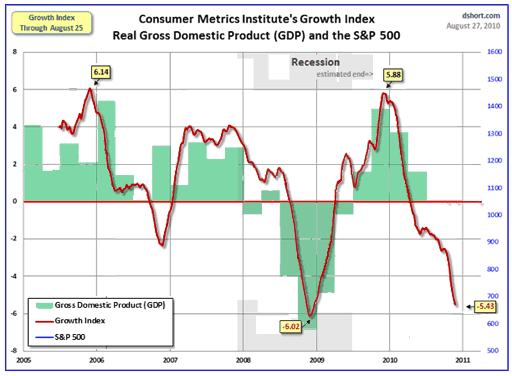
Barring some sudden reversal in consumer attitudes and habits, the 2010 economic slowdown will be longer and at least as painful as the one experienced in 2008. Furthermore, the shape of this contraction event indicates that it is probably not an independent “double dip”, but simply a continuation of the “Great Recession” of 2008 after a few quarters of now lapsed consumer stimulation.


(chart from Doug Short)

The bubble that isn't. Daniel Gross, Slate.

220 years of 10-yr bond yields:

This is not a recovery. Paul Krugman, NYT.

Will the economy actually enter a double dip, with G.D.P. shrinking? Who cares? If unemployment rises for the rest of this year, which seems likely, it won’t matter whether the G.D.P. numbers are slightly positive or slightly negative. All of this is obvious. Yet policy makers are in denial.

okay, so most people can agree that's the problem; problem is, what's the solution??

Krugman has a number of ideas, none of which he's sure will work, but all of which he's sure are worth trying in case they might work

but, as per the following, most of P.K.'s suggestions are infeasible or have huge risks:

Krugman's solution -- NITRO. Bruce Krasting.

Procrastination on foreclosures now blatant, may backfire. American Banker.

Widespread fear freezes housing markets. Joe Nocera, NYT.

2 charts: all you need to know about Canada's housing bubble. VREAA.

China will collapse. George Friedman, Stratfor, interviewed on CNBC Asia.
makes comparison of China now to Japan 20 years ago


Armageddon-watch:

WWIII ahead: Warfare defining human life by 2020. Paul Farrell, MarketWatch.


other fare:
Were you born on the wrong continent? America's misguided culture of overwork. A book review. Salon.

Live tiger found in check-in baggage. Traffic.

Our planet is close to climate tipping points. climatologist James Hansen.

income up? only the top 1%!!


Everybody knows. Leonard Cohen, via Jesse's Cafe Americain.

Thursday, August 26, 2010

August 26

[post revised on Sept 1 to correct attribution and to insert missing hyperlink to external source]

yesterday's $36 billion U.S. 5-year Treasury auction closed at 1.374%, as low as the 5-yr yield has been since the early '60s, with the exception of December 2006 at 1.358%; today's 7-year auction also drew a record-low yield, of 1.989%

data today:

initial jobless claims better, down to 473k, from upwardly-revised 504k; 4-wk M.A. at 487k

14.4% of mortgages are delinquent or in foreclosure in Q2, down from 14.7% in Q1

and we had one more regional Fed survey come out today: the KC Fed manuf survey was at 0 for August, down from 14 in July;

these regional manufacturing surveys give us a good idea of what to expect for the ISM next week; the Empire was the first to come out, on Aug 16th, and it was up slightly from 5 in July to 7 in August; Richmond Fed fell to 11 from 16; Philly Fed fell to -7.7 from 5; KC fell today; Dallas Fed will be on Monday and Chicage Fed manufacturing index on Tuesday, then the ISM will come out on Wed.; as per Bill at Calculated Risk, based on the #s that have come out, we can expect the ISM to have slipped again, but to remain above 50


tomorrow we get Q2 GDP; consensus forecast is for +1.4%, down from the advance estimate of 2.4%; the CBO says fiscal stimuls added somewhere between 1.7% and 4.5% to GDP growth; so, absent that stimulus, if the consensus estimate is in the right ballpark, Q2 GDP could have been anywhere from -3.1 to -0.3%; and, as per Jan Hatzius (see here), fiscal policy will go from being a contributor to growth in the last 5 quarters, to a detractor from growth starting in Q3 and forward; so even if underlying domestic demand stays at the Q2 level, which doesn't seem likely given recent deterioration in most indicators, Q3 GDP is set to go negative

also tomorrow, start of Jackson Hole; Ben will give his outlook; do you think he will refer to inflation expecations as well-anchored? despite, via TIPs, evidence to the contrary?


I've been saying for awhile that those who say the U.S. today is not like Japan was are right; the similarities are similar (huge burst asset bubble, too much debt, zombie banks, ineffective policy efforts), but the differences actually make the U.S. worse, not better, off (no savings, so U.S. savings rates having to go up, unlike down in Japan, which cushioned the blow to aggregate demand; unemployment twice what it was in Japan)

Albert Edwards agrees: the U.S. is "much, much worse than Japan a decade ago"

also:

There is still too much hope about. Until the mantra changes from "equities for the long term" to "Bonds at any price", we will not have completed our Ice Age journey.... the Japanese template of supposedly "expensive" bonds outperforming supposedly "cheap" equities; this will feel nothing like a flesh wound…


as per a posting at zerohedge, BofA Merrill Lynch asks is the U.S. becoming Japan:
Ethan Harris says there is just a 35% chance of QE2 and 20% chance of sustained deflation, largely because the Fed reacted so much faster than the BoJ did (policy paralysis in Japan)

but also because, apparently, there are no zombie banks in the U.S. (disputable) and that there is no "acceptance of zero growth" in the U.S. as there was in Japan (perhaps the Japanese only "accepted" it once they realized they couldn't do anything more to engineer stronger growth --- and, as Richard Koo says, Japan was fortunate to do as much as they did which prevented an outcome far worse)

not sure whether Michael Hartnett's contrast of much higher unemployment in the U.S. relative to Japan is a positive contrast, or negative one; otherwise, the similarities he presents vis-a-vis Japan: (interest rates low but not working; asset price performance is deflationary; debt, deleveraging, deflation), like those of Harris (popping of massive asset bubble; impaired banking system; near-zero inflation; large external shock; premature fiscal tightening), seem more compelling (negative) than the (positive) contrasts (Hartnett: non-financial debt-to-GDP did not grow as much in U.S. as in Japan; policy responses (QE & capital injections) were quicker; creative destruction, i.e. high unemployment; Harris: cultural adversion to radical steps, along with the distinctions mentioned above, response time, zombie banks and acceptance of zero growth in Japan)

so how Harris comes up with those odds is beyond me

meanwhile, BoA's Jeffrey Rosenberg says "the backdrop of both cash on balance sheet and credit market availability means that unlike in Japan, the ability to finance growth on corporate balance sheets does not stand as an impediment to any recovery" --- okay, but (a) perhaps that cash is defensive in nature as companies get funding not because they need to or have plans to invest it in productive capacity, but while they can; and (b) though the corporate sector has lots of cash, its a result of lots of debt issuance, and while that is good in the sense that corporates having extended maturities of its debt leaves it less vulnerable to a seize-up in the credit markets --- it means they also has lots of debt, and remain highly leveraged; and (c) even if they do have cash to deploy, with excess capacity and stagnant demand, why should they put it to work in risky projects (and M&A does not stimulate sustainable economic growth)

what BoA/ML fails to mention, but David Rosenberg does not, is that Japan had a high savings rate at the start of the crisis, in contrast to the U.S., cushioning the blow as the savings rate fell over time (whereas in the U.S. it is going up); Japan's lost decade was cushioned by a global economic boom which supported its export sector; and the U.S. has a much larger output gap to deal with


okay, credit where credit is due:

an analyst/strategist, who has made some very good calls in the past, advocating getting into stocks in early 2009 and advocating raising some cash in April of this year, was out yesterday with a bold call: to go max equities, min bonds, anticipating the S&P to be up about 50% over the next 2 years; will he continue his good run?

his forecast is predicated on a soft landing, accompanied by P/E multiple expansion

he cites 5 "good" reasons to believe in the soft landing thesis (with my comments in parentheses): a positively-sloped yield curve (with the Fed at 0, the yield curve can't be anything but positively-sloped, so to suggest that every time the Fed is at 0 is bullish for the economy avoids the reasons WHY the Fed still remains at 0); increasing M&A activity is indicative of corporate and bank confidence (the fact that corporations are using their cash for M&A rather than for investment in productive capacity in the economy doesn't strike me as indicative of confidence in the economy or in a rebound in aggregate demand); dividends are being hiked, which would not be the case if corporations feared a hard landing (as per last point, corporations have leveraged up, opportunistically taking on debt while the getting's good, and are sitting on a lot of cash with, apparently, little productive purpose, so paying out more in dividends is a shareholder-friendly way of doing something with cash that would otherwise sit idle); firings and thus jobless claims have been increasing just modestly (perhaps firings aren't rising more now because firings were so high in the depths of the crisis that companies have cut to the bone already; the fact that there's no more fat to slice off seems small consolation to me when unemployment is already just under 10%); his fifth point is his prediction of a decline in the savings rate, which would be supportive of consumer spending (if true; it hasn't happened yet, as consumer credit has been in a steady decline since July 2008; and personal savings, which averaged $250 billion from 1994 through 2006, are at their highest level in a year, and have been trending up for each of the last 3 years; as they say, show me the money)

quite frankly, given the success of his earlier calls, I was hoping for some more robust analysis that that; for example, I'd rather pin my economic expectations on what yield changes tell me (T10 down 150bp since April), rather than the fact that the curve (necessarily) remains positive; and I'd rather premise my forecast on what the Philly Fed A-D-S, ECRI WLI, Consumer Metrics Institute Growth Index, jobless claims and the housing markets are telling me as leading indicators (or, on what John Husman looks at: widening credit spreads, combined with moderate yield curve, combined with falling stock prices, combined with ISM PMI below 54), rather than on his five indicators

He also notes that stocks are trading at 11.5 x forward earnings --- which sure DOES sound cheap --- but analyst earnings estimates are notoriously REactive to the trends in the economy, as opposed to being predictive so I take no solace whatsoever from low forward P/Es (note previous article which noted that based on forward P/E's stocks ALWAYs look cheap!)

as per the following chart from Doug Short, either the bond market has accurately foreshadowed a wobbly autumn stock market; or, if stocks don't sell off, then bonds have come too far and will sell-off; some are betting on the latter; and, yes, the bond market may have come too far too fast and give some back; but nothing I've heard comes close to trumping the things I've been looking at, so I continue to bet on the former


in fact, if anyone expects the S&P to hit 1575 (up 50% from today's 1050) in the next two years, I'd be game to bet on which happens first in the next two years, S&P at 1575 or S&P below 800

So, how about market sentiment? Where are we now?


As per the Financial Philosopher:

The Hope of early 2009 was followed a few months later by Relief that extended and even touched on some Optimism into early 2010. Now that monetary policy and fiscal stimulus appear to be running out of steam, it seems we have stepped backward in sentiment: Optimism and Relief appear to be dissipating, which brings us back to Hope. Hope is not a prudent plan
The elusive Canadian housing bubble. Alexandre Pestov, via zerohedge.

other fare:

The Coming Famine. book excerpt by Julian Cribb in the NYT.

Lo que separa la civilización de la anarquía son solo siete comidas.

(Civilization and anarchy are only seven meals apart.)—Spanish proverb

Wednesday, August 25, 2010

Inflation or Deflation?

Some say the world will end in fire,
Some say in ice.
From what I’ve tasted of desire
I hold with those who favor fire.
But if I had to perish twice,
I think I know enough of hate
To say that for destruction ice
Is also great
And would suffice.
—Robert Frost, Fire and Ice, 1920.

August 25

data yesterday:
Canadian retail sales were weak, but driven by price effects, as volumes were fine; US existing home sales were atrocious, dropping 27% in July from a downward-revised level in June, to a new historical low of 3.83 million, increasing the months' supply to 12.5; the Richmond Fed Manuf index dropped, but not as much as expected

today's data:
mortgage purchase applications remained very low (back to 1996 levels); durable goods missed expectations, big-time, and were particularly weak ex-transportation, and capital goods orders non-defense ex-aircraft were down 8%; new home sales followed suit with existing home sales, falling to the lowest level its been in the history of the data series (1963), and months' supply up to 9.1 (despite the inventory of new homes being as low as its been since I was born);

claims tomorrow and U.S. GDP on Friday


with recent data, most notably claims and housing, you can see that, though papered over with stimulus for awhile, the underlying problems in the economy are re-emerging. And:

More negative news flow coming. Calculated Risk.

regarding my point yesterday that Hilsenrath's column in the WSJ did not bode well for the answer to Evans-Pritchard 's question of whether or not the Fed has the will to do QE2 yet, Goldman's Jan Hatzius says not til Nov. 3, via zerohedge.

Japan and the ancient art of shrugging. Norihiro Kato, NYT. (hat tip, Rosenberg)

a rather long but VERY worthwhile read, with plenty of links to other background articles: Contained Depression. Michael Shedlock.

China's looming real-estate bubble. Shikha Dalmia and Anthony Randazzowsj, WSJ.

there is mounting evidence that Beijing has misallocated vast amounts of capital, touching off a real-estate crisis that could yet drag the world's second-largest economy down to earth....So many middle-class Chinese are being priced out of the market that their travails became the subject of a popular TV series called "Dwelling Narrowness." Beijing banned the show, fearing it would cause unrest.
for more discussion/debate on whether or not China's economy is a bubble:
Stephen Roach, Morgan Stanley, Jim Rickards, Omnis Gourp, and John Rutledge, Chinese Academy of the Sciences on CNBC.

The limits of stimulus. Patrick Chovanec.

nice little take-down of Bill Gross, by Yves Smith, naked capitalism.

"Boy, when you think you’ve seen the worst in utterly shameless, self serving tripe, someone manages to outdo it."
I'm late to this, because I only just started reading his blog, but this is worth highlighting:
"Extend & pretend": Where are we after one (and a half) years of the suspension of the FASB rules? Gonzalo Lira.

ever since April 2, 2009, when the FASB rules were suspended, the American banking system has been floating on nothing by air. By suspending rule 157, none of the banks have had to admit that they’re insolvent. With the suspension of mark-to-market, accounting rules are now basically mark-to-make-believe....

Has it worked? Prima facie, it would seem so. The banks seem to be stable, and have been raking in the big bucks ever since the rule was suspended....

everything is wonderful! Nothing hurts! However, the basic problems in the banking system remain: The banks are still broke, because of the same reason—the toxic assets on their books. The banks have taken “extend and pretend” to heart—they have lobbied to extend the suspension of FASB, while they have pretended to repair their balance sheets, when in fact, they have not.

In fact, compared to the write-off mania of ’08, the banks have not written off any of these non-performing assets. They sit like dead weight on the balance sheets of the banks—we still do not have a clear grasp of even how much of this garbage is still lurking out there, like turds in the Venice canals, because of the obfuscation of the basic accounting rules—an obfuscation which the banks insist on perpetuating. The banks still have the holes in their balance sheets which caused the crisis in 2008.


BP link of the day:

Slow violence and the BP coverups. Anne McClintock, counterpunch.

“Let me tell you something. Today we saw three sharks washed up dead on the beach. The insides of their noses were black with oil. The membranes of their mouths were black with oil. Their eyes were black with oil.” Steve is a war veteran who has seen a great deal of horror, but he seems to find this memory inordinately upsetting. “I am telling you this for the sake of our grandchildren,” he said. “We have an apocalypse going on and no one is paying enough attention.”
and

BP could well stand, not for Beyond Petroleum, but for Beyond Principle. In a particularly nefarious act of cost-cutting and labor control, BP has hired prison inmates to do the clean-up, refusing to let them wear respirators, as this makes it visible that conditions are hazardous. Nor can they carry cell-phones lest they document the damage. Forced labor: slavery déjà vu. And there’s an extra perk for BP. Private companies like BP who use people on work-release get tax rebates of $2,400 for every worker they employ.


other fare:

on the multiple energy miracles that we need; talking energy with Bill Gates.

Can Exercise Make You Feel More Full? Scientific American.

Digital devices deprive brain of needed downtime. NYT.