Pages

Showing posts with label china. Show all posts

Sunday, November 24, 2019

2019-11-25 Charts and Links

Global Debt To Hit All Time High $255 Trillion, 330% Of World GDP.
Bank of America's Michael Hartnett on Friday calculated that since the collapse of Lehman, government debt has increased by $30tn, corporates debt by $25tn, household by $9tn, and financial debt by $2tn; And with central banks expected to support government debt, BofA warns that "the biggest recession risk is disorderly rise in credit spreads & corporate deleveraging."

Is There a Threat of a New Global Economic Crisis?
The unprecedented debt load of major economies, like the United States, China and the EU is fraught with a disastrous threat for the entire world. This could lead to a disaster that will by far exceed the Great Depression if deleverage starts, Valdai Club expert Alexander Losev warns. … despite the unprecedented growth of world debt in the past ten years after the 2008 crisis, investment activity in the real economy is declining, growth in the world economy and international trade is slowing and the risk of a global recession is on the rise. The accumulated aggregate debt is becoming a real threat to the stability of the global financial system.

Here's The Simple Reason Why A Global Economic Recovery Is Not Coming.
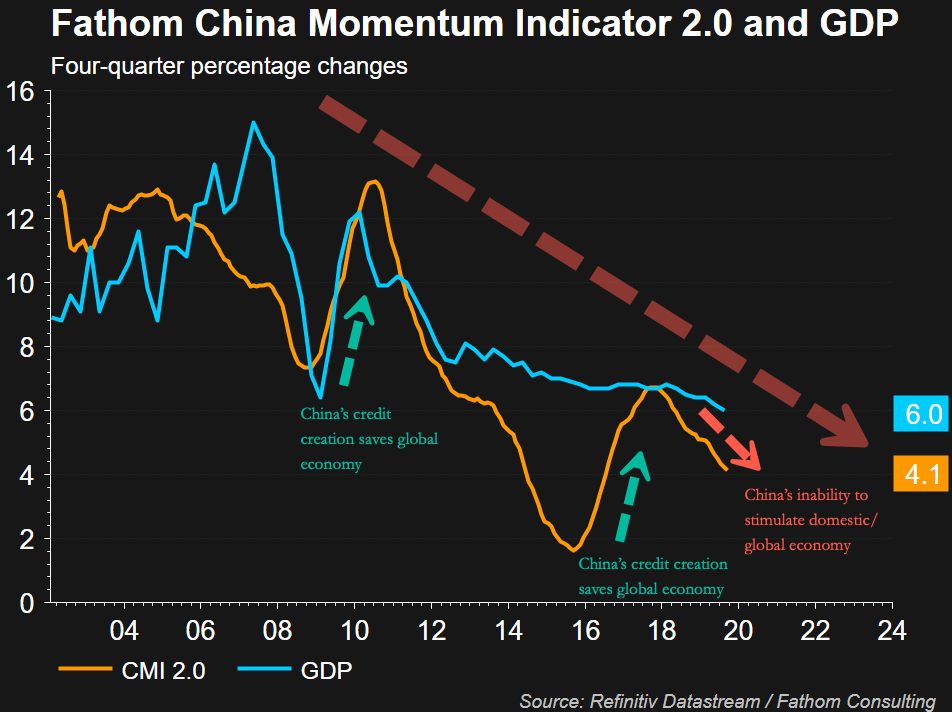
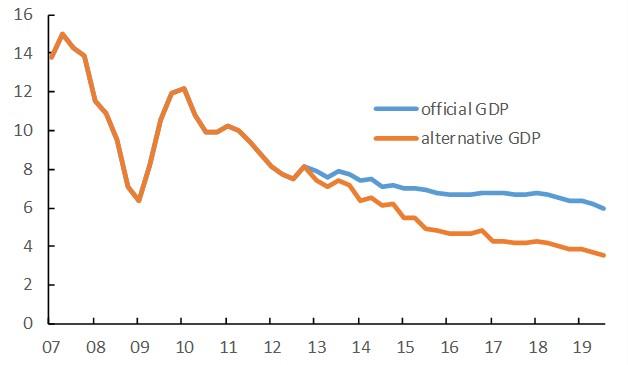
But has the global economy indeed troughed, and is a period of smooth sailing ahead? The answer will depend, as it traditionally has in the past decade, on whether China will stimulate both its own, and the global economy to the point where it successfully triggers a global inflationary shockwave around the globe. Unfortunately, the answer for now appears to be a resounding no, and not just as a result of the latest leading economic indicators out of China which missed across the board, confirming that Beijing is bracing for the first ever sub-6% GDP print. As Saxo Bank's Christopher Dembik writes, there is another reason why China will not open massively the credit tap anytime soon. But before we get into his argument, as a reminder, the latest Chinese credit data was a disaster, with the revised Aggregate Financing data series printing at its lowest level on record as we discussed in "China's Credit Creation Unexpectedly Collapses At The Worst Possible Time."
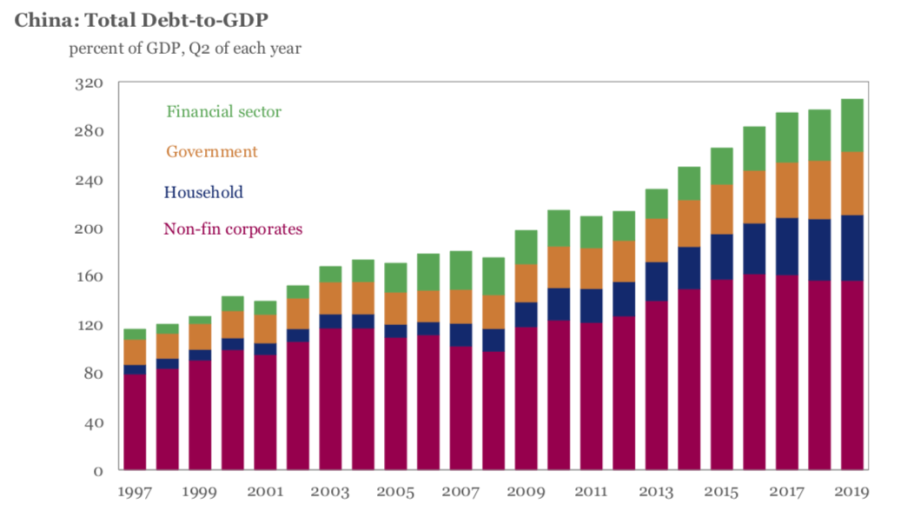

Why China's Growth Rate Is Much, Much Lower Than You Think. 
Here Are Goldman's Top Trades And Themes For 2020.
Wage growth is picking up… from repressed levels back to normal


Seeing as I brought up the topic of the (misleading) savings rate recently:
Why The Measure Of “Savings” Is Entirely Wrong.
The reality is the measure of “personal savings,” as calculated by the Bureau of Economic Analysis, is grossly inaccurate. However, to know why such is the case, we need to understand how the savings rate is calculated….
The differential between incomes and the actual “cost of living” is quite substantial. As Researchers at Purdue University found, in the U.S., $132,000 was found to be the optimal income for “feeling” happy for raising a family of four. A Gallup survey found it required $58,000 to support a family of four in the U.S. (Forget about being happy, we are talking about “just getting by.”)
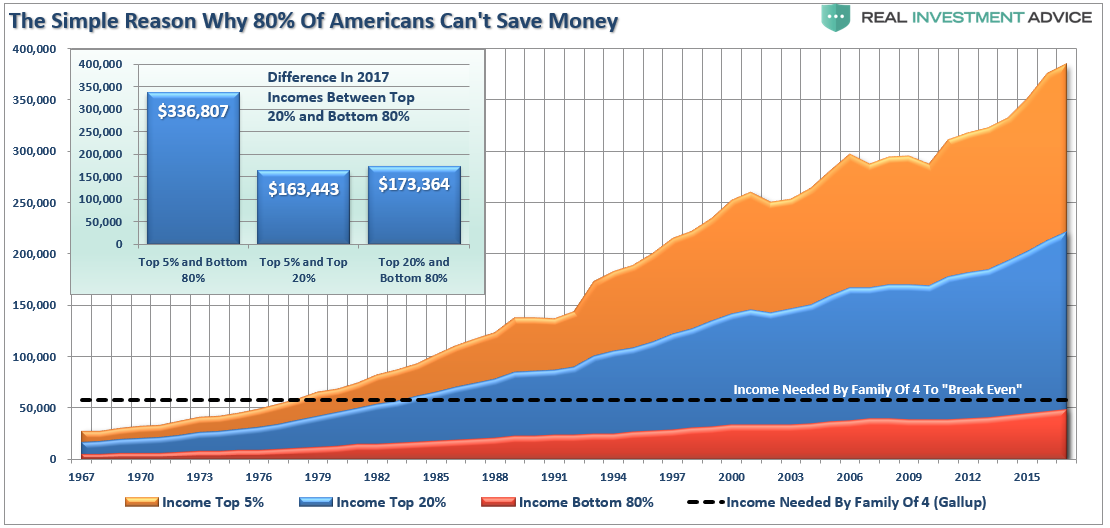
The “gap” between the “standard of living” and real disposable incomes is shown below. Beginning in 1990, incomes alone were no longer able to meet the standard of living so consumers turned to debt to fill the “gap.” However, following the “financial crisis,” even the combined levels of income and debt no longer fill the gap. Currently, there is almost a $2654 annual deficit that cannot be filled.
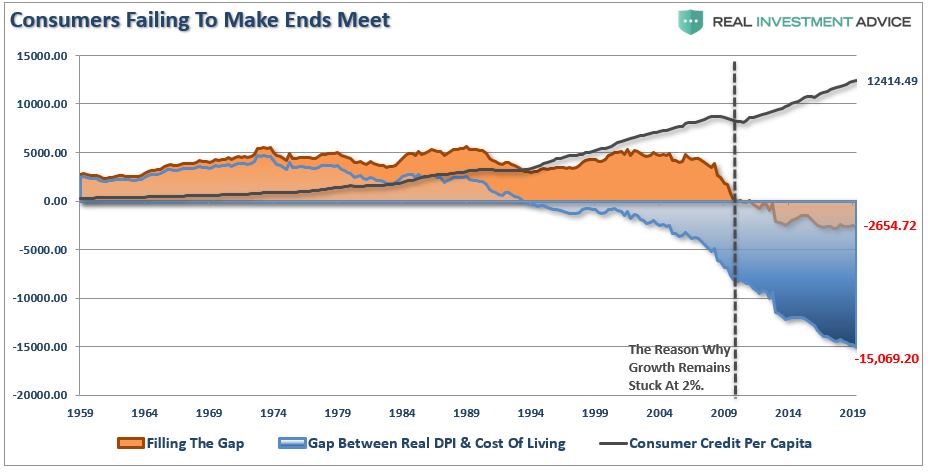
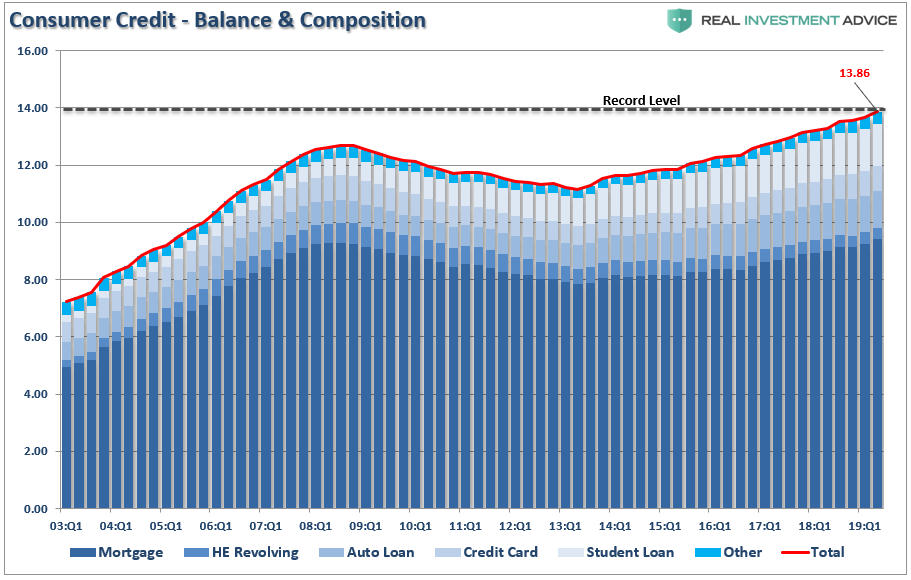
That gap explains why consumer debt is at historic highs and growing each year. If individuals were saving 8% of their money every year (as per the phony US personal savings rate), debt balances would at least be flat, if not declining, as they are paid off.


Consumers Are Keeping The US Out Of Recession? Don’t Count On It.

Fed's "National Activity Index" Plunges To 2-Year Low.


(Not just) for the ESG crowd:

Brookfield markets new green bond in Canada, sets sights on Brazil and India.

Climate-proofing Canada’s economy.
There is no denying that climate change is now a mainstream issue, as evidenced by vigorous debates in the recent federal election. While governments are struggling to come up with public-policy responses, global investors and financial institutions are not standing around. The investment world is already shaping markets in response to the effects of climate change.

Lewis Lapham in Lapham’s Quarterly: Paying the Piper.
The warming of the planet currently spread across seven continents, four oceans, and twenty-four time zones is the product of a fossil-fueled capitalist economy that over the past two hundred years has stuffed the world with riches beyond the wit of man to marvel at or measure. The wealth of nations comes at a steep price—typhoons in the Philippine Sea, Category 5 hurricanes in the Caribbean, massive flooding in Kansas and Uttar Pradesh, forests disappearing in Sumatra and Brazil, unbearable heat in Paris, uncontrollable wildfires in California, unbreathable air in Mexico City and Beijing.

The capitalist dynamic is both cause of our prosperous good fortune and means of our probable destruction, the damage in large part the work of Adam Smith’s invisible hand, guided by the belief that money buys the future. Nature doesn’t take checks. Who then pays the piper—does capitalism survive climate change, or does a changed climate put an end to capitalism? The question informs this issue of Lapham’s Quarterly…

Steve Keen: ‘4°C of global warming is optimal’ – even Nobel Prize winners are getting things catastrophically wrong.
William Nordhaus was awarded the 2018 Nobel Prize in Economics for “integrating climate change into long-run macroeconomic analysis”. This implies that he worked out what global heating means for our economy, given what climate scientists say will happen to our planet. But Nordhaus’s predictions of what global heating will cost the earth are dangerously at odds with the science. In his Nobel Prize lecture, Nordhaus described a 4°C increase in global average temperature as “optimal” — that is, the point at which the costs and benefits of mitigating climate change are balanced. In a subsequent academic paper based on this lecture, he stated that “damages are estimated to be 2 percent of output at a 3°C global warming and 8 percent of output with 6°C warming”. This is a trivial level of damage, equivalent for the 6°C warming case to a fall in the rate of economic growth over the next century of less than 0.1% per year. …. The average global temperature during the last Ice Age was 4°C cooler than today. There’s no way we can accurately predict what GDP would be in such a cool world today, but we know that most of Europe north of Berlin, and of America north of New York, would be under a kilometre of ice. To argue that this would cut GDP by just 3.6% is simply absurd.

Climate Change Is Coming for Global Trade. As sea levels rise and storms become fiercer, container shipping could be in for major disruptions

Ford’s Mustang Mach-E is an electric SUV with up to 300 miles of range. (Starting at US$43,895 and coming in late 2020)


Geopolitics

Ian Bremmer: The End of the American International Order: What Comes Next?
This is the text of a speech delivered by Bremmer on November 18 at the 2019 GZERO Summit in Tokyo.

Bound to Fail: The Rise and Fall of the Liberal International Order. Journal of International Security.
The liberal international order, erected after the Cold War, was crumbling by 2019. It was flawed from the start and thus destined to fail. The spread of liberal democracy around the globe—essential for building that order—faced strong resistance because of nationalism, which emphasizes self-determination. Some targeted states also resisted U.S. efforts to promote liberal democracy for security-related reasons. Additionally, problems arose because a liberal order calls for states to delegate substantial decision-making authority to international institutions and to allow refugees and immigrants to move easily across borders. Modern nation-states privilege sovereignty and national identity, however, which guarantees trouble when institutions become powerful and borders porous. Furthermore, the hyperglobalization that is integral to the liberal order creates economic problems among the lower and middle classes within the liberal democracies, fueling a backlash against that order. Finally, the liberal order accelerated China’s rise, which helped transform the system from unipolar to multipolar. A liberal international order is possible only in unipolarity. The new multipolar world will feature three realist orders: a thin international order that facilitates cooperation, and two bounded orders—one dominated by China, the other by the United States—poised for waging security competition between them.


Other Fare:

Blockbuster WSJ Investigation: How Google Interferes With Its Search Algorithms and Changes Your Results.


Book Review:

David Graeber: Against Economics – reviews Robert Skidelsky’s Money and Government: The Past and Future of Economics.
There is a growing feeling, among those who have the responsibility of managing large economies, that the discipline of economics is no longer fit for purpose. It is beginning to look like a science designed to solve problems that no longer exist. A good example is the obsession with inflation. Economists still teach their students that the primary economic role of government—many would insist, its only really proper economic role—is to guarantee price stability. We must be constantly vigilant over the dangers of inflation. For governments to simply print money is therefore inherently sinful. If, however, inflation is kept at bay through the coordinated action of government and central bankers, the market should find its “natural rate of unemployment,” and investors, taking advantage of clear price signals, should be able to ensure healthy growth. These assumptions came with the monetarism of the 1980s, the idea that government should restrict itself to managing the money supply, and by the 1990s had come to be accepted as such elementary common sense that pretty much all political debate had to set out from a ritual acknowledgment of the perils of government spending. This continues to be the case, despite the fact that, since the 2008 recession, central banks have been printing money frantically in an attempt to create inflation and compel the rich to do something useful with their money, and have been largely unsuccessful in both endeavors. 
We now live in a different economic universe than we did before the crash. Falling unemployment no longer drives up wages. Printing money does not cause inflation. Yet the language of public debate, and the wisdom conveyed in economic textbooks, remain almost entirely unchanged.

One expects a certain institutional lag. Mainstream economists nowadays might not be particularly good at predicting financial crashes, facilitating general prosperity, or coming up with models for preventing climate change, but when it comes to establishing themselves in positions of intellectual authority, unaffected by such failings, their success is unparalleled. One would have to look at the history of religions to find anything like it. To this day, economics continues to be taught not as a story of arguments—not, like any other social science, as a welter of often warring theoretical perspectives—but rather as something more like physics, the gradual realization of universal, unimpeachable mathematical truths. “Heterodox” theories of economics do, of course, exist, but their exponents have been almost completely locked out of what are considered “serious” departments, and even outright rebellions by economics students (from the post-autistic economics movement in France to post-crash economics in Britain) have largely failed to force them into the core curriculum.

As a result, heterodox economists continue to be treated as just a step or two away from crackpots, despite the fact that they often have a much better record of predicting real-world economic events. What’s more, the basic psychological assumptions on which mainstream (neoclassical) economics is based—though they have long since been disproved by actual psychologists—have colonized the academy, and have had a profound impact on popular understandings of the world.

Nowhere is this divide between public debate and economic reality more dramatic than in Britain, which is perhaps why it appears to be the first country where something is beginning to crack. It was center-left New Labour that presided over the pre-crash bubble, and voters’ throw-the-bastards-out reaction brought a series of Conservative governments that soon discovered that a rhetoric of austerity—the Churchillian evocation of common sacrifice for the public good—played well with the British public, allowing them to win broad popular acceptance for policies designed to pare down what little remained of the British welfare state and redistribute resources upward, toward the rich. “There is no magic money tree,” as Theresa May put it during the snap election of 2017—virtually the only memorable line from one of the most lackluster campaigns in British history. The phrase has been repeated endlessly in the media, whenever someone asks why the UK is the only country in Western Europe that charges university tuition, or whether it is really necessary to have quite so many people sleeping on the streets.

The truly extraordinary thing about May’s phrase is that it isn’t true. There are plenty of magic money trees in Britain, as there are in any developed economy. They are called “banks.” Since modern money is simply credit, banks can and do create money literally out of nothing, simply by making loans. Almost all of the money circulating in Britain at the moment is bank-created in this way. Not only is the public largely unaware of this, but a recent survey by the British research group Positive Money discovered that an astounding 85 percent of members of Parliament had no idea where money really came from (most appeared to be under the impression that it was produced by the Royal Mint).


Quotes of the Week:

Rubino: “Every sector of the U.S. economy is so over indebted I don’t see how we go on much longer. The Fed is desperately trying to prolong this thing. We’re running trillion dollar deficits now, and what that is for is to keep the system from falling apart. We are 11 years into an expansion, a record. This is the longest bull market in history, and this is the longest economic expansion in history… These guys don’t know exactly what’s going to happen in the next recession, but they are afraid that the system is so highly leveraged that even a garden-variety three quarters of a percent of negative growth and a garden variety of 20 % drop in stock prices might be fatal. The system might not be able to handle that because it would cause so much damage and there are so many different places that can blow up that the system would spin out of control. We would get 2008-09 again but on steroids because the numbers are so much bigger this time around. So, they want to avoid that at all costs.”


US AG William Barr: “in waging a scorched earth, no-holds-barred war of ‘Resistance’ against this Administration, it is the Left that is engaged in the systematic shredding of norms and the undermining of the rule of law.”

… much more on Adam Schiff’s and the Democrats’ Orwellian “campaign to blow smoke up America’s ass for three years running” by JHK here, and more on our Pravda-like B.S. media’s inane coverage or our insane world by Johnstone here, in which politicians and the media “use a light sprinkling of fact to weave a narrative that has very little to do with reality”


Photo of the Week:
Hope we don’t have any “Black Swans” coming, because they are fierce-looking!


Totally Unrelated – Catchy Headlines; just checking if you’re reading these:

Pointless work meetings 'really a form of therapy'.

Cops put GPS tracker on man’s car, charge him with theft for removing it.

They Can't Stop Us:' People Are Having Sex With 3D Avatars of Their Exes and Celebrities.

Monday, November 11, 2019

2019-11-11 Charts and Links

Global debt surges to record high $188 tn: IMF chief.

Ray Dalio: The World Has Gone Mad, and the System is Broken.

I say these things because:
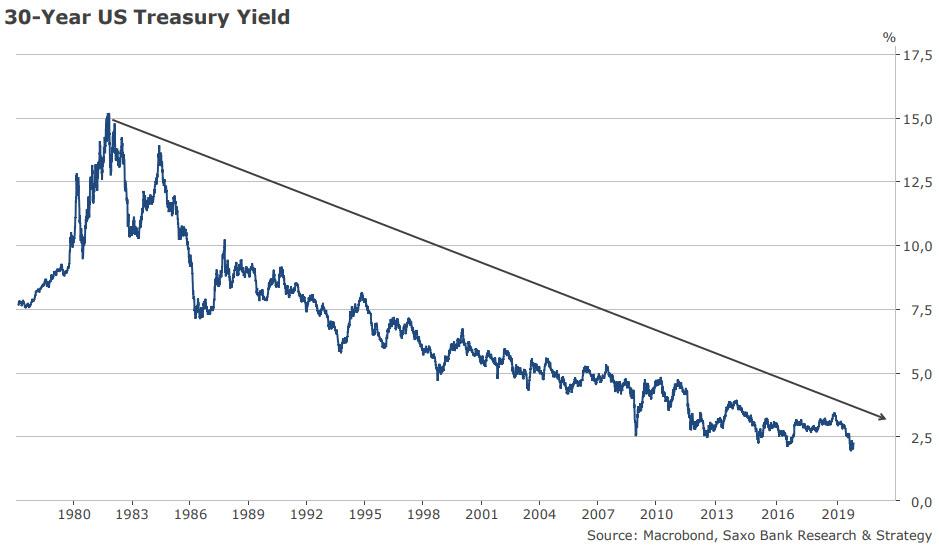
Money is free for those who are creditworthy because the investors who are giving it to them are willing to get back less than they give. More specifically investors lending to those who are creditworthy will accept very low or negative interest rates and won’t require having their principal paid back for the foreseeable future. They are doing this because they have an enormous amount of money to invest that has been, and continues to be, pushed on them by central banks that are buying financial assets in their futile attempts to push economic activity and inflation up. The reason that this money that is being pushed on investors isn’t pushing growth and inflation much higher is that the investors who are getting it want to invest it rather than spend it. This dynamic is creating a “pushing on a string” dynamic that has happened many times before in history (though not in our lifetimes). As a result of this dynamic, the prices of financial assets have gone way up and the future expected returns have gone way down while economic growth and inflation remain sluggish. Those big price rises and the resulting low expected returns are not just true for bonds; they are equally true for equities, private equity, and venture capital, though these assets’ low expected returns are not as apparent as they are for bond investments because these equity-like investments don’t have stated returns the way bonds do. As a result, their expected returns are left to investors’ imaginations. Because investors have so much money to invest and because of past success stories of stocks of revolutionary technology companies doing so well, more companies than at any time since the dot-com bubble don’t have to make profits or even have clear paths to making profits to sell their stock because they can instead sell their dreams to those investors who are flush with money and borrowing power.

How Much Higher Can Yields Rise Before Stocks Get Slammed? Marko Kolanovic Answers. 


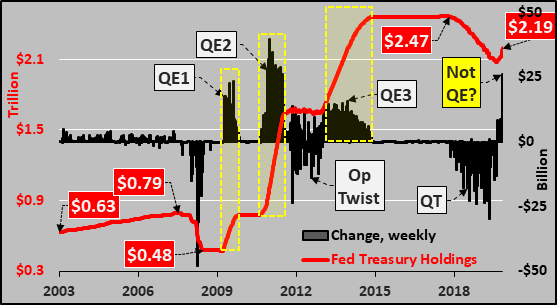
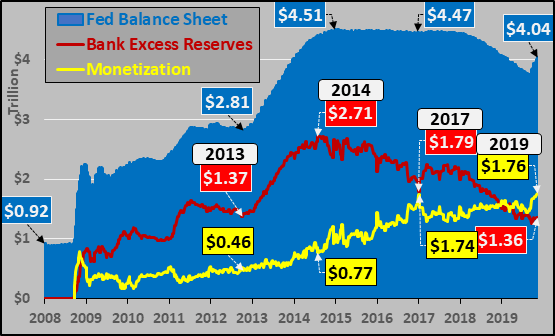
"Not QE", Monetization, & "Definitely Asset Inflation"

The chart below shows the Federal Reserve holdings of Treasuries, a weekly change (black columns) and total holdings (red line) during QE1, QE2, Operation Twist, QE3, QT, and "Not QE". Got it?!? This current "Not QE" explosion in QE is like some kind of old time vaudeville act (like the old Abbott and Costello bit, "who's on first, what's on second, I don't know's on third"). … As the Fed restarted "not QE" but did not go through the façade of attempting to stock the new money away as "excess reserves", this new money is flowing straight into assets, like monetary heroine.


Who Needs Graham & Dodd When We Have 'Quantitative' & 'Easing'?


The Recession In The Auto Industry Is Tanking The Global Economy.
The global economy continues to grind to a halt and the culprit has never been clearer: the auto industry. For the better part of almost 2 years now, we have been reporting monthly on marked slowdowns in key auto markets like China, North America and Europe. Now, the slowdown in this massive industry is what’s helping spur an overall global economic slowdown, according to FT. The reaches of the auto market go deep, with long supply chains and large consumption of raw materials, textiles, chemicals and electronics. The industry is home to millions of jobs and last year, the sector shrank for the first time since the global financial crisis. The IMF is estimating that this fall in output accounted for more than 25% of the slowdown in the global economy between 2017 and 2018.


Charts from Albert Edwards via Mike Shedlock 


“All Big-3 precursors considered, the near-term outlook is weaker than normal but not yet recessionary—the expansion appears to have enough policy support, spending capacity growth and overall momentum to continue through at least the first quarter or two of 2020.

Deeper into the year, the outlook could darken as many forecasters predict, especially if corporate earnings continue to slide. But we could just as easily see more of the same—an economy that grinds slowly higher as real incomes grow, asset prices trend upwards and bank balance sheets expand. To gauge which of the scenarios is becoming more likely, I suggest watching the Big-3 and tuning out most everything else.”


“Even though this is a finance and economics blog, I haven’t written about the disruption in the repo markets. That is in part because the upset is not in any way, shape, or form like the 2008 period when banks were unwilling to repo even Treasuries to each other overnight because they were fearful another major dealer (say Morgan Stanley, which was on the verge of going tits up) would go the way of Lehman. I thought posting on it would feed the false narrative (which sadly is still kicking around) that the repo crunch is a sign of systemic stress, which it isn’t. The second reason is that pretty much no one seems to have a clue as to why this is happening including most troublingly, the Fed. Perversely, the fact that the Fed is so clearly behind the curve is almost certain to make whatever the underlying problems are worse. Flatfooted central banks waking up to a problem and randomly hitting switches to try to make it go away is not only not a good look, but it makes the Confidence Fairy have a sad, which makes market upsets worse.

We’ll give a high level review of some of the major theories and why they don’t add up (and worse, look like special pleading by banks for regulatory breaks they don’t need) and will turn to an idea from John Dizard of the Financial. Dizard argues that the big banks even with the apparent repo crisis make more money lending to the FX swaps market. This is consistent with big fish like JP Morgan’s Jamie Dimon whining about regulation rather than sounding at all worried.

Mind you, we are not saying there are not problems here. What we are questioning is whether they are being characterized properly and whether they could become systemic. If Dizard is right, and Dizard is reviving and amplifying concerns raised by the Bank of International Settlements two years ago, the problem is in FX swaps and forwards, which amount to dollar lending but unlike repos, aren’t booked on balance sheet. That means that this area is a big blind spot for central banks; ….


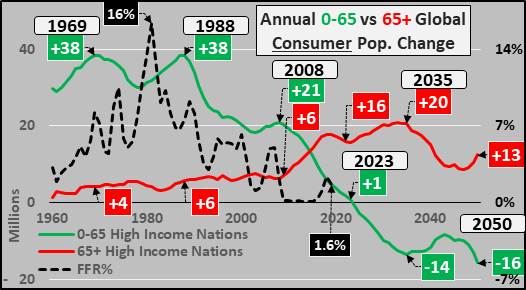
Six Cohort Growth Since 2000 Smoothed


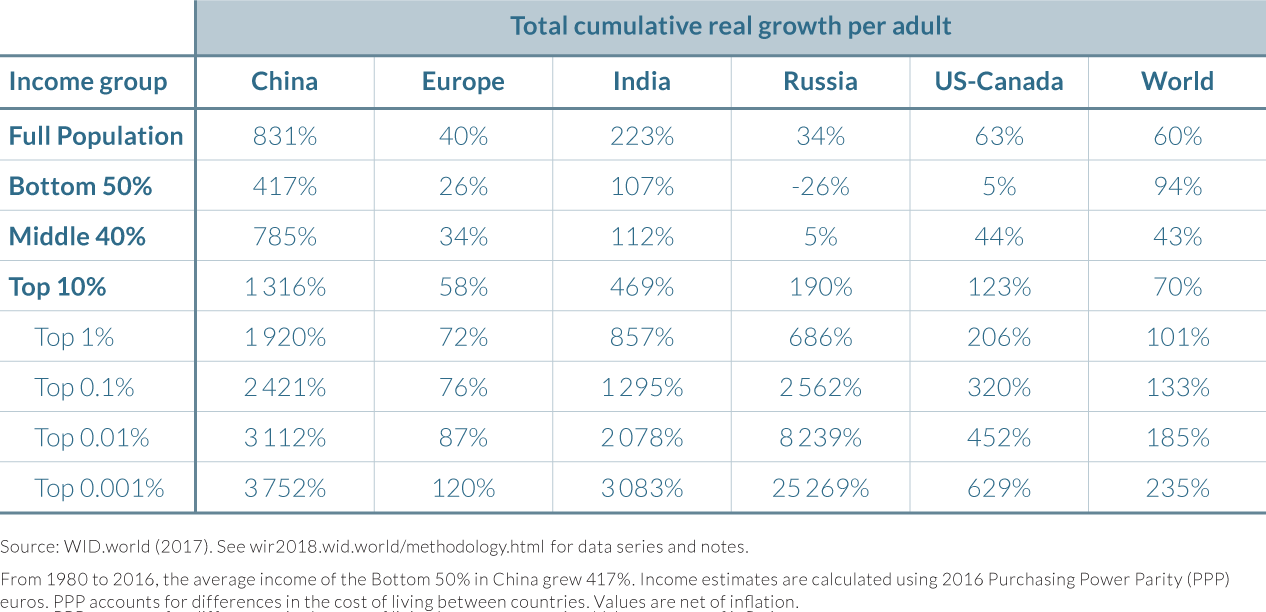
Table 2.1.1 Global income growth and inequality, 1980–2016


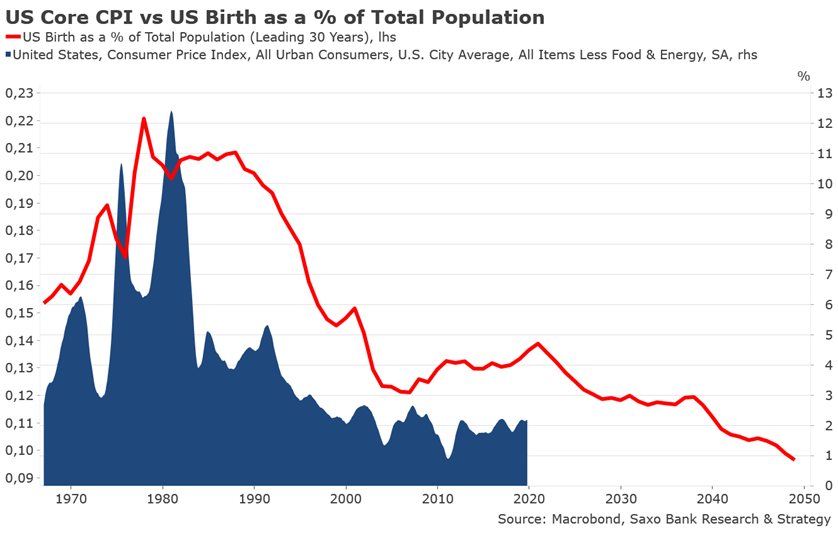
Simply put, in our fractional reserve banking system, the bulk of "money" in the economy is lent into existence by a rising quantity of loans. But the data is clear that those who undertake new loans (create new money) will be in indefinite decline, while roughly equally and oppositely, those that pay down or pay off existing loans (destroy existing money) will take their place. …

Thus, there are two options to continue growing debt (aka, "money"). Either encourage the continually fewer working age persons among consumer nations to take out ever more debt (via perversely paying borrowers with NIRP or similar to undertake new loans) and/or central banks conjure it from nowhere. ZIRP, NIRP, QE, LTRO, and acronyms yet to be invented will all have the express purpose to destroy assets (purchasing bonds, stocks, etc. that are never to return to the market) and replace them with newly printed "money" which will chase the remaining assets higher. This monetization is to avoid a free-market from pricing assets based upon a declining quantity of buyers and fast increasing quantity of sellers.


It is the progressive and degenerative fundamental weakness (slowing population growth and outright population declines among consumers) that is the premise for ever greater market interference that drives the observed economic and financial market "strength". Of course, the policy of centrally directing asset appreciation has clear winners (a declining quantity of institutions, asset holders, federal governments) and losers (a fast growing quantity of young, poor, working class, and those with few or no assets).

(read, especially, the “What Does This Mean?” section) 


Trending Down. Tim Morgan, Surplus Energy Economics. 
Ultimately, the economy isn’t, as the established interpretation would have us believe, a financial system at all. Rather, it’s an energy system, driven by the relationship between (a) the amount of energy to which we have access, and (b) the proportion of that energy, known here as ECoE (the Energy Cost of Energy), that is consumed in the access process.

Properly understood, money acts simply as a ‘claim’ on the output of the energy economy, and driving up the aggregate of monetary claims only increases the scope for their elimination in a process of value destruction.

…

My energy-based economic model, the Surplus Energy Economics Data System (SEEDS), is showing a worsening deterioration, and now points to a huge and widening gap between where the economy really is and the narrative being told about it from the increasingly unreal perspective of conventional measurement.

…

we should anticipate a major financial shock, far exceeding anything experienced in 2008 (or at any other time), as a direct result of the widening divergence between soaring financial ‘claims’ and the reality of an energy-driven economy tipping into decline.”


(not just) for the ESG crowd : 


Exactly 40 years ago, scientists from 50 nations met at the First World Climate Conference and agreed that alarming trends for climate change made it urgently necessary to act. Since then, similar alarms have been made through the 1992 Rio Summit, the 1997 Kyoto Protocol, and the 2015 Paris Agreement, as well as scores of other global assemblies and scientists’ explicit warnings of insufficient progress. Yet greenhouse gas emissions are still rapidly rising, with increasingly damaging effects on the Earth's climate. An immense increase of scale in endeavors to conserve our biosphere is needed to avoid untold suffering due to the climate crisis.


In three weeks, the world's leaders will begin to gather in Madrid for the 25th United Nations Climate Change Conference. The intensity of the global climate strikes this year suggests that the proceedings will be scrutinized as never before. But the decisions made, or not made, will also have repercussions for global markets.

We’re transitioning towards a lower carbon economy, albeit at a slower pace than needed to stay within a two degrees Celsius climate scenario (2DS).

…

If governments are serious about halting climate change, some form of stimulus will be needed.

…

One alternative is to make high-carbon incumbents prohibitively expensive.

…

Until now, the willingness of governments to take steps to halt climate change has been open to question, given the potential implications for inflation, government debt and employment. But we see several reasons why change may come over the next 12 months. Significantly, awareness and concern about climate change among the general population are growing, driven by more frequent extreme weather, media coverage and actions by protest groups.


(Pictured) Quote of the Week 


California Brewery is Printing “Epstein Didn’t Kill Himself” on the Bottom of its Cans. 


Wednesday, March 30, 2011

March 30

QOTD:
Won't it be cool if subsequent versions of QE are referenced with Roman numerals like the Super Bowl?
John Roque, WSJ.

The unbelievable truth about Ireland and its banks. BBC.
To prevent Irish banks toppling over one after another, the European Central Bank has lent 117bn euros to them and the Central Bank of Ireland has lent them a further 71bn euros. So that's 188bn euros of loans from the eurozone's taxpayers to Ireland's banks - which makes the 67.5bn euros lent directly by the eurozone and IMF to the Irish government look like peanuts. And a further 20bn euros of bank bonds - another form of bank debt - is still guaranteed by the Irish state through the Eligible Guarantee Scheme. So that is 208bn euros of taxpayer loans to Ireland's banks - equivalent to a remarkable 154% of GDP.
[Irish] Bank bailout cost (so far). Corner Turned.

The 'grand bargain' is just a start. Martin Wolf, FT.
It would be helpful – and honest – for the German government and the governments of other creditor countries to tell their people that they are rescuing their own savings in the guise of rescuing peripheral countries. The alternative is to write off loans and recapitalise their banks directly. To admit this would be to admit their policies have been at fault. That would surely be helpful.
Europe needs debt relief, not decades of austerity. The Guardian.
From Donegal to the Algarve, to the streets of Athens, voters on Europe's "periphery", as economists dismissively call it, are slowly waking up to a sobering truth – they face years of austerity, yet wage cuts, job losses and crumbling public services will not extricate them from financial crisis. In fact, by driving their economies into an ever deeper slump, it may even make things worse. The pain could just bring more pain....
Markets and voters across the eurozone have grown wearily accustomed to watching the cycle of a looming fiscal crisis as bond yields rocket, followed by just enough action from Brussels to jolt investors out of panic mode, followed by another bout of the jitters as they realise the rhetoric from euro leaders isn't matched by reality.

As Steen Jakobsen, chief economist at Saxo Bank, put it in a note on Friday: "It's clear that the electorates are beginning to realise that all solutions offered by the policymakers are based on the promise to do something in the future, and never right here, right now."

But time is running out, and Europe has two choices. It can continue hammering the economies of Greece, Ireland and soon Portugal deeper into crisis, while their already furious voters become increasingly resentful about the pain being imposed by their European "partners"; or it can accept that the scale of debts has simply become unsustainable, and open negotiations now about an orderly default.
As Obama and Congress fiddle, America liquidates housing sector. Chris Whalen.

the current national policy mix of more regulation, decreased government subsidies and, to add further urgency, a shrinking banking system, is the perfect storm for the housing, which is now down six months in a row. Despite my long-held desire to see market-based reform in the US housing sector, I think all parties need to be aware of the precarious situation facing the American economy and banks as home prices collapse for lack of credit....
The net, net here is that the available pool of credit available for the housing sector is shrinking and thus prices must also decline to adjust for that supply of credit. This fact of continued decline in home prices is going to have a chilling effect...
I estimate that Fannie and Freddie alone are hiding $200 billion worth of bad loans on their books simply because there is no market for these foreclosed homes. Ditto for the largest servicer banks such as Wells Fargo, Bank of America, JPMorgan Chase and Citigroup. To clean up this mess with finality is going to cost $1 trillion or so in round numbers. But nobody in Washington wants to go there.
Where the bailout went wrong. Neil Barofsky, NY Times Op-Ed.
As per James Kwak:
Back in late 2008 and early 2009, there was a lot of talk about how a true solution for the problems of the banking system would require a solution for the problems of homeowners, since the banks’ losses were largely the result of mortgage defaults. One of the major technical achievements of the administration was showing that it was possible to stabilize the financial system and restore the banks to short-term profitability without doing much for homeowners.
The Federal Open Mouth Committee is back in action. Pater Tenebrarum.
Hawks (relatively speaking) and doves within the Fed are busy trading slightly contradictory statements in public again, in a performance that is eerily reminiscent of the 'exit talk' (exit from unusual monetary accommodation measures that is) that proliferated about one year ago.....

led to this campaign of advance burying of 'QE3' by means of 'QE2' funeral eulogies. Surely 'QE3' won't be talked about so much anymore if even 'QE2' comes under official scrutiny. Since the current QE program is slated to end in June, market participants are given fair warning not to expect more 'coups de whiskey' for the stock and commodity markets immediately thereafter. This in turn means that the times are set to become slightly more interesting. Given that there is not the slightest evidence yet that private sector deleveraging has run its course, a cessation of excessive monetary pumping may end up stopping various bubble activities in their track in very short order. This is to say, both financial markets as well as the economy may slump again fairly quickly....

Helicopter pilot Ben Bernanke has been rather quiet, letting the rest of the board spread the message. Alas, we suspect he's personally still firmly in the pro easy money camp. At least this is what we would have to conclude considering his well known views on the Great Depression as well as Japan's post bubble era. His usual refrain was that policy makers were 'too timid' in these instances, but as it were, the BoJ is a veteran of two (now 2.5) QE programs as well, so if one wants to be 'less timid', then 'QE1' and 'QE2' alone obviously won't cut it. In that sense we would be inclined to discount the advance funeral rites for 'QE3' as just more hot air. Nevertheless, there will be a pause, and should the economy's momentum not falter again immediately, then we'd expect the 'exit' palaver to increase in both volume and frequency.

Surpluses, debt and depressions.... Randall Wray via Pragmatic Capitalism.

China's 5-year plan and global interest rates. Martin Feldstein.

Visualizing the food and energy crunch. Pragmatic Capitalism.

Debt: The first five thousand years. David Graeber.

The biggest urban legend in finance. Rob Arnott.

Fannie and Freddie hiding over $100 billion of losses? naked capitalism.


other fare:
Exceptional And Unexceptional America. Andrew Sullivan, The Atlantic.

Thursday, February 17, 2011

February 17

Quarterly report on household debt and credit. FRBNY.
this data is a little dated, as more recent data has shown a touch of releveraging, but on a long-term trend basis:
Aggregate consumer debt continued to decline in the fourth quarter, continuing its trend of the previous two years. As of December 31, 2010, total consumer indebtedness was $11.4 trillion, a reduction of $1.08 trillion  (8.6%) from its peak level at the close of 2008Q3, and $155 billion (1.3%) below its September 30, 2010 level. Household mortgage indebtedness has declined 9.1%, and home equity lines of credit (HELOCs) have fallen 6.5% since their respective peaks in 2008Q3 and 2009Q1. For the first time since 2008Q4, consumer indebtedness excluding mortgage and HELOC balances did not fall, but rose slightly ($7.3 billion or 0.3%) in the quarter.  Consumers’ non-real estate indebtedness now stands at $2.31 trillion, the same level as in2010Q2, 8.4% below its 2008Q4 peak.


But if we get some further payroll growth, we should see more credit growth:

Intermezzo: the fight against credit contraction. macrofugue.

Rich valuations and poor market returns. John Hussman.
Last week, the S&P 500 Index ascended to a Shiller P/E in excess of 24 (this “cyclically-adjusted P/E” or CAPE represents the ratio of the S&P 500 to 10-year average earnings, adjusted for inflation). Prior to the mid-1990′s market bubble, a multiple in excess of 24 for the CAPE was briefly seen only once, between August and early-October 1929. Of course, we observe richer multiples at the heights of the late-1990′s bubble, when investors got ahead of themselves in response to the introduction of transformative technologies such as the internet. After a market slide of more than 50%, investors again pushed the Shiller multiple beyond 24 during the housing bubble and cash-out financing free-for-all that ended in the recent mortgage collapse.

And here we are again. This is not to say that we can rule out yet higher valuations, but with no transformative technologies driving the economy, little expansion in capital investment, and ongoing retrenchment in consumer balance sheets, I can’t help but think that the “virtuous cycle” rhetoric of Ben Bernanke is an awfully thin gruel by comparison. We should not deserve to be called “investors” if we fail to recognize that valuations are richer today than at any point in history, save for the few months before the 1929 crash, and a bubble period that has been rewarded by zero total return for the S&P 500 since 2000. Indeed, the stock market has lagged the return on low-yielding Treasury bills since August 1998. I am not sure that even members of my own profession have learned anything from this....
While we can certainly find analysts who believe stocks are cheap, we can easily test the long-term accuracy of their methods (which often amount to nothing more than applying an arbitrary multiple to forward operating earnings, or dividing the forward earnings yield by the 10-year Treasury yield). Frankly, many of those alternative methods stink. Regardless of whether an analyst claims that stocks are cheap or expensive, they should be expected to provide some sort of evidence that their methods have a strong relationship with subsequent market returns.

The cognitive dissonance of it all. Kyle Bass, Hayman Advisers.

Per Chris Whalen, Wells Fargo's CFO quit due to an internal dispute over financial disclosures. zerohedge.

Victor Shih on the Chinese economy. The Browser. (Five Books)

Monday, February 7, 2011

February 7

QOTD1:
Faced with the choice between changing one’s mind and proving there is no need to do so, almost everyone gets busy on the proof. ~ John Kenneth Galbraith

QOTD2:
People can foresee the future only when it coincides with their own wishes, and the most grossly obvious facts can be ignored when they are unwelcome. ~ George Orwell


Canadian corporate bonds an expensive proposition. FP.
according to PIMCO's Ed Devlin.
“The fundamental problem with the Canadian corporate bond market is that there is are too many investors chasing too few issuers,” Mr. Devlin said in a recent note to clients.

He noted that 59% of Canada’s main corporate bond benchmark is concentrated in just 10 issuers. By comparison the percentage of the index concentrated in 10 issuers is 20% in the U.S., 26% in Great Britain and 35% in the Eurozone.
Housing prices to drop 25%, [Capital Economics] forecaster predicts. The Star.

Negative annualized stock market returns for the next 10 years or longer? It's far more likely than you think. Mish.

Entranced by China's bubbling economy. Edward Chancellor, FT.

Mr Mansharamani starts out with George Soros’s theory of reflexivity.... markets are determined by a “two-way feedback mechanism in which reality helps shape the participants’ thinking process and the participants’ thinking helps shape reality”. Chaos rules as errors of perception feed back into reality.

The financial instability hypothesis of the late Hyman Minsky complements Mr Soros’s reflexivity.... already inflated asset prices can only be sustained by further price appreciation and ever increasing leverage. 

According to Mr Minsky, when Ponzi finance is widespread, the economy is likely to develop into a “deviation-amplifying system”. All great bubbles have easy money and growing leverage. Mr Mansharamani turns to Friedrich Hayek and the Austrian economists to show how inappropriately low interest rates fuel credit growth and over-investment.

Behavioural psychology also helps explain why bubbles develop. Humans have a chronic tendency to overconfidence. We underestimate the probability of events that we haven’t recently experienced... For instance,...  it was generally believed house prices could not fall because they had been on a continuously rising trend in earlier decades.

Mr Mansharamani surveys recent research into swarm behaviour in the insect world. While ants lay and follow trails of pheromone, the speculative crowd follows a trail of recently minted money. Politics provides yet another prism for identifying bubbles. Great speculative booms are often stimulated by governments, sometimes with the intent of lining the pockets of public officials. All bubbles are accompanied by fraud.

China today has the characteristics of a truly great bubble. The value of the housing stock is set to exceed 350 per cent of GDP this year... Construction accounts for around one-quarter of economic activity in China...

A reflexive process appears to be at work as the anticipation of future Chinese economic growth drives new construction, while new construction drives economic growth.

Ponzi finance proliferates in China. Wasteful infrastructure projects are funded with bank loans and land grants from local governments, which themselves depend on land sales for the bulk of their income. Chinese banks bypass credit restrictions by securitising loans to developers, while state-owned enterprises boost profits by dabbling in real estate. China’s financial system has become in Mr Minsky’s phrase a “deviation-amplifying system”.


Tuesday, January 25, 2011

January 24

Do we really have a balance sheet recession? David Beckworth.

The age of de-leveraging. Jason Leach.

How I learnt to stop worrying and love The Bank. Steve Keen.

How will they prop up stocks after QE? An answer? Bruce Krasting.

The Fed can’t go bankrupt. Anymore. FT Alphaville.

More evidence of undercapitalization/insolvency of major banks. Yves Smith.

National debt = great recession 2.0. Dian Chu.

Spain's bank nationalization and the euro zone crisis. Ed Harrison.

The real cost of Chinese NPLs. Michael Pettis.

China vs. inflation: a love-30 match so far. Dian Chu.
Beijing most likely will come to grip very soon that eventually somebody got to pay somewhere, and there’s just no way around it, and that the time has come for some decisive actions with a combination of more aggressive monetary, fiscal and regulatory measures to show it really means business.

For example, instead of the symbolic two 25-bps interest rate hikes in Oct. and Dec., Beijing probably will do an immediate 50-bps rate hike by early February and another 50 bps in early March to blunt the start of the typical yearly run-up of crude oil, and other commodities. Then, depending on the market reaction and new economic data, more hikes could be implemented later on in the year. Fiscal policies such as taxes, and financial regulations and restrictions on speculative activities could be necessary.

Meanwhile, the expectation of a Yuan appreciation is keeping liquidity swimming. So, perhaps China would do just the opposite, as suggested by Andy Xie, a currency depreciation, which would lead to a capital outflow forcing interest rates up. There [are]many more things that China has to do to get the inflation situation under control, which most likely will send shock waves throughout global markets.

Social Unrest Could Make or Break A Party: Nmbers may be rigged or "smoothed out", but can't fool the regular Chinese Joe's and the smart money.

China's runaway chariot. Charles Smith.

SocGen crafts strategy for China hard-landing. Ambrose Evans-Pritchard.

Record Food Prices Causing Africa Riots Stoking U.S. Farm Economy. Bloomberg.

Inflation: not here, not now. John Taylor.


other fare:
of amusement: Gartman investment SAT score 410.

Thursday, January 20, 2011

January 20

Consumers and the Economy, Part II: Household Debt and the Weak U.S. Recovery. FRBSF.

The U.S. economic recovery has been weak, especially in employment growth. A microeconomic analysis of U.S. counties shows that this weakness is closely related to elevated levels of household debt accumulated during the housing boom. Counties where household debt grew moderately from 2002 to 2006 have seen a moderation of employment losses and a robust recovery in durable consumption and residential investment. By contrast, counties that experienced large increases in household debt during the boom have been mired in a severe recessionary environment even after the official end of the recession.

Quarterly Review and Outlook. Van Hoisington and Lacy Hunt.
We see seven main impediments to economic progress in 2011 that will slow real GDP expansion to the 1.5%-2.5% range. First, fiscal policy actions are neutral for 2011. Second, state and local sectors will continue to be a drag on the economy and labor markets in 2011. Third, Quantitative Easing round 2 (QE2) will likely produce only a slight economic benefit as the Fed continues to encourage additional leverage in an already over-indebted economy. Fourth, while consumers boosted economic growth in the second half of 2010 by sharply reducing their personal saving rate, such actions are not sustainable. Fifth, expanding inventory investment, the main driver of economic growth since the end of the recession in mid-2009, will be absent in 2011. Sixth, housing will continue to be a persistent drag on growth. Seventh, external economic conditions are likely to retard U.S. exports....

In spite of the adverse psychological reaction to the QE2, long Treasury bond yields dropped to 4.3% at the end of 2010, down 30 basis points from the close of 2009, producing a total return of slightly more than 10% for a portfolio of long Treasury and zero coupon bonds. The problematic economic environment and its depressive effect on inflation suggests long Treasury bond yields could easily decrease another 30 basis points in 2011, which would produce another double-digit rate of return for a similar portfolio. The probabilities of even lower yields are significant.

One step forward in the Euro zone? Claus Vistesen.
The system has reached the stage that a bankrupt sovereign state is issuing debt to buy bonds in a vehicle that is tasked with buying debt from a bankrupt Sovereign state that is no longer able to go to market. Folks this is reaching the level of a Monty Python skit.

This brings up a serious question not seen answered in the public yet.Who is ultimately responsible for the bonds that the rescue fund is going to be selling as AAA investments? Whose AAA balance sheet is guarantying these bonds that will be sold to investors like Japan?

EMU policies are pushing Southern Europe into systemic political crisis. Ambrose Evans-Pritchard.
Let us assume for the sake of argument that Europe succeeds in containing the immediate EMU debt crisis, with help from Asia, and that Germany’s fractious coalition actually agrees to a bail-out fund big enough to make any difference. What does this achieve, other than allowing banks to buy time by offloading liabilities onto European and Chinese taxpayers?

Is core Europe heading for a hard landing? Michael Darda.


Europe's Gordian Knot. Scott Minerd, Guggenheim Investment.


America has ‘reached the point of no return,’ Reagan budget director warns. Raw Story.

Stockman, who described himself as a libertarian during a recent interview with Reason.tv, told Raw Story that the economy got into this mess because of the public and private sectors' addiction to "guns and butter Keynesianism," an economic policy that amounts to a Ponzi scheme that has ballooned since 1990.

"If we see what's going on carefully, we've reached the final unmasking of the Keynesian illusion, that Keynesianism is really nothing but borrowing, stealing from the future to induce consumption today," he said. "There are no multipliers. Every one of these programs we've had from 'cash for clunkers' to housing purchase credits have disappeared as soon as they expired and simple shifted activities in time by a few months."

Stockman explained that before 1980, it took about $1.50 of new borrowing -- public or private -- to generate $1 of GDP growth. By the mid-1990s, it was $2.50 or $3 of borrowing for a $1 of GDP growth. By 2007, before the big collapse and meltdown finally came, $7 of public and private debt was added to the national balance sheet in order to get $1 of GDP growth.

"When you get to the point of $7 of borrowing to get $1 of income, you're obviously on an unsustainable path and pretty close to hitting the wall, which more or less we have," he said.

"So the addicts in Washington are now unfortunately terrified to stop all this borrowing whether it's for guns or butter for fear of the economy will collapse.... That's why we're just at the beginning of solving this massive financial collapse we had in 2008 and not in the process of healthy recovery as some of the pals in the White House or on Capitol Hill or on Wall Street would have you believe."

We cannot support ever-rising debt. Andrew Smithers.


Hedge funds bet China is a bubble close to bursting. Telegraph.


I like Ike: A powerful warning ignored. Jeremy Grantham.


I have been wrong -- I've been too bullish: Albert Edwards.


Sovereign debt crisis -- can it happen here? Soc Gen, via zero hedge.


Sustainable Credit Report 2011. World Economic Forum, via zerohedge.
finds that while global credit stock doubled from $57 trillion to $109 trillion in just 10 years (from 2000 to 2010), it will need to double again to $210 trillion by 2020 in order to provide the necessary credit-driven growth for world GDP to retain its current growth rate


The Financial Crisis: Will It Lead to America's Decline? FORA.TV.
Niall Ferguson, David Gergen, Mort Zuckerman.

Wednesday, January 12, 2011

January 12

"Illusory Prosperity" - Ludwig von Mises on Monetary Policy. John Hussman.


Hussman: The Anti-Tepper Makes an Apology (kind of). The Reformed Broker.
The manager's January 10th commentary reads as part admission of wrongheadedness, part bitter cartoon villain fist-shaking (you'll see!) and part doubling down on his bear case thesis. He admits that it's his job to generate returns in all environments but then pulls the fiduciary card to excuse his excess caution. Oh yeah, he also basically calls us all idiots. I guess we'll have to make do with only our profits as consolation for the insult.
Bearish John Hussman Is Sounding Like Someone Desperate To Keep His Clients. Clusterstock.


The market is a heartless beast. Pragmatic Capitalism.
The equity market is priced based on future profit expectations that are often right, but more often than not prove to be wrong. As we saw in 2007 those expectations were high, investors believed economic downturn would be thwarted and the environment ultimately surprised substantially to the downside. As the waterfall decline ensued we experienced the inverse reaction in 2009. Markets and expectations overshot to the downside. Expectations for profit growth became far too low and classic mean reversion ensued. As the economy stabilized in 2009 the economy remained stagnant at best. But the economy’s loss had become corporate America’s gain. The massive cost cuts made these corporations lean and mean. Corporate America’s diverse revenue stream kicked in as the global economy strengthened and leveraged up these lean balance sheets. Despite persistent weakness in the US economy profits continued to rebound through 2009 & 2010 even as US unemployment continued to climb. That heartless bitch did not care about the unemployed, stagnant wages or l-shaped recoveries. She cared only for the bottom line and the bottom line was robust – particularly when compared to expectations....

If I have made one mistake in recent years it has been focusing on what should be good for an economy (job growth, fair markets, organic growth, etc) as opposed to what the market desires (higher profits no matter how they come).... Ultimately, the purpose of research is to generate investment profits.  Connecting the dots between this research and actionable ideas is vital to success.  If you allow the emotion of a macro outlook to infect your work your results will suffer.   Remember, the market is not the economy.

Which country prints more and runs bigger government deficits: Canada or the US? Rebecca Wilder at Angry Bear.

Is inflation about to burst the Chinese bubble? naked capitalism.

China's lending quota? Michael Pettis.
would I have taken seriously a quota on new lending? Not really. It seems to me that if Beijing wants GDP growth in 2011 to come in at the expected 9%, the amount of new investment in China – which is determined in large part by the banking system – is really not something they can decide today. It is going to be whatever it needs to be given developments in household consumption growth and the trade surplus.


This is why I argued a few weeks ago that at whatever level the new loan quota was set, I was not going to think of it as constraining new lending in any way. Either the loan quota would be adjusted (upwards, almost inevitably) or more new lending would occur outside the banks’ balance sheets, as it did in 2009 and 2010.

Investment this year I suspect is going to be extremely high, as high as in 2009 and 2010, because it is only with very high levels of investment that we are likely to manage GDP growth rates high enough to keep Beijing happy. So my guess is that 2011 will be yet another year in this increasingly strained investment-driven party. Chinese GDP growth will continue to be the envy of the world, while those of us who worry about the sustainability and quality of the growth will worry more than ever.
Economic forecasting delusions. FT Alphaville.

So economists who tend to predict near the consensus are, by definition, unlikely to anticipate extreme events, while those who correctly predict the occasional Black Swan tend to get everything else wrong... Generally we agree with the standard defence that it’s not the forecast part of forecasts that matters, but rather their underlying information and logical coherence. And indeed, sometimes these are extremely helpful regardless of the outcome.

Tuesday, November 23, 2010

November 23

Zombie bears. Barry Ritholtz.

Failure to consider constraints. Mish.
skim thru the first part about his predictions, but the rest of the post is good review

Shadow over Asia. Interview of Vitaliy Katsenelson by David Galland.
I am a big believer that in the boxing match between a visible and an invisible hand, though the invisible hand may lose a few rounds, it will win the match every time....
There are no shortcuts to greatness. As long as they keep building new bridges [to nowhere], the economic numbers will register that there is growth, but at some point the piper will have to be paid, and these projects have a negative return on capital....
The problem with China is pretty much the same as with any bubble. Though it may have had a solid foundation under it, it is simply a good thing taken too far.... the actions taken by the Chinese government, especially after the recent global recession, have basically supersized the bubble that was already forming.... The government can drive this bubble further than a rational observer would expect....
In the case of Japan, their government basically ran out of chips. I think the Chinese government still has enough chips to keep the bubble going awhile longer. These bubbles usually last longer than the reputation of the person who predicts their demise.

Friday, October 29, 2010

October 29

Misguided love affair with China; China's massive monetary expansion and crack-up boom. Mish.

The problem with QE2. Comstock Partners.

POMO still matters. Jim Bianco.


I wouldn't normally be this liberal in extensively excerpting from another author's post, but the IRA's weekly letter is only freely available for one week, after which time it goes behind a subscription firewall, and I thought this post worthwhile enough to have recorded:
Triple Down: Fannie, Freddie, and the Triumph of the Corporate State. Chris Whalen, IRA.
Despite examples of the success of restructuring with F and even General Motors, the invidious cowards who inhabit Washington are unwilling to restructure the largest banks and GSEs. The reluctance comes partly from what truths restructuring will reveal. As a result, these same large zombie banks and the U.S. economy will continue to shrink under the weight of bad debt, public and private. Remember that the Dodd-Frank legislation was not so much about financial reform as protecting the housing GSEs. Because President Barack Obama and the leaders of both political parties are unwilling to address the housing crisis and the wasting effects on the largest banks, there will be no growth and no net job creation in the U.S. for the next several years. And because the Obama White House is content to ignore the crisis facing millions of American homeowners, who are deep underwater and will eventually default on their loans, the efforts by the Fed to reflate the U.S. economy and particularly consumer spending will be futile. As Alan Meltzer noted to Tom Keene on Bloomberg Radio earlier this year: "This is not a monetary problem."
Indeed, the public embrace by the Federal Open Market Committee of further quantitative easing or "QE", instead of calling for the immediate restructuring of the largest zombie banks, actually threatens to push the U.S. into a deeper and far more dangerous economic path. According to the Q2 2010 Bank Stress Index survey conducted by IRA and our review of the Q3 2010 earnings results, the financial condition of smaller lenders is actually improving. While the FDIC now has over 800 banks on its troubled list, the righteous banks for which we currently have "positive" outlooks in The IRA Advisory Service are showing better earnings and less credit stress.
Part of the reason for the improvement is that the FDIC and state regulators have taken a very hard line with smaller banks, pushing many into resolutions and distressed asset sales. But for the healthy lenders that survive and investors that buy failed banks, there will be a lot of money left on the table -- profits that will come back into earnings via recoveries and other windfalls and help to boost the private economy. Resolution and liquidation is how a free market economy regenerates. The trouble is, the approach taken with the large banks and the GSEs is precisely the opposite of that applied to smaller lenders. The policy of the Fed and Treasury with respect to the large banks is state socialism writ large, without even the pretense of a greater public good.
Forget Treasury Secretary Tim Geithner lying about the relatively small losses at American International Group (AIG); the fraud and obfuscation now underway in Washinton to protect the TBTF banks and GSEs totals into the trillions of dollars and rises to the level of treason. And the sad part is that all of the temporizing and excuses by the Fed and the White House will be for naught. The zombie banks and GSEs alike will muddle along until the operational cost of servicing bad loans engulfs them. Then they will be bailed out -- again -- or restructured....
So why did our BSI measure show rising stress in Q2 2010? Over the past several years, the large zombie banks actually looked better on our BSI survey than the average, this due to overt subsidies, QE and low interest rates. But now the larger lenders are sinking under the weight of rising servicing costs, falling asset returns and other problems linked to mortgage securitizations. So while the Fed continues to try to revive the largest banks via massive monetary ease, the FOMC is at the same time preparing to do further damage to solvent lenders, insurers and other investors via QE2.
The IRA has spoken to a number of executives in banks and life insurance companies about the impact of QE and Fed zero interest rate policy on their income statements and balance sheets. The universal message: If rates do not return to "normal" levels by year-end, the pain in terms of reduced earnings on assets and the resultant negative cash flow will start to become so apparent that the financial markets will actually notice. In particular, we have been told that by year end several of the largest publicly traded banks and life insurers could show significant declines in net interest earnings due to QE -- declines driven by falling net interest income that may provoke ratings downgrades. And when this next systemic crisis comes -- whether in December or later in 2011 --- the full blame will belong to the members of the Bernanke Fed and the Obama Administration.....
Walter Bagehot believed that central banks should lend aggressively in times of financial insolvency, the rate of the loans should be very high -- not zero as is the current FOMC policy. John Hussman wrote: "Bagehot's name has surfaced in a few editorials in recent weeks, but they have invariably focused on the "lend freely" portion of his advice, while overlooking Bagehot's admonition to impose costs, capital requirements, and other safeguards where public funds are concerned. In short, liquidity should be available to Fannie Mae and Freddie Mac, but the interest rates charged should be very high."
Of course the problem of adopting Bagehot's rule regarding high real credit costs is that you immediately expose all of the insolvent financial institutions -- including the US Treasury. This the Obama Administration, Treasury Secretary Geithner and the functionaries on the FOMC will not do. But the examples of Ford, GM and the smaller banks in the U.S., most of which have restructured without bankruptcy, suggest that the path to economic renewal requires reorganization and losses to creditors.
In the case of the large banks and GSEs, this means a great deal of pain for investors and taxpayers alike when, no, if, these institutions are finally restructured. But that is the good news and thereby lies the path to national recovery. What we need from the Fed is some leadership on the issue of making the White House take responsibility for restructuring the economy.

Friday, May 14, 2010

Yawn! Yuan.

Amidst all the speculation that China would have to let its currency appreciate, I predicted at our year-end forecast meeting back in December that China had enough problems of its own (too much productive overcapacity, a real estate bubble waiting to burst, under-stated unemployment), and that it was an export-dependent mercantilist, long accustomed to beggar-thy-neighbour policies, and though the U.S. might like it, I couldn't see how yuan appreciation would further China's own aims; so that China would do whatever it took to keep that export engine of its economy running when the other engines, i.e. credit-fueled unsustainable building bubbles (housing, production capacity and infrastructure), spluttered; so that protectionism and yuan devaluation were much more likely than yuan appreciation.

well, perhaps its already started. Guess the Chinese don't like the fall of the Euro, so are trying to prop it up as best they can ---- and, of course, trying to make the Euro appreciate is no different than trying to make the yuan depreciate.

Rumors That China Is Now DEVALUING The Yuan