Pages

Tuesday, October 15, 2019

2019-10-15 Charts and Links


Summary: The years leading up to the 2000 stock market bubble were extraordinary and unprecedented. They caused unique pain to the portfolios of valuation-driven investors. The valuation extremes, though, created the greatest opportunity set for valuation-driven investors since the Great Depression. While the events of the last decade have not been as striking as those of the late 1990s, the recent cycle has gone on for significantly longer and the pain caused to our portfolios has begun to approach 1990’s levels. As the current cycle has ground on slowly but surely, the valuation extremes have moved wider, creating an opportunity set for valuation-driven investors that looks as extraordinary as what we saw 20 years ago.


As the financial markets enter what I expect to be a rather disruptive completion to the recent speculative half-cycle, it will be helpful for investors to consider certain propositions that are readily available from history, rather than insisting on re-learning them the hard way.

Employment data is the last to know
Proposition: Risk-sensitive assets and confidence measures generally precede economic shifts; production, consumption and income measures are coincident with broad economic activity; and labor market measures lag the economy. The unemployment rate is the single most lagging economic indicator available.
….
Market losses precede recession recognition, not the other way around
Proposition: By the time a U.S. recession begins, stocks have typically been in a bear market for months. Indeed, by the time a recession is widely accepted, a great deal of bear market damage has typically already been done.
…
Low interest rates aren’t your friends
Proposition: Low interest rates don’t “justify” elevated stock market valuations. Rather, the combination of low interest rates and high valuations simply implies that both stocks and bonds are priced to produce similarly low future returns.
..
The present level of overvaluation may be even worse than it looks
Proposition: If interest rates are low because nominal growth rates are also low, those low interest rates don’t “justify” elevated valuations at all. The low growth rate itself is sufficient to produce low returns, without any change in price. In this situation, elevated valuations simply penalize returns twice.
...


As manufacturing plummets to the weakest levels since September 2009 and new export orders collapse, the US railroad industry has jus seen carload volumes tumble to three-year lows… The manufacturing recession is more widespread than the mid-cycle slowdowns in 2012 and 2015/16. The slowdown has been concentrated in manufacturing for well over a year, driven by a downturn in business investments in 2019. The rail slowdown is a direct result of a manufacturing recession... last week.. indication that the downturn has spilled over into service sector output and employment.


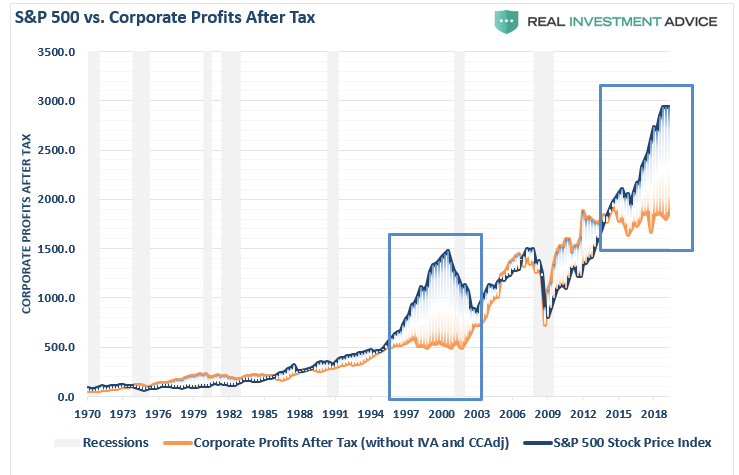
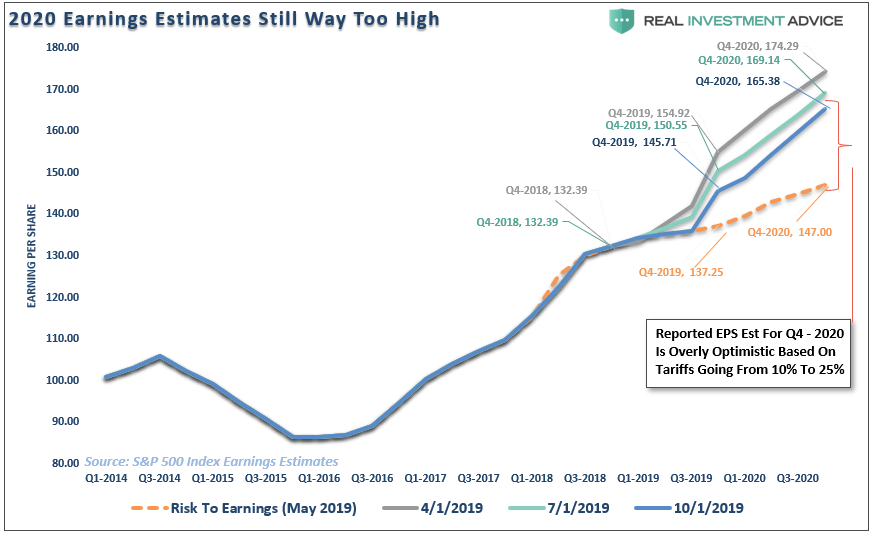
The Disconnect Between Equities And Macro Grows Wider
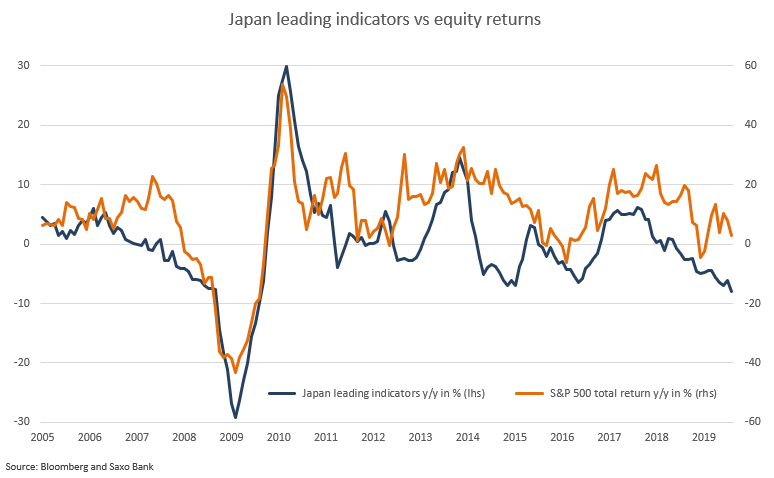


IMF WEO: The International Monetary Fund made a fifth-straight cut to its 2019 global growth forecast, citing a broad deceleration across the world’s largest economies as trade tensions undermine the expansion.


Contrarian Thoughts

Mark Carney also told the Guardian it was possible that the global transition needed to tackle the climate crisis could result in an abrupt financial collapse. He said the longer action to reverse emissions was delayed, the more the risk of collapse would grow.

Here’s the basic proposition of capitalism: if something can be done for a profit, then it creates more value than the sum its of inputs. But here’s the thing: that’s an unproven assertion. In fact, in many cases, it is not true. Worse, over the not very long run (a couple hundred years) it is almost certainly false.

The Tyranny of Economists. How can they be so wrong, so often, and yet still exert so much influence on government policy?

Thursday, April 28, 2011

qe

QE: the slogan masquerading as serious policy. Marshall Auerback.
The U.S. Federal Reserve signaled the end of its controversial $600 billion bond-buying program as planned. And not a moment too soon. This was probably the most over-hyped event since the launching of the Titanic. Frankly, I’m not surprised by the lack of impact of QE2. I’ve always regarded it as a slogan, rather than a policy, and contended that its effects were oversold and predicated on a fundamental misunderstanding of basic monetary operations. The Fed introduced a program whose central thesis was that the unprecedented central bank intervention would reboot bank lending. Yet three years later, total bank loans are lower than they were before the Fed undertook quantitative easing.


The inability of monetary policy initiatives to do anything more than stabilize a very shaky financial system was always clear from the outset, if only policy makers truly understood what the problem was. There wasn’t a shortage of credit nor were interest rates punitive with respect to intended borrowing. People just didn’t want to borrow because the economy was collapsing and they were carrying too much debt.

As Stephen Randy Waldman has noted, the mainstream belief that quantitative easing would stimulate the economy sufficiently to put a brake on the downward spiral of lost production and increasing unemployment was nonsensical and based on a completely wrongheaded understanding of basic monetary/banking operations. He quotes from Winterspeak:

People believe that fractional reserve banking, in some weird way, has banks taking deposits, multiplying it (through what seems like a strange and fraudulent process), and then making a larger quantity of loans. In fact, banks make whatever loans they think make sense from a credit perspective, and then borrow the money they need from the interbank market to meet their reserve requirements. If the banking sector as a whole is net short of deposits, it can borrow the extra money it needs from the Fed. If you think this is a weird and pointless regulation you are correct. Canada, for example, has no reserve requirements and yet seems to have a banking sector. The quantity banks can loan out is constrained by capital requirements and credit assessments.

Reserves, then, are like a bank’s checking account at the Fed. A bank can lend those reserves only to another institution that is allowed to hold reserves at the Fed. Banks do lend reserves to one another in the fed funds market, but since banks already have more than a trillion dollars in excess reserves, there is no need to give them more in order to encourage them to lend to one another.

Those who point to the success of QE2 make the following observations: In the US, growth accelerated after the implementation of QE2 from a 1.7% annualized pace in the second quarter to 2.6% in the third quarter and 3.1% in the fourth quarter. Inflation expectations ceased falling and began rising back to normal levels. Confidence rose. And the pace of hiring improved meaningfully. In both February and March, private firms added over 200,000 jobs. Since the Fed’s policy began, the unemployment rate has fallen a full percentage point.

But just because a rooster crows first thing in the morning doesn’t prove that this is what causes the sun to rise. These are two separate occurrences with no underlying causation. The very deficits now decried so loudly by the deficit hawks and ratings agencies are likely what engendered recovery, not QE2.

So what has QE2 actually achieved? Little in the way of positive impact, but much in terms of its deleterious impact by fomenting additional speculative activity, notably in the commodities complex — gas and food prices. Obviously, with other determinants of aggregate demand in question, commodity prices and the gasoline price in particular now matter. The price of gasoline is almost as high as it was at its brief peak in May-July 2008. In the past, increases in expenditures on gasoline could be managed by consumers because they had access to credit. That is certainly less true today. Rising fuel prices could tip the economy towards greater weakness. As it now stands, the U.S. economy has been growing around trend (2.7%) and the first quarter was probably below that. Tipping the economy towards weakness would bring growth way below the current optimistic above trend consensus.

Though it cannot be proved, in the minds of many the current wave of speculative and investment demands is tied to the Fed’s emergency measures of ZIRP and QE. Within the Fed itself, a number of inflation hawks have reflected this belief, notably Dallas Fed President Richard Fisher and former Kansas President Tom Hoenig. If so, this inadvertent adverse consequence of QE means that the Fed might be hoisted on its own petard.

In sum, whether one wants to focus on the bank reserves or the deposits created by QE2, it does not increase the “ability” of banks to create loans or the private sector to spend that did not exist before. In both cases, the effect of QE2 is to replace a longer-dated treasury with shorter-term investments within private portfolios, which on balance reduces income received by the private sector. Whether or not that increases spending would depend on whether the private sector wishes to borrow more or to reduce saving out of current income (things they can do anyway with or without QE2). Again, it makes little sense to encourage households and firms to increase debt or to reduce saving within the current context of record private sector debt. But the current prevailing deficit hysteria is, perversely, encouraging precisely that state of affairs.

Ultimately, QE2 screwed savers by robbing them of income through the Fed’s treasury purchases, undermined banks’ earnings by in effect swapping a higher yielding treasury with bank reserves that today yield a mere .25%, and eviscerated the living standards of the middle class by helping to spike the speculative punch bowl in the commodities space. Not a bad trifecta for a Fed Chairman who claims to be doing everything in his power to prevent us from becoming the next Japan but who in fact is hastening our arrival at that very destination.
A pros and cons analysis of QE3. Peter Tchir.
I’m a little concerned that much of what I read and hear tends to view re-investment as a continuation of QE2. I don’t see it that way. Any re-investment of proceeds from a treasury redemption is merely keeping the status quo. No new money is being created nor being pumped into the system, its no different than if the Fed had originally purchased this longer dated bond....


Certainly the argument that ‘it worked’ would be difficult to make, the reality would be that just like so many other programs is that it increased current economic activity at the expense of future economic activity. 

Apparently QE2 is "disappointing". Cullen Roche.

Wednesday, March 30, 2011

March 30

QOTD:
Won't it be cool if subsequent versions of QE are referenced with Roman numerals like the Super Bowl?
John Roque, WSJ.

The unbelievable truth about Ireland and its banks. BBC.
To prevent Irish banks toppling over one after another, the European Central Bank has lent 117bn euros to them and the Central Bank of Ireland has lent them a further 71bn euros. So that's 188bn euros of loans from the eurozone's taxpayers to Ireland's banks - which makes the 67.5bn euros lent directly by the eurozone and IMF to the Irish government look like peanuts. And a further 20bn euros of bank bonds - another form of bank debt - is still guaranteed by the Irish state through the Eligible Guarantee Scheme. So that is 208bn euros of taxpayer loans to Ireland's banks - equivalent to a remarkable 154% of GDP.
[Irish] Bank bailout cost (so far). Corner Turned.

The 'grand bargain' is just a start. Martin Wolf, FT.
It would be helpful – and honest – for the German government and the governments of other creditor countries to tell their people that they are rescuing their own savings in the guise of rescuing peripheral countries. The alternative is to write off loans and recapitalise their banks directly. To admit this would be to admit their policies have been at fault. That would surely be helpful.
Europe needs debt relief, not decades of austerity. The Guardian.
From Donegal to the Algarve, to the streets of Athens, voters on Europe's "periphery", as economists dismissively call it, are slowly waking up to a sobering truth – they face years of austerity, yet wage cuts, job losses and crumbling public services will not extricate them from financial crisis. In fact, by driving their economies into an ever deeper slump, it may even make things worse. The pain could just bring more pain....
Markets and voters across the eurozone have grown wearily accustomed to watching the cycle of a looming fiscal crisis as bond yields rocket, followed by just enough action from Brussels to jolt investors out of panic mode, followed by another bout of the jitters as they realise the rhetoric from euro leaders isn't matched by reality.

As Steen Jakobsen, chief economist at Saxo Bank, put it in a note on Friday: "It's clear that the electorates are beginning to realise that all solutions offered by the policymakers are based on the promise to do something in the future, and never right here, right now."

But time is running out, and Europe has two choices. It can continue hammering the economies of Greece, Ireland and soon Portugal deeper into crisis, while their already furious voters become increasingly resentful about the pain being imposed by their European "partners"; or it can accept that the scale of debts has simply become unsustainable, and open negotiations now about an orderly default.
As Obama and Congress fiddle, America liquidates housing sector. Chris Whalen.

the current national policy mix of more regulation, decreased government subsidies and, to add further urgency, a shrinking banking system, is the perfect storm for the housing, which is now down six months in a row. Despite my long-held desire to see market-based reform in the US housing sector, I think all parties need to be aware of the precarious situation facing the American economy and banks as home prices collapse for lack of credit....
The net, net here is that the available pool of credit available for the housing sector is shrinking and thus prices must also decline to adjust for that supply of credit. This fact of continued decline in home prices is going to have a chilling effect...
I estimate that Fannie and Freddie alone are hiding $200 billion worth of bad loans on their books simply because there is no market for these foreclosed homes. Ditto for the largest servicer banks such as Wells Fargo, Bank of America, JPMorgan Chase and Citigroup. To clean up this mess with finality is going to cost $1 trillion or so in round numbers. But nobody in Washington wants to go there.
Where the bailout went wrong. Neil Barofsky, NY Times Op-Ed.
As per James Kwak:
Back in late 2008 and early 2009, there was a lot of talk about how a true solution for the problems of the banking system would require a solution for the problems of homeowners, since the banks’ losses were largely the result of mortgage defaults. One of the major technical achievements of the administration was showing that it was possible to stabilize the financial system and restore the banks to short-term profitability without doing much for homeowners.
The Federal Open Mouth Committee is back in action. Pater Tenebrarum.
Hawks (relatively speaking) and doves within the Fed are busy trading slightly contradictory statements in public again, in a performance that is eerily reminiscent of the 'exit talk' (exit from unusual monetary accommodation measures that is) that proliferated about one year ago.....

led to this campaign of advance burying of 'QE3' by means of 'QE2' funeral eulogies. Surely 'QE3' won't be talked about so much anymore if even 'QE2' comes under official scrutiny. Since the current QE program is slated to end in June, market participants are given fair warning not to expect more 'coups de whiskey' for the stock and commodity markets immediately thereafter. This in turn means that the times are set to become slightly more interesting. Given that there is not the slightest evidence yet that private sector deleveraging has run its course, a cessation of excessive monetary pumping may end up stopping various bubble activities in their track in very short order. This is to say, both financial markets as well as the economy may slump again fairly quickly....

Helicopter pilot Ben Bernanke has been rather quiet, letting the rest of the board spread the message. Alas, we suspect he's personally still firmly in the pro easy money camp. At least this is what we would have to conclude considering his well known views on the Great Depression as well as Japan's post bubble era. His usual refrain was that policy makers were 'too timid' in these instances, but as it were, the BoJ is a veteran of two (now 2.5) QE programs as well, so if one wants to be 'less timid', then 'QE1' and 'QE2' alone obviously won't cut it. In that sense we would be inclined to discount the advance funeral rites for 'QE3' as just more hot air. Nevertheless, there will be a pause, and should the economy's momentum not falter again immediately, then we'd expect the 'exit' palaver to increase in both volume and frequency.

Surpluses, debt and depressions.... Randall Wray via Pragmatic Capitalism.

China's 5-year plan and global interest rates. Martin Feldstein.

Visualizing the food and energy crunch. Pragmatic Capitalism.

Debt: The first five thousand years. David Graeber.

The biggest urban legend in finance. Rob Arnott.

Fannie and Freddie hiding over $100 billion of losses? naked capitalism.


other fare:
Exceptional And Unexceptional America. Andrew Sullivan, The Atlantic.

Monday, March 21, 2011

March 21

QOTD:

"The President does not have power under the Constitution to unilaterally authorize a military attack in a situation that does not involve stopping an actual or imminent threat to the nation."
Barack Obama
uhhmm, I guess that was then and this is now:

The Libyan War of 2011. George Friedman, Stratfor.

Yemen in crisis. Stratfor.

What's happening in Bahrain explained. Mother Jones.

Iran calls on Saudi Arabia, UAE to leave Bahrain "immediately"


Japan's financial position is better than you think. Prag Cap.

QEII fails - sell US equities. Russell Napier, CLSA.


Friday, March 11, 2011

March 11

How QE works. Ed Harrison.

QE and the term structure of rates. Warren Mosler.
summary: if the market thinks QE will work, then the economy will heat up over time and inflationary pressure will build so the Fed will need to hike rates, and the term structure of rates reflects more Fed hikes down the road; if the Fed ends QE, the market place will deem that as the Fed removing support from the economy, and this less stimulative policy will mean a relatively weaker economy and less inflationary pressure so fewer future interest rates hike --- and the curve will respond appropriately