Pages

Showing posts with label Pettis. Show all posts

Sunday, November 24, 2019

2019-11-25 Charts and Links

Global Debt To Hit All Time High $255 Trillion, 330% Of World GDP.
Bank of America's Michael Hartnett on Friday calculated that since the collapse of Lehman, government debt has increased by $30tn, corporates debt by $25tn, household by $9tn, and financial debt by $2tn; And with central banks expected to support government debt, BofA warns that "the biggest recession risk is disorderly rise in credit spreads & corporate deleveraging."

Is There a Threat of a New Global Economic Crisis?
The unprecedented debt load of major economies, like the United States, China and the EU is fraught with a disastrous threat for the entire world. This could lead to a disaster that will by far exceed the Great Depression if deleverage starts, Valdai Club expert Alexander Losev warns. … despite the unprecedented growth of world debt in the past ten years after the 2008 crisis, investment activity in the real economy is declining, growth in the world economy and international trade is slowing and the risk of a global recession is on the rise. The accumulated aggregate debt is becoming a real threat to the stability of the global financial system.

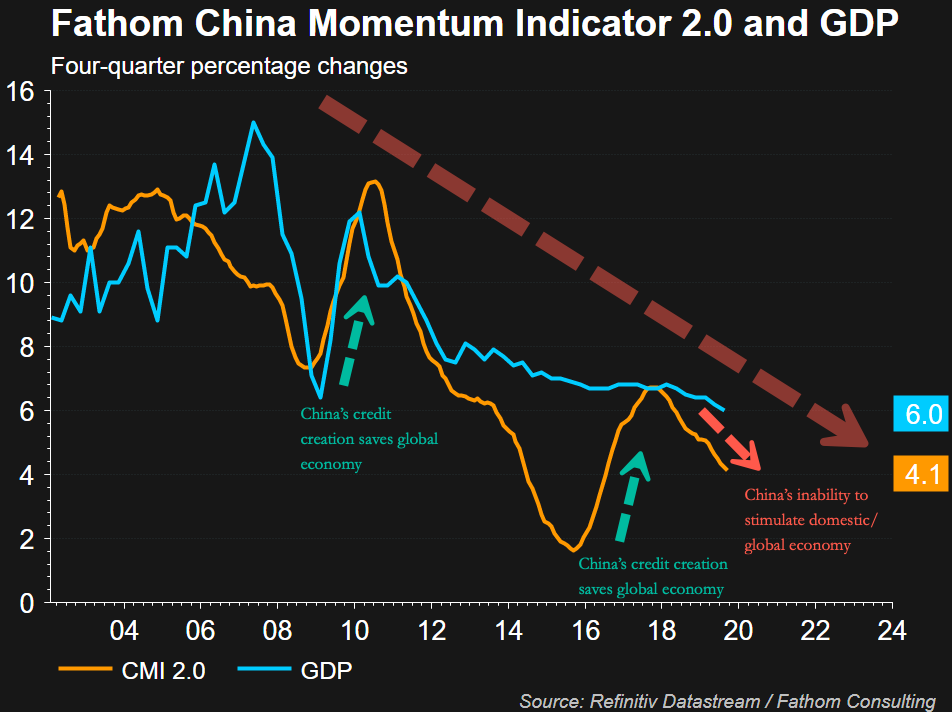
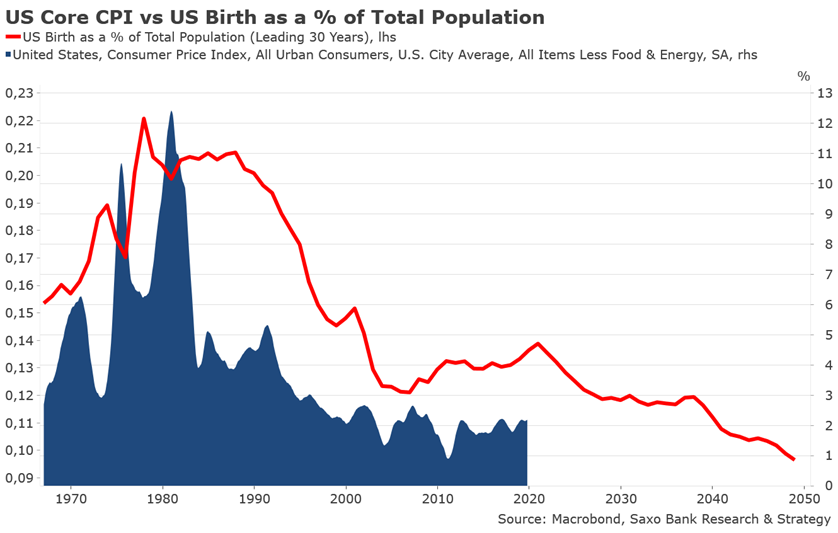
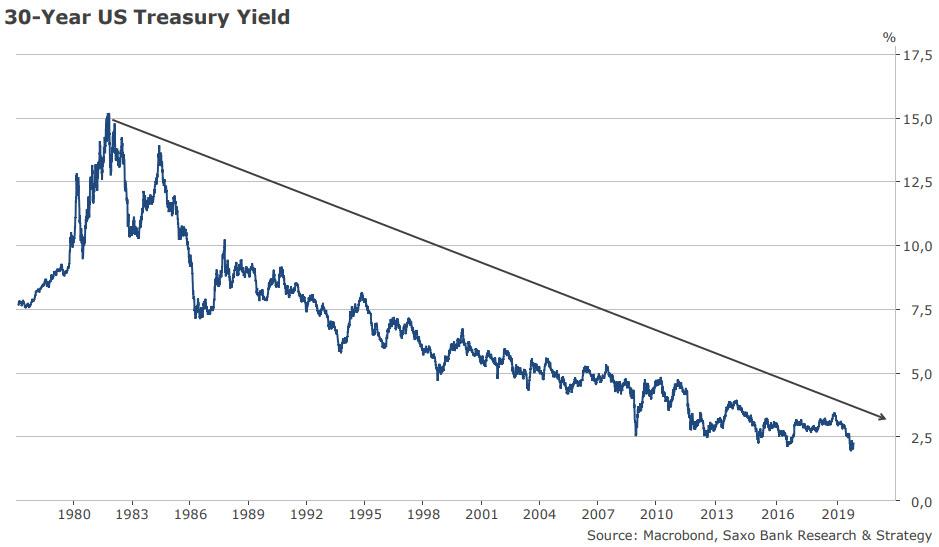
Here's The Simple Reason Why A Global Economic Recovery Is Not Coming.
But has the global economy indeed troughed, and is a period of smooth sailing ahead? The answer will depend, as it traditionally has in the past decade, on whether China will stimulate both its own, and the global economy to the point where it successfully triggers a global inflationary shockwave around the globe. Unfortunately, the answer for now appears to be a resounding no, and not just as a result of the latest leading economic indicators out of China which missed across the board, confirming that Beijing is bracing for the first ever sub-6% GDP print. As Saxo Bank's Christopher Dembik writes, there is another reason why China will not open massively the credit tap anytime soon. But before we get into his argument, as a reminder, the latest Chinese credit data was a disaster, with the revised Aggregate Financing data series printing at its lowest level on record as we discussed in "China's Credit Creation Unexpectedly Collapses At The Worst Possible Time."
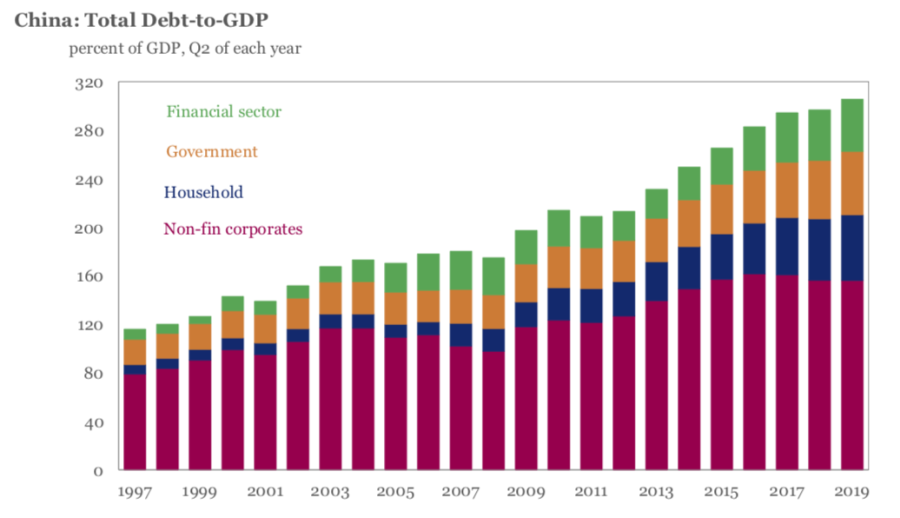

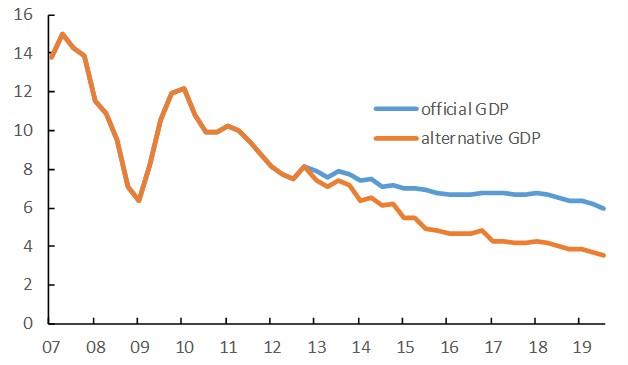
Why China's Growth Rate Is Much, Much Lower Than You Think

Here Are Goldman's Top Trades And Themes For 2020.
Wage growth is picking up… from repressed levels back to normal


Seeing as I brought up the topic of the (misleading) savings rate recently:
Why The Measure Of “Savings” Is Entirely Wrong.
The reality is the measure of “personal savings,” as calculated by the Bureau of Economic Analysis, is grossly inaccurate. However, to know why such is the case, we need to understand how the savings rate is calculated….
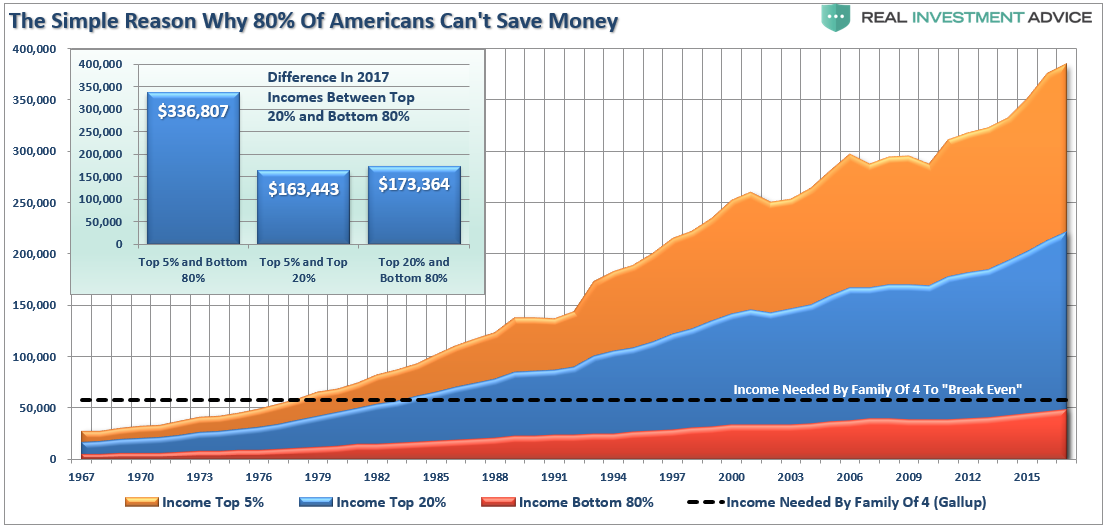
The differential between incomes and the actual “cost of living” is quite substantial. As Researchers at Purdue University found, in the U.S., $132,000 was found to be the optimal income for “feeling” happy for raising a family of four. A Gallup survey found it required $58,000 to support a family of four in the U.S. (Forget about being happy, we are talking about “just getting by.”)
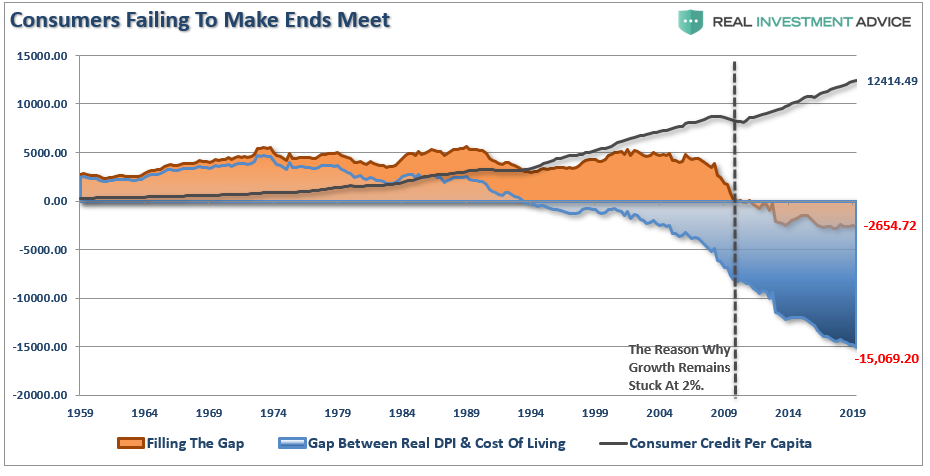
The “gap” between the “standard of living” and real disposable incomes is shown below. Beginning in 1990, incomes alone were no longer able to meet the standard of living so consumers turned to debt to fill the “gap.” However, following the “financial crisis,” even the combined levels of income and debt no longer fill the gap. Currently, there is almost a $2654 annual deficit that cannot be filled.
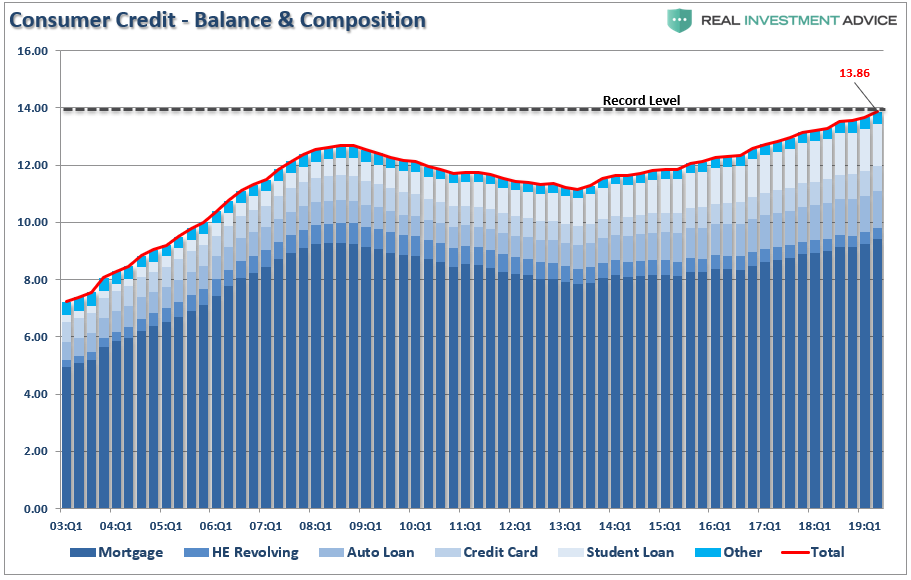
That gap explains why consumer debt is at historic highs and growing each year. If individuals were saving 8% of their money every year (as per the phony US personal savings rate), debt balances would at least be flat, if not declining, as they are paid off.


Consumers Are Keeping The US Out Of Recession? Don’t Count On It.

Fed's "National Activity Index" Plunges To 2-Year Low.


(Not just) for the ESG crowd:

Brookfield markets new green bond in Canada, sets sights on Brazil and India.

Climate-proofing Canada’s economy.
There is no denying that climate change is now a mainstream issue, as evidenced by vigorous debates in the recent federal election. While governments are struggling to come up with public-policy responses, global investors and financial institutions are not standing around. The investment world is already shaping markets in response to the effects of climate change.

Lewis Lapham in Lapham’s Quarterly: Paying the Piper.
The warming of the planet currently spread across seven continents, four oceans, and twenty-four time zones is the product of a fossil-fueled capitalist economy that over the past two hundred years has stuffed the world with riches beyond the wit of man to marvel at or measure. The wealth of nations comes at a steep price—typhoons in the Philippine Sea, Category 5 hurricanes in the Caribbean, massive flooding in Kansas and Uttar Pradesh, forests disappearing in Sumatra and Brazil, unbearable heat in Paris, uncontrollable wildfires in California, unbreathable air in Mexico City and Beijing.

The capitalist dynamic is both cause of our prosperous good fortune and means of our probable destruction, the damage in large part the work of Adam Smith’s invisible hand, guided by the belief that money buys the future. Nature doesn’t take checks. Who then pays the piper—does capitalism survive climate change, or does a changed climate put an end to capitalism? The question informs this issue of Lapham’s Quarterly…

Steve Keen: ‘4°C of global warming is optimal’ – even Nobel Prize winners are getting things catastrophically wrong.
William Nordhaus was awarded the 2018 Nobel Prize in Economics for “integrating climate change into long-run macroeconomic analysis”. This implies that he worked out what global heating means for our economy, given what climate scientists say will happen to our planet. But Nordhaus’s predictions of what global heating will cost the earth are dangerously at odds with the science. In his Nobel Prize lecture, Nordhaus described a 4°C increase in global average temperature as “optimal” — that is, the point at which the costs and benefits of mitigating climate change are balanced. In a subsequent academic paper based on this lecture, he stated that “damages are estimated to be 2 percent of output at a 3°C global warming and 8 percent of output with 6°C warming”. This is a trivial level of damage, equivalent for the 6°C warming case to a fall in the rate of economic growth over the next century of less than 0.1% per year. …. The average global temperature during the last Ice Age was 4°C cooler than today. There’s no way we can accurately predict what GDP would be in such a cool world today, but we know that most of Europe north of Berlin, and of America north of New York, would be under a kilometre of ice. To argue that this would cut GDP by just 3.6% is simply absurd.

Climate Change Is Coming for Global Trade. As sea levels rise and storms become fiercer, container shipping could be in for major disruptions

Ford’s Mustang Mach-E is an electric SUV with up to 300 miles of range. (Starting at US$43,895 and coming in late 2020)


Geopolitics

Ian Bremmer: The End of the American International Order: What Comes Next?
This is the text of a speech delivered by Bremmer on November 18 at the 2019 GZERO Summit in Tokyo.

Bound to Fail: The Rise and Fall of the Liberal International Order. Journal of International Security.
The liberal international order, erected after the Cold War, was crumbling by 2019. It was flawed from the start and thus destined to fail. The spread of liberal democracy around the globe—essential for building that order—faced strong resistance because of nationalism, which emphasizes self-determination. Some targeted states also resisted U.S. efforts to promote liberal democracy for security-related reasons. Additionally, problems arose because a liberal order calls for states to delegate substantial decision-making authority to international institutions and to allow refugees and immigrants to move easily across borders. Modern nation-states privilege sovereignty and national identity, however, which guarantees trouble when institutions become powerful and borders porous. Furthermore, the hyperglobalization that is integral to the liberal order creates economic problems among the lower and middle classes within the liberal democracies, fueling a backlash against that order. Finally, the liberal order accelerated China’s rise, which helped transform the system from unipolar to multipolar. A liberal international order is possible only in unipolarity. The new multipolar world will feature three realist orders: a thin international order that facilitates cooperation, and two bounded orders—one dominated by China, the other by the United States—poised for waging security competition between them.


Other Fare:

Blockbuster WSJ Investigation: How Google Interferes With Its Search Algorithms and Changes Your Results.


Book Review:

David Graeber: Against Economics – reviews Robert Skidelsky’s Money and Government: The Past and Future of Economics.
There is a growing feeling, among those who have the responsibility of managing large economies, that the discipline of economics is no longer fit for purpose. It is beginning to look like a science designed to solve problems that no longer exist. A good example is the obsession with inflation. Economists still teach their students that the primary economic role of government—many would insist, its only really proper economic role—is to guarantee price stability. We must be constantly vigilant over the dangers of inflation. For governments to simply print money is therefore inherently sinful. If, however, inflation is kept at bay through the coordinated action of government and central bankers, the market should find its “natural rate of unemployment,” and investors, taking advantage of clear price signals, should be able to ensure healthy growth. These assumptions came with the monetarism of the 1980s, the idea that government should restrict itself to managing the money supply, and by the 1990s had come to be accepted as such elementary common sense that pretty much all political debate had to set out from a ritual acknowledgment of the perils of government spending. This continues to be the case, despite the fact that, since the 2008 recession, central banks have been printing money frantically in an attempt to create inflation and compel the rich to do something useful with their money, and have been largely unsuccessful in both endeavors. 
We now live in a different economic universe than we did before the crash. Falling unemployment no longer drives up wages. Printing money does not cause inflation. Yet the language of public debate, and the wisdom conveyed in economic textbooks, remain almost entirely unchanged.

One expects a certain institutional lag. Mainstream economists nowadays might not be particularly good at predicting financial crashes, facilitating general prosperity, or coming up with models for preventing climate change, but when it comes to establishing themselves in positions of intellectual authority, unaffected by such failings, their success is unparalleled. One would have to look at the history of religions to find anything like it. To this day, economics continues to be taught not as a story of arguments—not, like any other social science, as a welter of often warring theoretical perspectives—but rather as something more like physics, the gradual realization of universal, unimpeachable mathematical truths. “Heterodox” theories of economics do, of course, exist, but their exponents have been almost completely locked out of what are considered “serious” departments, and even outright rebellions by economics students (from the post-autistic economics movement in France to post-crash economics in Britain) have largely failed to force them into the core curriculum.

As a result, heterodox economists continue to be treated as just a step or two away from crackpots, despite the fact that they often have a much better record of predicting real-world economic events. What’s more, the basic psychological assumptions on which mainstream (neoclassical) economics is based—though they have long since been disproved by actual psychologists—have colonized the academy, and have had a profound impact on popular understandings of the world.

Nowhere is this divide between public debate and economic reality more dramatic than in Britain, which is perhaps why it appears to be the first country where something is beginning to crack. It was center-left New Labour that presided over the pre-crash bubble, and voters’ throw-the-bastards-out reaction brought a series of Conservative governments that soon discovered that a rhetoric of austerity—the Churchillian evocation of common sacrifice for the public good—played well with the British public, allowing them to win broad popular acceptance for policies designed to pare down what little remained of the British welfare state and redistribute resources upward, toward the rich. “There is no magic money tree,” as Theresa May put it during the snap election of 2017—virtually the only memorable line from one of the most lackluster campaigns in British history. The phrase has been repeated endlessly in the media, whenever someone asks why the UK is the only country in Western Europe that charges university tuition, or whether it is really necessary to have quite so many people sleeping on the streets.

The truly extraordinary thing about May’s phrase is that it isn’t true. There are plenty of magic money trees in Britain, as there are in any developed economy. They are called “banks.” Since modern money is simply credit, banks can and do create money literally out of nothing, simply by making loans. Almost all of the money circulating in Britain at the moment is bank-created in this way. Not only is the public largely unaware of this, but a recent survey by the British research group Positive Money discovered that an astounding 85 percent of members of Parliament had no idea where money really came from (most appeared to be under the impression that it was produced by the Royal Mint).


Quotes of the Week:

Rubino: “Every sector of the U.S. economy is so over indebted I don’t see how we go on much longer. The Fed is desperately trying to prolong this thing. We’re running trillion dollar deficits now, and what that is for is to keep the system from falling apart. We are 11 years into an expansion, a record. This is the longest bull market in history, and this is the longest economic expansion in history… These guys don’t know exactly what’s going to happen in the next recession, but they are afraid that the system is so highly leveraged that even a garden-variety three quarters of a percent of negative growth and a garden variety of 20 % drop in stock prices might be fatal. The system might not be able to handle that because it would cause so much damage and there are so many different places that can blow up that the system would spin out of control. We would get 2008-09 again but on steroids because the numbers are so much bigger this time around. So, they want to avoid that at all costs.”


US AG William Barr: “in waging a scorched earth, no-holds-barred war of ‘Resistance’ against this Administration, it is the Left that is engaged in the systematic shredding of norms and the undermining of the rule of law.”

… much more on Adam Schiff’s and the Democrats’ Orwellian “campaign to blow smoke up America’s ass for three years running” by JHK here, and more on our Pravda-like B.S. media’s inane coverage or our insane world by Johnstone here, in which politicians and the media “use a light sprinkling of fact to weave a narrative that has very little to do with reality”


Photo of the Week:
Hope we don’t have any “Black Swans” coming, because they are fierce-looking!


Totally Unrelated – Catchy Headlines; just checking if you’re reading these:

Pointless work meetings 'really a form of therapy'.

Cops put GPS tracker on man’s car, charge him with theft for removing it.

They Can't Stop Us:' People Are Having Sex With 3D Avatars of Their Exes and Celebrities.

Tuesday, January 25, 2011

January 24

Do we really have a balance sheet recession? David Beckworth.

The age of de-leveraging. Jason Leach.

How I learnt to stop worrying and love The Bank. Steve Keen.

How will they prop up stocks after QE? An answer? Bruce Krasting.

The Fed can’t go bankrupt. Anymore. FT Alphaville.

More evidence of undercapitalization/insolvency of major banks. Yves Smith.

National debt = great recession 2.0. Dian Chu.

Spain's bank nationalization and the euro zone crisis. Ed Harrison.

The real cost of Chinese NPLs. Michael Pettis.

China vs. inflation: a love-30 match so far. Dian Chu.
Beijing most likely will come to grip very soon that eventually somebody got to pay somewhere, and there’s just no way around it, and that the time has come for some decisive actions with a combination of more aggressive monetary, fiscal and regulatory measures to show it really means business.

For example, instead of the symbolic two 25-bps interest rate hikes in Oct. and Dec., Beijing probably will do an immediate 50-bps rate hike by early February and another 50 bps in early March to blunt the start of the typical yearly run-up of crude oil, and other commodities. Then, depending on the market reaction and new economic data, more hikes could be implemented later on in the year. Fiscal policies such as taxes, and financial regulations and restrictions on speculative activities could be necessary.

Meanwhile, the expectation of a Yuan appreciation is keeping liquidity swimming. So, perhaps China would do just the opposite, as suggested by Andy Xie, a currency depreciation, which would lead to a capital outflow forcing interest rates up. There [are]many more things that China has to do to get the inflation situation under control, which most likely will send shock waves throughout global markets.

Social Unrest Could Make or Break A Party: Nmbers may be rigged or "smoothed out", but can't fool the regular Chinese Joe's and the smart money.

China's runaway chariot. Charles Smith.

SocGen crafts strategy for China hard-landing. Ambrose Evans-Pritchard.

Record Food Prices Causing Africa Riots Stoking U.S. Farm Economy. Bloomberg.

Inflation: not here, not now. John Taylor.


other fare:
of amusement: Gartman investment SAT score 410.

Wednesday, January 12, 2011

January 12

"Illusory Prosperity" - Ludwig von Mises on Monetary Policy. John Hussman.


Hussman: The Anti-Tepper Makes an Apology (kind of). The Reformed Broker.
The manager's January 10th commentary reads as part admission of wrongheadedness, part bitter cartoon villain fist-shaking (you'll see!) and part doubling down on his bear case thesis. He admits that it's his job to generate returns in all environments but then pulls the fiduciary card to excuse his excess caution. Oh yeah, he also basically calls us all idiots. I guess we'll have to make do with only our profits as consolation for the insult.
Bearish John Hussman Is Sounding Like Someone Desperate To Keep His Clients. Clusterstock.


The market is a heartless beast. Pragmatic Capitalism.
The equity market is priced based on future profit expectations that are often right, but more often than not prove to be wrong. As we saw in 2007 those expectations were high, investors believed economic downturn would be thwarted and the environment ultimately surprised substantially to the downside. As the waterfall decline ensued we experienced the inverse reaction in 2009. Markets and expectations overshot to the downside. Expectations for profit growth became far too low and classic mean reversion ensued. As the economy stabilized in 2009 the economy remained stagnant at best. But the economy’s loss had become corporate America’s gain. The massive cost cuts made these corporations lean and mean. Corporate America’s diverse revenue stream kicked in as the global economy strengthened and leveraged up these lean balance sheets. Despite persistent weakness in the US economy profits continued to rebound through 2009 & 2010 even as US unemployment continued to climb. That heartless bitch did not care about the unemployed, stagnant wages or l-shaped recoveries. She cared only for the bottom line and the bottom line was robust – particularly when compared to expectations....

If I have made one mistake in recent years it has been focusing on what should be good for an economy (job growth, fair markets, organic growth, etc) as opposed to what the market desires (higher profits no matter how they come).... Ultimately, the purpose of research is to generate investment profits.  Connecting the dots between this research and actionable ideas is vital to success.  If you allow the emotion of a macro outlook to infect your work your results will suffer.   Remember, the market is not the economy.

Which country prints more and runs bigger government deficits: Canada or the US? Rebecca Wilder at Angry Bear.

Is inflation about to burst the Chinese bubble? naked capitalism.

China's lending quota? Michael Pettis.
would I have taken seriously a quota on new lending? Not really. It seems to me that if Beijing wants GDP growth in 2011 to come in at the expected 9%, the amount of new investment in China – which is determined in large part by the banking system – is really not something they can decide today. It is going to be whatever it needs to be given developments in household consumption growth and the trade surplus.


This is why I argued a few weeks ago that at whatever level the new loan quota was set, I was not going to think of it as constraining new lending in any way. Either the loan quota would be adjusted (upwards, almost inevitably) or more new lending would occur outside the banks’ balance sheets, as it did in 2009 and 2010.

Investment this year I suspect is going to be extremely high, as high as in 2009 and 2010, because it is only with very high levels of investment that we are likely to manage GDP growth rates high enough to keep Beijing happy. So my guess is that 2011 will be yet another year in this increasingly strained investment-driven party. Chinese GDP growth will continue to be the envy of the world, while those of us who worry about the sustainability and quality of the growth will worry more than ever.
Economic forecasting delusions. FT Alphaville.

So economists who tend to predict near the consensus are, by definition, unlikely to anticipate extreme events, while those who correctly predict the occasional Black Swan tend to get everything else wrong... Generally we agree with the standard defence that it’s not the forecast part of forecasts that matters, but rather their underlying information and logical coherence. And indeed, sometimes these are extremely helpful regardless of the outcome.

Wednesday, December 1, 2010

December 1

QOTD:

Politics is the art of looking for trouble, finding it everywhere, diagnosing it incorrectly and applying the wrong remedies. Groucho Marx.

Edward Harrison summarizes Bill Gross' latest, and offers some of his own views, including:

There are four ways to reduce real debt burdens:
  • by paying down debts via accumulated savings.
  • by inflating away the value of money.
  • by reneging in part or full on the promise to repay by defaulting
  • by reneging in part on the promise to repay through debt forgiveness
Right now, everyone is fixated on the first path to reducing (both public and private sector) debt. I do not believe this private sector balance sheet recession can be successfully tackled via collective public sector deficit spending balanced by a private sector deleveraging. The sovereign debt crisis in Greece tells you that. More likely, the western world’s collective public sectors will attempt to pull this off. But, at some point debt revulsion will force a public sector deleveraging as well.

And unfortunately, a collective debt reduction across a wide swathe of countries cannot occur indefinitely under smooth glide-path scenarios. This is an outcome which lowers incomes, which lowers GDP, which lowers the ability to repay. We will have a sovereign debt crisis. The weakest debtors will default and haircuts will be taken. The question still up for debate is regarding systemic risk, contagion, and economic nationalism because when the first large sovereign default occurs, that’s when systemic risk will re-emerge globally.
Ireland's reparation burdens. Barry Eichengreen.
The Irish “rescue package” finalized over the weekend is a disaster. You can say one thing for the European Commission, the ECB and the German government: they never miss an opportunity to make things worse.
The rough politics of European adjustment. Michael Pettis.
I have no doubt that enormous amounts of scotch tape, paper clips, and chewing gum are going to be deployed quickly to hold the whole thing together, and that perhaps in a week or two we will be all throwing sighs of relief as policymakers firmly announce that Europe was put to the ultimate test and proved itself manfully. But does that mean we can stop worrying – was this really the ultimate test? No, of course not. If previous history is any guide, this crisis will re-emerge in different places every few months until it is truly resolved...

Unfortunately it is going to require a lot more than emergency liquidity loans, no matter how plentiful, to arrive at a final resolution. These loans simply paper over the financing gap until the next big refinancing exercise, and each new loan effectively shortens the duration of the debt or claims a higher level of seniority, so that the capital structure becomes increasingly risky. As the capital structure becomes riskier, it takes a smaller and smaller event to set off the next crisis.
Hangover theory and morality plays. Steve Waldman. 
Austrian-ish “hangover theory” claims, plausibly, that if for some reason the economy has been geared to production that was feasible and highly valued in previous periods, but which now is no longer feasible or highly valued, there will be a slump in production.... There is no school of economic thought I know of that suggests increased prosperity and consumption in and of themselves require a painful purge. The claim is that some patterns of economic activity create the appearance of prosperity and enable temporary consumption that cannot be sustained, and that moving from a period during which such patterns obtain to a more “sustainable pattern of specialization and trade” involves adjustments that are difficult.... 
It is not technocratic economists who will win the day and pull us out of our cul-de-sac, but angry Irishmen and Spaniards who challenge, on moral terms, the right of German bankers to impose vast deadweight costs on current activity because they lent greedily into what might easily have been recognized as a property and credit bubble.
European Leaders Should Focus on the Banks, Not the Sovereigns. Peter Atwater.
The market is saying “when” not “if” any more. To stop the spreading contagion, European leaders need to stop focusing on the sovereigns and start focusing on the banks. As we have already seen, troubled sovereign nations can be kept alive for an extended period of time, but banks can’t. But rather than growing sovereign double leverage even further -- in which a troubled nation, like Ireland, borrows from the EU to put equity capital into its banks -- if the EU is serious about stopping the growing banking contagion, it is going to have to consider its own pan-European TARP/FDIC program for Europe’s largest banks. And whether Europe has the stomach for that we’ll soon find out. But until Europe divorces banking strength from sovereign strength, they will both go down together.
Much ink has been spilled in the press over the Irish problem and the laxity of the country’s southern Mediterranean counterparts in contrast to the highly “disciplined” Germans. But perhaps we have to revisit that caricature. Not only has the Irish crisis blown apart the myth of the virtues of fiscal austerity during rapidly declining economic activity, but it has also illustrated that Germany’s bankers were every bit as culpable as their Irish counterparts in helping to stoke the credit bubble.....
All of the rescue plans that have been introduced in Ireland or Greece thus far rest on the assumption that, with more time, the eurozone’s problem children could get their fiscal houses in order — and Europe could somehow grow its way out of trouble. But the fiscal austerity being offered as the “medicine” is turning out to be worse than the disease. It has exacerbated the downturn and unleashed a horrible debt deflation dynamic in all of the areas where it was reluctantly implemented.
“Despite the recent drama, we believe we have only seen the opening act, with the rest of the plot still evolving,” Buiter wrote. “Accessing external sources of funds will not mark the end of Ireland’s troubles. The reason is that, in our view, the consolidated Irish sovereign and Irish domestic financial system is de facto insolvent.”
Why the Irish crisis is such a huge test for the eurozone. Martin Wolf, FT.

So what, against this background, needs to be done by individual countries and the eurozone? Not what was done in Ireland, is one answer. The Irish banking system is worse than too big to fail; it is too big to save. The first duty of the state is to save itself, not to load its taxpayers with obligations to rescue careless lenders. If the eurozone is not a “transfer union”, that has to work both ways: taxpayers of one state should not rescue those of others from having to save their banks from their follies.
The Irish state should have saved itself by drastic restructuring of bank liabilities. Bank debt simply cannot be public debt. If bank debt is to be such debt, bankers should be viewed as civil servants and banks as government departments. Surely, creditors must take the hit, instead.
That leaves the sovereigns. What is needed here, as eurozone leaders recognise, is a combination of generous funding with restructuring: the former is to reverse self-fulfilling panics; the latter is to recognise the realities of insolvency. Managing this combination would be very tricky.
Endgame. Eurointelligence.

The EU’s credibility is sinking with each agreement. We are now fast approach default time... We at Eurointelligence consider a default of Greece, Ireland, and Portugal a done deal. The question is only now whether Spain can scrape through.
Can the eurozone afford its banks? Robert Peston, BBC.
For Europe's very biggest banks, the ratio of their assets to their equity capital is 50% greater than for the UK's banks and 100% in excess of the so-called leverage ratio of big US banks, according to Bank of England calculations. Or to put it another way, Europe's giant banks appear to be taking far bigger financial risks than US and UK banks in relation to the reserves they retain as protection against potential losses.

So here's the big question. O'Neill may well be right that a reformed, integrated eurozone could cope with the aggregated sovereign debts of its members. But it is altogether another question whether even Germany could afford to underwrite the liabilities of the eurozone's monster banks, if creditors started to seriously question whether those banks have sufficient capital.
If Ireland doesn't take the bailout. Gonzalo Lira.

the problem in Ireland really isn’t so much the state’s deficits—rather, it’s the state’s guarantees of the Irish banks. That is what led to this mess. Yes, the Irish public sector is bloated, but it’s the banks that are busting the fiscal budget.

The Irish government allowed the banks to grow too big for too long, and to get mixed up in too many dicey deals—and so when the crisis hit in 2008, instead of letting them fail, Brian Cowen and his Fiana Fáil government backstopped those banks.

Much like in the United States in 2008, the Irish confused an insolvency issue with a liquidity issue. They thought their banks were having a cash crunch, when really, they were broke.

Cowen is reaping what he sowed: Even if the 2008 crisis had been a cash crunch and not an insolvency issue, Cowen never should have backstopped those banks—not when their combined liabilities were twice the GDP of Ireland...

Right now, the Irish people know that they are footing the bill so that British, German and American banks don’t suffer for having been foolish enough to be caught with Irish bank bonds. Rightfully, the Irish people are pissed.

Monday, November 22, 2010

Some thoughts, with references

I share the views of the world of:

Richard Koo, Paul Krugman, Mark Thoma, etc., w.r.t.:
the unique, persistent nature of balance sheet recessions, as distinct from normal cyclical recessions; the need for more government intervention to get unemployment down; the liquidity trap, which causes normal transmission channels of monetary easing, which normally induce housing-led recoveries, to be no better than pushing on a string; and, therefore, the primacy of fiscal policy to fill the gap in aggregate demand in order to achieve the objectives of reducing unemployment and increasing inflation; but, in the absence of sufficient fiscal policy, the necessity for further monetary policy easing, however non-traditional and (in-)effective that may be;

Irving Fisher, Steve Keen, Gary Shilling, Van Hoisington and Lacy Hunt, David Rosenberg, Felix Zulauf, Ray Dalio, Albert Edwards, etc., w.r.t.:
the huge excess of unsustainable debt growth built up over two decades, and the concomitant excessive spending, represented enormous pulling-forward of aggregate demand, which ultimately must be paid for with future savings from income and therefore lower future demand in the same scale as past excess consumption; that that process of debt accumulation appeared to be sustainable not due to income growth but due to the chimera of wealth enhancement due to elusive/temporary asset-price appreciation in the housing market; the credit expansion created excess claims to underlying real wealth; once the asset-price bubble burst, i.e. the Minksy moment, the resultant debt-deflation dynamics, including the paradox of thrift, deleveraging, declining money multipliers and monetary velocity, deflation of broadest measures of effective money supply, which, contrary to the views of many traditional economists, critically includes credit (which dwarves traditional measures of money supply, like M2) (i.e. deflation is a decrease in money and credit relative to available goods and services); and resultant disinflation of wage and price levels; in this deleveraging, disinflationary, low-growth environment, there's no evidence that the secular bull market in bonds has expired, as the phenomenon of lower yields for the last 25 years has been consistent with declining rates of nominal GDP growth, which persists --- i.e. yields have yet to see their lows

Kenneth Rogoff and Carmen Reinhart, et al, w.r.t.:
the costliness of economic recessions that are coupled with financial crises, both in terms of share of GDP and recovery time, particularly given the hits to the consumer due to the debt burden mentioned above and the housing recession; that recovery is extended until the debt overhang is absolved or resolved

Chris Whalen, Josh Rosner, Janet Tavakoli, William Black, John Hussman, etc., w.r.t:
the disastrous policy of rescuing the banks rather than rescuing the banking system, i.e. following the failed Japanese model rather than the successful Nordic model of responding to a financial crisis; that fundamentally nothing that caused the credit crisis has gone away or improved (and in fact have gotten worse when it comes to commercial real estate), only that the inherent problems on bank balance sheets have been glossed over or hidden from public view but remain there (e.g. all of the nation's banks jointly earned $22billion in Q2, thanks largely to reducing reserves against losses by $27billion compared to a year earlier), making the banks into zombie banks and effectively nationalizing the whole mortgage market, but without having done anything to help homeowners with mortgages, the root of the problem; and that without proper debt restructuring (haircuts, debt-for-equity swaps, etc.), the problem will persist and fester; the government's notion that re-capitalizing the banks would result in a multiplier effect (each dollar of capital injected into banks by the government would result in $8 of new lending to families!) proclaimed by Obama was either naive idiocy or duplicitous crony capitalism; that extend-and-pretend merely postpones the necessary adjustments and extends the adjustment period

Joseph Stiglitz, Paul Krugman, Simon Johnson, Paul Volcker, Robert Reich, Mervyn King, William Black, Dean Baker, etc etc etc, w.r.t:
the TBTF banks are not TBTF; until they are broken up and until the paper-ponzi-pushing egomaniac CEOs of those TBTFs lose their sway over policy via their lapdogs, policy-makers will stick with their failed strategies, to the detriment of the economy; the financial sector of the economy is a tax on the productive sectors of the economy

Meredith Whitney and Chris Whalen w.r.t:
the likelihood of states and municipalities defaulting on their debt

Gary Shilling w.r.t.:
the housing recession is not over; house prices remain too high based on price-to-income and price-to-rent metrics, and will fall further thanks to high vacancy rates, tight credit, nonexistent income growth, high unemployment, poor supply-demand dynamics, fraud-closure problems, shadow inventory; reduced housing construction has not yet compensated for too-long a period of over-building, etc.

Warren Mosler, Marshall Auerback and Randall Wray w.r.t.:
on the fiscal side, that, operationally, government spending is not constrained by revenues, there is no solvency problem for the federal government, or any government that issues its own currency; on the monetary side, that QE is not money printing, it is an asset swap (though the monetary base will increase, and, in this very limited sense QE could be construed as money printing, the monetary base does not constitute a full measure of money, which in aggregate will be unaffected); QE is thus not inflationary; it is functionally equivalent to the government issuing T-bills rather than long bonds; excess reserves do not get lent out; expansion of the monetary base is a result of increased lending, not a cause of increased lending; unintended consequences of monetary ease include that ZIRP reduces income for savers, and QE pulls yet more interest income out of the private sector of the economy, neither of which helps the situation; therefore, as per above, I disagree vehemently with the likes of Alan Meltzer who complain that the "enormous increase in bank reserves [caused by QE] will surely bring on severe inflation if allowed to remain" --- though I also disagree with the Fed's notion that it is the paying of interest on reserves that "breaks the link between the quantity of reserves and banks' willingness to lend"

Michael Pettis, w.r.t.:
China's huge trade surplus means that although it accounts for a significant share of global growth, it does not actually contribute significantly to global growth; i.e. its trade surplus means that it absorbs much more demand than it supplies; in fact, China's policy of perpetuating both existing global imbalances and also internal imbalances will make the inevitable adjustment processes that much more difficult and painful; China has been able to maintain high rates of growth by mercantilist export-led growth strategies, which parasitically rely on consumption growth in OECD countries, thereby making the trading partners that China relies on that much weaker (i.e. by appropriating other countries’ demand), and also by continually investing in excess productive capacity (65% of GDP accounted for by fixed-asset investment), which is already well out of line with global demand (akin to the significant over-building in U.S. residential and non-residential construction); massive overinvestment and misallocation of capital seldom ends well; that China is fundamentally not all that dissimilar in nature to Japan circa-1980s (when Japan was considered a miraculous economic success story, and keiretsu were all the rage, as was Japanese innovation and work ethic and MITI-central planning, etc., and when its share of global GDP went from 7% in 1970 to 18% in 1990 --- but has subsequently fallen back to 8%); Chinese consumption growth has been far short of its GDP growth, such that consumption has fallen to just 36% of GDP in 2009, from an already low 46% in 2000, an unhealthily small share of GDP, and is reflective of household income growth, which, while robust by developed country standards, has trailed GDP growth; this internal imbalance will require a period of difficult re-balancing, which, though not necessarily imminent, is inevitable; the question is whether income and consumption growth can exceed GDP growth with that latter being sustained in the prevailing range of 8-10%, which would be inconsistent with historical precedents, or the rebalancing would require GDP growth to fall below household income and consumption growth

Jim Chanos, w.r.t.:
China = Dubai times 1000; China = Enron; China's lending bubble, real estate bubble, stock market bubble, aura bubble

Chanos, Dylan Grice and Peter Gibson, w.r.t.:
every single financial crisis in the last 150 years has been preceded by rampant credit growth; there is a Chinese financial crisis in the making

Marshall Auerback and Albert Edwards w.r.t.:
that beggar-thy-neighbour geopolitics has become the norm, and portend the a potential nasty trade war, particularly given domestic U.S. political considerations and also given China's consistent policy of always doing what's in its own best mercantilist interest; that "Chimerica" has been a chimera; the Fed's attempt to trash the dollar may be motivated by a desire to force the Chinese, who have no wish to revisit the inflation-induced social unrest of 1989, to revalue the yuan sooner rather than later if QE causes commodity and food-price inflation to get out of hand (its unlikely that the Chinese are unaware that food price inflation was a primary contributor to social unrest at the start of the Iranian, Russian and French Revolutions)

Ambrose Evans-Pritchard, w.r.t.:
Europe's "gamble of launching a premature and dysfunctional currency without a central treasury, or debt union, or economic government to back it up, and before the economies, legal systems, wage bargaining practices, productivity growth and interest rate sensitivity, of [the Teutonic] north and [Club Med] south Europe had come anywhere near sustainable convergence, may now backfire horribly" due to its one-size-fits-none arrangements; problems in Ireland and Greece and Portugal cannot be ring-fenced, because Spain will be next in line and it is big enough to bring the whole house of cards down

Dean Baker, Jeremy Grantham, etc., w.r.t.:
the precariousness of the housing market in Canada; that it is naive to believe that "conservative" Canadians could not have bid house prices up much too high just because subprime lending is not endemic here as it was in the U.S., or because mortgages are non non-recourse and mortgage interest payments are not tax-deductible; none of these things changes the fact that most people now own too much home, evidenced by price-to-income, price-to-rent and debt-to-income ratios well above historic norms

John Hussman, etc., w.r.t.:
the over-valued, over-bought, over-bullish stock market, which is discounting far better results than the economy can produce; that market participants were apparently making the assumption in early 2010 that the economy would return to normal as per typical post-war recoveries, implying that profits would return to 2007-"normal" and earnings growth would continue at 1990-2006 rates, allowing for aggressive valuation metrics; that their expectations were quite validly shaken by the Euro debt crisis in the spring and the economic evidence that this recovery would not follow the path of typical recoveries; that the recent bounce back is a sugar-high, under-pinned only by psychology and not fundamentals; and, given prevailing economic and market conditions, is susceptible to a steep drop with little warning


without reference, in my own view:

contrary to popular opinion, stocks do NOT generally earn 10% over the long-run; the historical average has been half that

Earnings growth is typically lower than nominal GDP growth; earnings are currently elevated relative to economic growth; analysts are extrapolating historically high profit margins indefinitely into the future

Modest nominal GDP growth prospects (IMHO) portend modest prospective earnings growth

Stock-holders do not ultimately get paid with “operating” earnings, they get paid with total (reported) earnings; the recent convention of focusing on operating earnings is a perversion of proper valuation analysis; furthermore, forward earnings estimates are unreliable indicators of even future operating earnings, much less reported earnings

Forward P/Es are therefore irrelevant; stocks always look cheap on forward P/E basis, and do nothing to forecast returns on a trailing P/E basis, stocks are moderately expensive (P/E of 16.5 vs long-term median of 14.3), but this assumes the last year’s earnings are representative, and it too has been a very unreliable indicator of future returns On a normalized P/E basis, stocks are 40% overvalued (P/E of 23.7 vs historical median of 16.9) Historically, when normalized P/E ratios were as rich as they are currently, 10-year forward price returns have been not much above zero, with significant volatility in the interim


Other thoughts:

the U.S. economy has received the biggest peacetime stimulus it has received in 75 years but it has resulted in nothing more than lacklustre growth; with final sales so weak, even without a further drop in the cyclical sectors of housing or consumer durables, even a modest dip in inventories could be sufficient to send the economy into a double dip; the usual catalysts for self-sustaining growth have been absent in this recovery; debt deleveraging, with no end in sight, has offset fiscal and monetary stimulus, the former of which does have an end in sight, and the latter of which is pushing on a string, while inventory-led growth, which surprised me by persisting in Q3, is nonetheless not sustainable;

C + I + G + X - M
absent income growth or credit growth, consumption growth will be absent;absent signs of demand growth, and with prevailing excess capacity, investment growth will be absent;the waning of fiscal stimulus by itself detracts from growth, and, with political gridlock, the prospect of further stimulus, with the exception of the likely extension of the Bush tax cuts, which are unlikely to have much impact on aggregate demand, is remote;net exports, particularly if the greenback's depreciation persists, is the one component of GDP that seemingly offers much prospect for growth, though to some degree will be provided by lacklustre import growth, which, though a mathematical contributor to growth, would be reflective of weak growth of the first three components (C, I and G); meanwhile, if the European situation worsens, not only will the weaken, but the impact on risk appetites generally would likely cause general US$ appreciation, and, in any case, there’s not much prospect of significant revaluation of the yuan, implying that the largest component of the U.S. trade deficit will be relatively immune to currency impacts

though both the ECRI WLI and Consumer Metrics Institute gauge are not as negative as they were two months ago, they both herald a double dip

ISM new orders minus inventories foreshadows a decline in ISM to well below 50

inflation expectations have historically been highly correlated with the ISM, so when the ISM falls to 45, that would be consistent with inflation expectations falling from 2% to 1%, which would be positive for bond prices

Ben B does not heed own advice -- says Fed does NOT seek inflation above 2%; didn’t he tell Japan to target high inflation in order to convince the public the BoJ really meant to reflate?

Ben Bernanke said to Milton Friedman "you're right, we did it; we won't let it happen again"; but, ironically, it could very well be that QE is the destabilizing force that causes the next crash; if QE-induced commodity and food price inflation force China's hand, prompting it to break its unbridled expansion of credit, which could cause, given that the market's broad-based resurgence of confidence is seemingly predicated on the emerging markets and commodity prices themes, a re-evaluation of global risk appetite, and if higher food and oil and gas prices in the U.S. impose a tax on the consumer that further slows discretionary spending

Fed needs negative real interest rates to reflate --- but with Fed funds constant and inflation falling (particularly the type of inflation that matters from a debt deleveraging perspective, wage inflation), real interest rates are getting less negative over time

state and local governments will continue to act like 50 little Hoovers; is California (or Illinois or New Jersey) any different than Ireland?

inordinately high corporate cash balances exemplify the type of cash hoarding that goes on when monetary velocity declines

to stimulate the economy, the government could increase aid to the unemployed, reduce employers' payroll taxes, allow expensing of investment costs, provide further state aid, invest in infrastructure, or offer income tax cuts; this list of options is in descending order of effectiveness according to the CBO; and yet the first option has already been kaiboshed, and the only option that is politically feasible in the near future, the extension of the Bush tax cuts, will be least effective option

there are falling pressures on each component of M*V = P*Q

the credit crisis was not an issue of liquidity, but one of solvency; liquidity issues have been temporarily "solved" by glossing over the solvency issues, which have not been alleviated (debtors have too much debt relative to the means to repay it; creditors at risk);

the Fed estimates that the shadow banking system was $20 trillion in size at the start of the crisis, relative to the $11 trillion size of the traditional banking system, and has now fallen to $16 trillion, still in excess of the now $13 trillion size of traditional banking


US = Japan2