"Low-probability" events that I currently predict:
- U.S. is experiencing a balance sheet recession, much like the Japanese did, which leads to very different outcomes than do typical inventory-led recessions, meaning that this will be a bump-along, virtually no-growth era, albeit with lots of volatility
- the wide output gap will persist; economic slack will continue to be disinflationary
- U.S. housing STILL has not bottomed; houses remain overvalued and with the excess supply of homes, even ignoring shadow inventory, (months supply of existing homes now at 12.5 months), pressure on prices will resume
- the U.S. household balance sheet continues to have very much more debt than can be serviced given incomes and nonexistent income growth (median household income adjusted for inflation has not grown since 1997); there will be many more write-offs, loan loss provisions need to increase, which will hit earnings, and deleveraging will persist for a LONG time
- as households delever, deflation picks up (deflation is the contraction of money and credit; though prices as calculated in the CPI are not yet falling, M3 IS, thus deflation)
- with excess capacity and no demand growth, there's no impetus for production growth (other than very short-term inventory cycles), so there is no impetus for employment growth
- waning of inventory rebound and of federal fiscal stimulus will not just no longer add to growth, but will detract from growth, as will the state & local budget cut-backs
- if the U.S. does not double-dip, it will only be because the NBER decides the recession starting December 2007 hasn't actually ended yet (a mid-recession bounce off the lows that does not reclaim the old peak before the down-trend resumes may not justify an end-of-recession call)
- Canada will not decouple from the U.S. going forward any more than it did in 2008/09
- Canada has its own internal imbalances (consumer credit, household debt, housing activity & prices) which makes it not just vulnerable via external shocks, but vulnerable too to unsustainable domestic demand
- China does not just contribute to global imbalances, but has its own severe internal imbalances, which are unsustainable and thus won't be sustained, and China will suffer the same fate as Japan in the 1990s and the U.S. now in the aftermath of the crash of an asset bubble (though many believe the Chinese government has plenty of ability to fine-tune the economy and keep growth near double-digit range, there is not much precedent for successful central planning economies)
- stocks remain in a secular bear market, despite the cyclical swings; stocks will fall below 800 as current very rich valuations (based on cyclically-adjusted P/E ratio and Q-ratio, as opposed to forward P/E) are predicated on robust earnings growth due to robust economic growth, neither of which will materialize; in fact, if fair value is 850ish, and given that stock markets always over-react in each direction, a revisiting of the 600s is not out of the question
- investors will shun stocks and continue to restock the fixed income holdings on their balance sheets, which, for households, remain very low, particulary given the aging baby boomer demographic situation
- Fed will be on hold at least until 2014, likely longer
- BoC will get its overnight rate no higher than 1% while Fed remains at 0%, and I believe it will cut rates again once the shxt hxts the fan again (i.e. once the fact that there's no recovery to speak of becomes obvious)
- the secular bull market in bonds that began in the 1980s has not been broken yet and will not be in the next few years; bond yields will break through the 2009 lows, getting closer to Japanese levels in 2011; US10s will get below 2%, Canada 10s under 2.5% and long bonds to 3%
Context: "Low probability" events that I have previously predicted:
- in late 2006, anticipated not just U.S. housing stalling, but crashing; a recession in 2007; an S&L-type financial crisis
- in Q1/2007, I thought the economy would be in recession in Q2, if it was not already (wrong; but it was by the end of the year)
- in Q2/2007, I predicted a Minsky moment, that the debt bubble would burst (and though I sold most of my non-bank ABCP, I foolishly rationalized not selling my one last piece as it was just a 2-month maturity)
- and that the S&P would fall below 1000 (I was the only in-house predictor of negative stock returns in 2008; however, I was also the only predictor of negative stock returns for the rest of 2007, which was incorrect; early again, like with the recession)
- it was in Q3/2007 that I first started predicting that the U.S. would likely, due to a cratering asset bubble and large private sector debt burden, have an outlook similar to Japan in the 1990s
- in late 2007/early 2008, I predicted that the Fed would drop rates to the old low of 1%
- and, at that time, I believed it was too early to be buying credit (but I did not advocate for selling credit, and I certainly did not foresee spreads widening anywhere near as much as they ultimately did)
- in early 2008 I noted that economic growth since the 1980s had been driven by debt growth, with more and more debt required over time to buy each unit of GDP growth, and therefore that in the absence of debt growth there would be no economic growth; and that though the government could fill the void for awhile and offset private sector deleveraging for a time, it could not do so indefinitely, so economy-wide deleveraging would happen
- in 2008 I agreed that subprime was contained --- to planet Earth
- and I predicted, when losses so far were under $400 billion, that credit writedowns would easily exceed $1 trillion
- I also suggested in mid-2008 that the Fed was in a liquidity trap and that monetary policy, though easy, would not be effective (pushing on a string)
- in Sept 2008, when the S&P was at 1200, I expected stocks to go down a further 14% in 2008 and be down 8% in 2009 (down to 800 then up to 1000) (wrong -- they went lower than I anticipated (to 666), then recovered much more than I anticipated (to 1150))
- in late 2008 I predicted that global decoupling was an optimistic myth, that the global economy relied on the U.S. consumer and would be dragged down by it
- in 2008 and 2009 (and still in 2010) I believed that U.S. housing was not yet in a sustainable recovery
- in early 2009 I predicted that unemployment, then at 8.1%, would exceed 10%; I predicted that the Fed would be on hold for quite some time as, though an overnight rate of 0% seemed very accomodative, relative to a Taylor Rule approximation, it wasn't easy enough, and, because it NEEDED to be very easy, it would STAY very easy; I remained in the deflationary camp; that Fed's so-called printing of money through QE was ineffective as it wasn't a helicopter drop into the hands of consumers, but was instead sitting in banks' excess reserves (effectively just an asset swap), so though the Fed could expand the monetary base, as the money multiplier and velocity fell, monetary base expansion would have no effect on P*Q
- in spring 2009, I removed my hedges, assuming stocks would get back to 900 (at which point I started hedging part of my equity exposure again) or 1000 (at which point I became fully hedged); I did not expect the S&P to get above 1000, and did actually expect much lower stock prices in H2/2009 (below the March low --- wrong) (so I became net short equities as stocks got to 1100 and further at 1200)
- in Sept 2009 I predicted that the Universe bond index would return over 6% and the long index around 10% in 2010
- in late 2009, I predicted that bond yields would head higher in the first half of 2010, along with stock prices, as investors assumed the recovery was underway and entrenched, but that yields and stocks would fall in the second half of 2010 as it became obvious that the stimulus-induced and inventory-led recovery was temporary and not sustainable and that underlying demand remained anaemic and the recovery was really no recovery at all
in other words, just b/c a type of event in a normal economic environment might be of "low probability", in a different type of environment, all bets are off, and probabilities need to be significantly re-appraised
Showing posts with label economy. Show all posts
Showing posts with label economy. Show all posts
Tuesday, August 24, 2010


Friday, July 30, 2010
July 30
the advance estimate of US Q2 GDP was reported today; and Q2 wasn't the only quarter reported: there were revisions to past months; Q1 was bumped up to a growth rate of 3.7% from the previously reported 2.7%.
therefore, the fact that Q2 only came in at 2.4% vs the 2.6% expected means we had lower than forecasted growth but off a higher base, right? which should be a good thing, right? not so fast!
the last two quarters of 2009 were both revised downwards by 0.6% each; and 3 of the 4 quarters of 2008 were marked down significantly as well, with revisions of -0.9%, -1.3% and -1.4% in Qs 2, 3 & 4, respectively, while Q1 was unchanged
so, we actually had lower-than-projected growth off a lower base; analysts were forecasting that as of June 30, Real GDP would grow to $13,582.8 billion, up 2.6% from the March 31 level of $13,238.6 billion
what we have instead, though, is that Real GDP is now estimated at $13,216.5 billion, which is 2.7% lower than anticipated
as for the details:
inventories contributed about 45% of the Q2 GDP growth (about 1% of the 2.4%), the 4th straight quarter that inventories boosted GDP --- but the inventory adjustment is likely waning
residential investment contributed 1/4 of the Q2 growth (0.6 of the 2.4%) --- but that was boosted by the tax credit, so it would be surprising if it didn't decline in Q3
PCE grew 1.6% in Q2, down from 1.9% in Q1 --- but on a seasonally-adjusted basis, it declined 0.2%, the first time it has fallen since Q1/2009
final sales to domestic purchasers was up just less than 1%
I know, I'm a glass-half-empty guy; I guess the good news is that net exports had a negative contribution of 2.78, as imports grew faster than exports (4.7% vs. 3.7%), so net exports fell 8%; and seeing as that's the largest negative contribution in years, perhaps it will be revised away, or will be offset in Q3 (how's that for glass half-full?)
government expenditures added to GDP, even at the state and local level --- that may be the last hurrah for state/local spending growth; we'll have to see what happens to overall government spending; Jan Hatzius is expecting a drag:

the ECRI WLI, by the way, fell a bit further, to -10.7, from -10.5
conversely, a few better-than-expected reports were UofM Confidence (67.8), Chicago PMI (62.3) and NAPM-Milwaukee (66)
on to the links:
Seven faces of "the peril". James Bullard, Federal Reserve Bank of St. Louis Review.
executive summary here
therefore, the fact that Q2 only came in at 2.4% vs the 2.6% expected means we had lower than forecasted growth but off a higher base, right? which should be a good thing, right? not so fast!
the last two quarters of 2009 were both revised downwards by 0.6% each; and 3 of the 4 quarters of 2008 were marked down significantly as well, with revisions of -0.9%, -1.3% and -1.4% in Qs 2, 3 & 4, respectively, while Q1 was unchanged
so, we actually had lower-than-projected growth off a lower base; analysts were forecasting that as of June 30, Real GDP would grow to $13,582.8 billion, up 2.6% from the March 31 level of $13,238.6 billion
what we have instead, though, is that Real GDP is now estimated at $13,216.5 billion, which is 2.7% lower than anticipated
as for the details:
inventories contributed about 45% of the Q2 GDP growth (about 1% of the 2.4%), the 4th straight quarter that inventories boosted GDP --- but the inventory adjustment is likely waning
residential investment contributed 1/4 of the Q2 growth (0.6 of the 2.4%) --- but that was boosted by the tax credit, so it would be surprising if it didn't decline in Q3
PCE grew 1.6% in Q2, down from 1.9% in Q1 --- but on a seasonally-adjusted basis, it declined 0.2%, the first time it has fallen since Q1/2009
final sales to domestic purchasers was up just less than 1%
I know, I'm a glass-half-empty guy; I guess the good news is that net exports had a negative contribution of 2.78, as imports grew faster than exports (4.7% vs. 3.7%), so net exports fell 8%; and seeing as that's the largest negative contribution in years, perhaps it will be revised away, or will be offset in Q3 (how's that for glass half-full?)
government expenditures added to GDP, even at the state and local level --- that may be the last hurrah for state/local spending growth; we'll have to see what happens to overall government spending; Jan Hatzius is expecting a drag:
the overall impact of fiscal policy (combining all levels of government) is likely to go from an average of +1.3 percentage points between early 2009 and early 2010 to -1.7 percentage points in 2011, a swing of about -3 percentage points

the ECRI WLI, by the way, fell a bit further, to -10.7, from -10.5
conversely, a few better-than-expected reports were UofM Confidence (67.8), Chicago PMI (62.3) and NAPM-Milwaukee (66)
on to the links:
Seven faces of "the peril". James Bullard, Federal Reserve Bank of St. Louis Review.
executive summary here
Bullard argues that promises to keep the policy rate near zero may be increasing the risk of falling into this state where inflation turns negative and remains there. He argues that promising to remain at zero for a long time is a double-edged sword. This policy is consistent with the idea that inflation and inflation expectations should rise in response to the promise, and that this will eventually lead the economy back toward the targeted equilibrium. But it is also consistent with the idea that inflation and inflation expectations will instead fall, and that the economy will settle in the neighborhood of the unintended steady state, as Japan has in recent years.... The policymaker is completely committed to interest rate adjustment as the main tool of monetary policy, even long after it ceases to make sense.... A better policy response to a negative shock is to expand the quantitative easing program through the purchase of Treasury securities.
Bullard isn't typically as hawkish as Lacker, Hoenig or Plosser; he's more centrist; but he is considered to have more of a hawkish than dovish tilt; in fact, he said so himself:
"I started out saying I was a hawk and I very much see myself in that role. Inflation is very costly for the economy so I’d be very reluctant to let inflation get out of control or do anything that would jeopardize our low and stable inflation rate"
So this is pretty significant that this QE2 argument is coming from a Fed governor with hawkish leanings.
recall that in Bernanke's 2002 speech about making sure deflation doesn't happen here, he recommended that if the Fed funds rate had fallen to zero, the next step would be to lower rates further out the curve, and this could be done in two ways, either by committing to keep the overnight rate at zero for an extended period (which they've done) and/or by "a more direct method, which I [Ben] personally prefer, would be for the Fed to begin announcing explicit ceilings for yields on longer-maturity Treasury debt"; he went on to say:
The most striking episode of bond-price pegging occurred during the years before the Federal Reserve-Treasury Accord of 1951. Prior to that agreement, which freed the Fed from its responsibility to fix yields on government debt, the Fed maintained a ceiling of 2-1/2 percent on long-term Treasury bonds for nearly a decade. Moreover, it simultaneously established a ceiling on the twelve-month Treasury certificate of between 7/8 percent to 1-1/4 percent and, during the first half of that period, a rate of 3/8 percent on the 90-day Treasury bill. The Fed was able to achieve these low interest rates despite a level of outstanding government debt (relative to GDP) significantly greater than we have today, as well as inflation rates substantially more variable.
get ready for new lows in yields!
Inflationistas and deflationistas. Paul Krugman.
Should China dump dollars for commodities? What about the "nuclear option" of dumping Treasuries? Can global trade collapse? Michael Shedlock.
Long-term mutual fund flows. ICI.
Equity funds had estimated outflows of $1.32 billion for the week, compared to
estimated outflows of $3.19 billion in the previous week.
that's the 12th sequential week of outflows; just how is the market going up??
oil spill link of the day:
Federal government covering up severity of oil spill? CNN via naked capitalism.
Tuesday, June 22, 2010
Q2 Forecast
US unemployment is high (near 10%) and core inflation is low (near 1%) so Fed needs to remain very accomodative; in fact, a Taylor Rule prescription suggests FOMC s/b at -5% or so right now, so, relative to where they should be, the Fed is as TIGHT as it ever has been in the AG/BB era
---> Fed on hold through 2012, likely longer, as per Japan
BoC caught between rock and hard place: doesn't want frothy domestic housing and household debt markets to turn into dangerous bubbles, so would like to be more restrictive, but knows external demand will highly influence economy, and risks there growing significantly
---> BoC will hike in July and likely again in September, getting to 1%, by which time the U.S. and global economic outlooks will have deteriorated sufficiently to keep BoC on hold indefinitely
U.S. economic outlook is gloomy for a number of reasons (with or without the European problem); paraphrasing from Andy Harless:
1. quantitative easing, which was temporarily buttressing demand, is over (for now) imparting a downward bias to growth in the coming quarters (before QE gets revived again)
2. fiscal stimulus has been largely exhausted (see recent post) so that its impact will be declining in the coming quarters, imparting a downward bias to growth; even if additional stimulus funds are come up with, they are likely to be modest given the political climate and the paranoia about fiscal deficits (legitimate concern for Mediterranean countries in Euro, but for US, like Japan before it, not yet a legitimate concern), such that any future stimulus will be less than past stimulus, so will have declining impact on GDP growth regardless

 3. pent-up demand from consumers (many of whom were worried about the losing their jobs last year but no longer are) has been largely exhausted, and its impact will likely decline over time, imparting a downward bias to growth in the coming quarters.
4. inventory adjustment process has run its course (manufacturing inventories are actually quite elevated relative to shipments/sales); significant increases in production are no longer necessary to maintain inventories, so while inventories added significantly to Q4/09 and Q1/10 growth, may detract, and certainly not add, to H2 growth.
5. recent dollar strength and weak external demand (particularly Europe, but anticipate slowing elsewhere as well, including BRICs) mean export growth will not drive robust recovery.
6. normally, the surge in productivity at the beginning of a recovery is followed by a surge in employment, with a lag of about two quarters; there has been no employment increase following last year’s surge in productivity (exempting census jobs, which, added in spring, will be lost by autumn); meanwhile, productivity growth has settled back into the normal range, which dampens hope for a future surge in employment.
7. Bush tax cuts expire at the end of 2010, which will be drag on income growth and thus on economic growth starting six months out
8. a housing double dip is soon arriving, as government stimulus for housing market, which temporarily supported house sales data, has been lost, and banks will need to increase the pace of foreclosure activity, and there is substantial shadow inventory already; and prices, though they have fallen substantially, remain above their long-term norms in terms of price-to-income and price-to-rent ratios, and can be expected to revert below their means given supply overhang, high unemployment, flat income growth, etc. (see T2 Partners' presentation)
9. the next wave of the credit crisis is ramping up right now; the first wave was subprime, whereas this wave is option ARM
 10. consumer balance sheets remain extremely stretched; the process of deleveraging has just begun, and will take many many years to be complete
11. state and local government budgets are severely impaired; these governments, some of which are already in crisis mode, will act like 50 little Hoovers going forward; state and local government spending is 50% larger than federal government spending; has acted as drag on growth in recent quarters, at an escalating pace, and given that fiscal year ends are June 30 and new budgets need to be pared back, the pace of contraction will escalate further
x. there is no evidence of any positive stimulus to growth that would offset all these negatives; in fact, the Consumer Metrics and ECRI leading indicators are already flagging potential of double-dip, and those indicators have been steadily deteriorating over recent weeks/months, with no signs of turning around; even the Conference Board's LEI, once you extract stock prices, yield curve and money supply growth, were negative in 2 of last 3 months


xi. as per Hussman, when you have had credit spreads widening over 6 months, in conjuction with stock prices down over 6 months, in conjunction with a moderate or flat yield curve, in conjunction with an ISM of 54 or below and moderate or declining employment growth, a current or imminent recession has been flagged without error in every instance (i.e. each those criteria is not particularly notable by itself, but in conjunction they are very notable); all the conditions are met with the exception of the ISM
---> U.S. double-dip
Canada is the tail that gets wagged by the U.S. dog; as goes their economy, so goes ours, although with more volatility; for more on Canada, see past post.
as per the Edward Chancellor piece (or brief summary here), I believe China is a bubble waiting to pop, a la Japan 1989 or US 1999; its growth has not just been supported by government stimulus, which, arguably, could continue indefinitely, but also by extraordinary and unhealthy credit growth, by a housing bubble, and by over-investing in yet more excess capacity (malinvestment), none of which are sustainable; its just a matter of (indeterminate) time before they pop and cause major headaches
I have long anticipated, and continue to anticipate the Japan scenario, or one much like it, to play out in the U.S.: i.e. once the BoJ was under 1%, it stayed there; and 10-year bond yields have been at or under 2% for over a decade; there has been deflation for 15 years; the Nikkei is at a quarter the level of its peak, and half the level it was at 10 years ago; money multiplier and velocity contraction have more than offset any money supply growth; real estate prices have been trending down persistently since the peak; consumption has been flat for over a decade; nominal GDP is at the same level it was at 18 years ago
even in the absence of a double-dip in the U.S. (which i DO expect), unemployment resolutely above its normal rate (NAIRU) is disinflationary, and we already have core CPI at 1%, which, i believe, posits strongly for deflation; even if one took the Fed's central tendency forecasts of unemployment and inflation for 2010/11/12, as per the SF Fed, the Fed should be on hold into 2012 (taking account of QE) or through 2012 (assuming no QE)
 none of this is good for stocks; all is good for bonds (and gold!)
stocks remain overvalued; forward P/E ratios are worse than useless; on a forward P/E basis, stocks are fairly valued, at just under 15 ---- but fwd P/E has been between 14 and 15 non-stop for the last 5 years!!!
forward earnings estimates are pricing in huge advances in E, not at all consistent with a modest GDP growth environment, much less a double-dip or Japan scenario
longer-term measures of valuation more clearly show how overvalued the stock market is; the Q-ratio, relative to its long term average, shows the S&P about 35% overvalues; the cyclically-adjusted P/E ratio (using 10-year average earnings) shows similarly (CAPE is north of 20, relative to long-term average of 16ish)

based on E of 60 and P/E of 15, fair value of S&P is 900ish
given that I predict another downleg for the economy, I anticipate that analysts will again overreact on the downside (as they did when S&P hit 666), and S&P will trade in 800s again in next 9 months
S&P/TSX will trade in kind
GoC 10years will trade south of 3% and long bonds will approach 3% (while US 10s will once again approach 2%)
p.s. bonus forecast item: Netherlands wins World Cup -- go Orange!
Monday, June 21, 2010
U.S. Fiscal Stimulus
U.S. real GDP through Q1 was +2.5% YoY, up from the trough of -3.8% after Q2/2009, following 5.6% and 3.1% annualized growth in Q4/09 and Q1/10, respectively.
But, as you can see from the following chart (click to enlarge), GDP growth in those quarters was driven substantially by changes in inventories.
 Absent those inventory changes, real GDP would have grown only on the order of about 1.8% and 1.5%, respectively --- hardly a vibrant bounceback of domestic demand from the sharpest recession since WWII, particularly given the degree of stimulus injected into the economy.
I'll ignore monetary stimulus for now, focusing on fiscal stimulus.
The contribution of the federal government's spending to GDP growth shown in the chart above gives an incomplete assessment of the goverment's true impact on GDP, as the other components are impacted by transfer payments, tax changes and the like. A much better measure is given by accounting for changes in the federal deficit.
The federal deficit grew nearly $1 trillion from 2008 to 2009, and is projected to grow a further $143 billion in 2010.
 So GDP shrunk 1.3% in 2009 despite $954 billion of extra spending by the Obama administration in 2009 relative to 2008 (a deficit of 10% of GDP, up from 3.2% in 2008).
The deficit is projected by the government to grow further in 2010, accounting for almost 40% of the projected growth in nominal GDP. The deficit is then anticipated to fall in the succeeding 3 years.
 Meanwhile, the government projects 2.6% growth in nominal GDP this year, followed by 4.6% growth next year, and 6% growth in each of the following 2 years.
These growth projections are made despite the fiscal retrenchment of 19% (of the previous year's deficit) in 2011, 35% in 2012 and 12% in 2013 (equivalent to 2.0%, 2.9% and 0.6%, respectively, of GDP).
 According to the government, $410 billion, or 52% of the allocated stimulus of $787 billion, has been spent so far ($163 billion of the $288 billion allocated for tax benefits; $115 billion of the $275 billion allocated for contracts, grants and loans; and $132 billion of the $224 billion allocated for entitlements.)
Through the first quarter, $373 billion had been spent, as shown here:
 So $110 billion was spent in the first quarter, up from $84 billion in the previous quarter --- but GDP growth decelerated from 5.6% to 3.1%, and absent inventories from 1.8% to just 1.5%.
As Zandi projected, the positive contributions to real GDP growth are just about done, and will turn negative in H2.
 So, though, as per above, the White House is projecting a bigger deficit in 2010 than 2009, which adds to GDP growth YoY, that will be front-loaded, with H2 relying on private demand for growth.
But, as you can see from the following chart (click to enlarge), GDP growth in those quarters was driven substantially by changes in inventories.
 Absent those inventory changes, real GDP would have grown only on the order of about 1.8% and 1.5%, respectively --- hardly a vibrant bounceback of domestic demand from the sharpest recession since WWII, particularly given the degree of stimulus injected into the economy.
I'll ignore monetary stimulus for now, focusing on fiscal stimulus.
The contribution of the federal government's spending to GDP growth shown in the chart above gives an incomplete assessment of the goverment's true impact on GDP, as the other components are impacted by transfer payments, tax changes and the like. A much better measure is given by accounting for changes in the federal deficit.
The federal deficit grew nearly $1 trillion from 2008 to 2009, and is projected to grow a further $143 billion in 2010.
 So GDP shrunk 1.3% in 2009 despite $954 billion of extra spending by the Obama administration in 2009 relative to 2008 (a deficit of 10% of GDP, up from 3.2% in 2008).
The deficit is projected by the government to grow further in 2010, accounting for almost 40% of the projected growth in nominal GDP. The deficit is then anticipated to fall in the succeeding 3 years.
 Meanwhile, the government projects 2.6% growth in nominal GDP this year, followed by 4.6% growth next year, and 6% growth in each of the following 2 years.
These growth projections are made despite the fiscal retrenchment of 19% (of the previous year's deficit) in 2011, 35% in 2012 and 12% in 2013 (equivalent to 2.0%, 2.9% and 0.6%, respectively, of GDP).
 Meanwhile, the impact of the American Recovery and Reinvestment Act of 2009 is waning.
The total stimulus included in the ARRA is $787 billion: Also shown as (from recovery.gov):
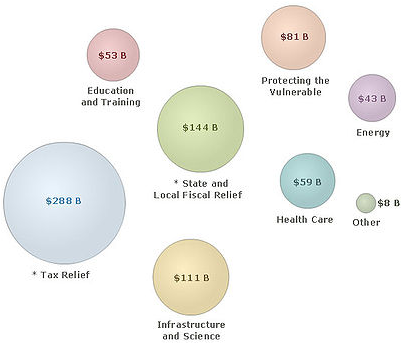
Solid data on the timing of fiscal stimulus due to the ARRA is hard to come by. The best guide I could find that projects into the future was provided by Mark Zandi of Moody's Economy.com.
As the following chart shows, the projections he made (in spring 2009) have substantial stimulus throughout 2010, but the stimulus will have peaked in the first quarter.
 According to the government, $410 billion, or 52% of the allocated stimulus of $787 billion, has been spent so far ($163 billion of the $288 billion allocated for tax benefits; $115 billion of the $275 billion allocated for contracts, grants and loans; and $132 billion of the $224 billion allocated for entitlements.)
Through the first quarter, $373 billion had been spent, as shown here:
 So $110 billion was spent in the first quarter, up from $84 billion in the previous quarter --- but GDP growth decelerated from 5.6% to 3.1%, and absent inventories from 1.8% to just 1.5%.
As Zandi projected, the positive contributions to real GDP growth are just about done, and will turn negative in H2.
 So, though, as per above, the White House is projecting a bigger deficit in 2010 than 2009, which adds to GDP growth YoY, that will be front-loaded, with H2 relying on private demand for growth.
And there will have to be enough growth to offset the continued declines to be expected from state and local governments. State and local government spending is about 50% bigger than federal government spending ($1.5 trillion vs. $1.05 trillion).
And state and local governments have already been detracting from GDP growth --- negative growth in 5 of the last 6 quarters, including the last 3, down 0.6%, 2.2% and 3.9% QoQ annualized, subtracting 0.1%, 0.3% and 0.5% from total GDP growth.
Double-dip? I think so.
Double-dip? I think so.
Friday, June 4, 2010
Turning Japanese
the future of the U.S., in pictures (click on each for larger version):
1) Japan's nominal GDP in 2010 at 1992 levels
 2) 15 years of Japanese deflation
 3) 13yrs of flat consumption and downward real estate prices
 4) positive money supply growth offset by declining multiplier and velocity
 5) lots of volatility in equities, but long bear market; BoJ, once under 1%, stays under 1%; 10yr yield under 2% for a decade

Friday, May 21, 2010
June or July?
Will the BoC hike on June 1, as had been widely expected as of a few weeks ago?
Or will they wait for the July meeting, given they had previously "committed", and reiterated that commitment numerous times, contingent on their inflation projections, to be on hold until the end of the second quarter... and given that economic and market uncertainty --- b/c of the situation in Europe, as well as FinReg in the U.S. --- prevails?
I tend to think that if the Bank was meeting today, given what the ECB is doing, and given what currencies are doing, and given that concerns about the possibility of a global economic double-dip may have mounted in the last couple of weeks, that it would be relatively costless for the BoC to take a wait-and-see approach for another month, whereas it would potentially look odd to hike in two weeks and then perhaps regret it.
That is, of course, if the decision were made today, in the midst of this recent turmoil. But the decision is not today. So that raises the question of what is the likelihood that some meaningful resolution of the European debt crisis is made in the next couple of weeks? In my estimation, this is a problem that is not going away; there is no short-term fix.
That said, there may be band-aids that could be applied that satisfy the market for a while, leading to a bounce-back from the currently oversold condition in stock markets and overbought condition in bond markets. In which case, that raises the question of what is the likelihood that the ECB and European politicians --- who have gotten the market so rattled in recent days and weeks --- actually come to an adequate resolution to satisfy the markets for awhile. Once again, in my estimation, the odds aren't that good; why would they change their stripes over the next week or two?
But let's leave the Euro situation off the table for now. What are the reasons the BoC might hike despite the Euro, and what are the reasons the BoC might hold off?
Hike now:
- by hiking, the Bank would not be tightening so much as starting the process of normalizing rates, and, even with a few hikes, could remain relatively accomodative for some time
- Taylor Rule estimates, based on current levels of CPI and employment, finally suggest that a rate north of 50bp is appropriate
- Q1 GDP is projected to come in up nearly 6% on an annualized basis, following Q4's rise of 1.2% (or 5% annualized)
- Canadian leading economic indicators are up 3% in the 3mths through April and 11% over the last year
- according to the Labour Force Survey, employment has climbed a whopping 148k over the last 3 mths (through April), and even the less volatile Survey of Employment Payrolls and Hours suggests employment has climbed 44k in the 3mths through Februay (pretty consistent with what the LFS said through Feb.)
- retail sales are up 9% YoY through Q1, including up 5.5% ex-autos & gas; retail sales are not just climbing strongly off trough levels, but have surged past the pre-recession peaks
- housing starts and building permits are up significantly off their 2009 lows, and basically back to 2007-type levels
- the Senior Loan Officer Survey says that banks have been easing lending conditions over the last couple of quarters (after a couple years of tightening)
- the Business Outlook Survey suggest future expectations are as positive as they've been over the last decade
Wait and see:
- as of the end of Q4, real and nominal GDP remain 2.5% and 4.4%, respectively, below the peak levels attained in 2008, so even with recent strong growth, the output gap remains substantial
- recent strong growth may be illusory and unsustainable, given that personal consumption accounts for 58% of GDP while personal income accounts for 53% of GDP, so consumption continues to be driven by debt growth;
- similarly, residential investment accounted for 6.9% of GDP at the end of Q4, presumably higher in Q1, and historically has always peaked right around that 7% level, which may portend a housing market due for some cooling
- C$, trading at 94 cents now, is below the BoC's forecasted level of 96-98 cents --- admittedly, it has only been below the Bank's forecast level for a few days, and, admittedly, a lower C$ should actually be stimulative for the economy, giving more reason for the Bank to remove accomodation, but the fact remains that a sharp fall in currency levels could be a telling indicator for the Bank
- further to last, for instance, oil prices have retreated to $70, the lowest level since last July --- which is good for the domestic demand side of the economy, but is a net negative for a net- exporter of oil, and is reflective of commodity prices more generally
- though merchandise trade exports are, through Q1, up 19% from the 2009 trough, they remain 24% below the 2008 peak --- and are sensitive to commodity prices, which have recently been heading down, as noted, and global economic activity, which is at risk
- similarly, wholesale trade is up 9% from the trough, but still down 5% from the previous peak
- though there has been recent job growth, and the number of unempoyed people, at 1.5 million, is down 6% from the worst point in 2009, there are still 42% more unemployed than at the start of the recession; and the unemployment rate, though down to 8.1% from the peak of 8.7%, remains well above the 5.8% pre-recession rate
- both core and headline CPI in Canada are below the Bank's target of 2%, and with the prevailing output gap and the other trends already mentioned, and with U.S. CPI below 1%, there's no clear reason to believe CPI would be escalating rather than be tame or even falling
- that is especially so given that though monetary reserves are up 30% YoY, M1 is up less than half that, at 13.5% YoY, M2 is up about half that, at 6.7% YoY, and M3 is up less than half that, at 2.9% YoY --- so the money multiplier and monetary velocity continue to decline
- indications of a consumer debt bubble in Canada include the facts that mortgage debt as a % of personal income has surged through the 100% level to 116% (vs. a 1990s peak of 84%) and household debt to 170% of GDP, up from 115% in 2000 (apparently Canadians learned nothing from the U.S.)
- the Fed has reiterated that it "continues to anticipate that economic conditions, including low rates of resource utilization, subdued inflation trends, and stable inflation expectations, are likely to warrant exceptionally low levels of the federal funds rate for an extended period", and it is an open question as to how much the BoC can hike without the Fed hiking without currency movements adversely affecting the domestic economy (more than the Bank would be comfortable with)
Really, what it comes down to is how sure is the Bank that recent strong economic trends off recession lows are likely to be sustained?
Personally, I don't buy into the back-to-normal theory, continue to believe that:
- further leveraging (debt growth) in the Canadian economy will make the fall all the worse when it comes
- the U.S. economy has been living off of federal government stimulus for the last year and will soon fall back when (a) that stimulus wanes, and (b) the next round of credit strains (Alt-A and Prime mortgage delinquencies, defaults and related foreclosures) ramps up, and (c) the crisis at the state and municipal levels becomes impossible to ignore
- China is a bubble waiting to burst (details in earlier posts) --- and the recent stock market moves in China may be suggesting that process is underway
- even if Canada, the U.S. and China didn't have their own inherent risks, the linkages in the global economy are too significant for European retrenching not to become problematic for the global economy at large, and European retrenchment will be not just necessary in the PIIGS, but, because of the prevailing bailout mentality, will bring down the European core countries as well (though German exporters will certainly benefit from a weaker Euro, that won't help Canadian or Chinese exporters, so there will be feedback loop impacts)
So, at the end of the day, what do I forecast?
- the Bank does nothing June 1 other than change its commentary to indicate its intention to hike
- the Bank hikes 50bp in July
- the Bank hikes by 25bp once more in early September
- by autumn, things will be visibly messy again
- there will be a European recession, and a double-dip U.S. recession, a significant China slowdown, and, consequently, another Canadian recession
- though domestic demand in Canada will not lead, it will follow; Canadian domestic demand will be the tail, not the dog --- the Canadian recession will not be driven solely by external demand, but the housing and debt bubble in Canada will be pricked by the next global recession
- further BoC hikes will be off the table for a long while, not until the Fed hikes
- the Fed won't hike until perhaps 2014 (yes, Dorothy is not in Kansas anymore; like The Vapors, she, and the FOMC, are Turning Japanese)
p.s. see Canadian Economic Review
Saturday, May 23, 2009
Reality vs. Perception
subtitle: have i f'd up?
or, alternatively: my convictions wavering?
Back in December, when the US 10 yr flirted with 2%, I figured that I'd been right to predict/worry that the housing depression, the blowing up of the debt bubble, the stock market collapse, the dismal economy, and the consequent imminent risk of deflation implied a period of structural lower government bond yields, a la Japan.
How fleeting that feeling was!
With the exception of a brief rally in late March after Ben announced implementation of Q.E., rates have been steadily trending higher almost all YTD, with the 10-yr now back to 3.45.
What's changed? Not the economic reality. The economy has contracted at a fast rate over the last two quarters (having fallen faster to a lower level now than anyone in mid-December must have been thinking likely), and though its contracting at a slower rate now (+ve 2nd derivative), the contraction is not yet over (still -ve 1st derivative).
The housing market has shown blips, but its done that off-and-on for two years. So the housing recession is also not yet over, for reasons I've cited before: home prices still too high relative to incomes or rents; still too much excess supply and shadow inventory; credit is constrained, particularly at lower end, which prevents the whole process of sellers at the lower end moving up to be buyers at the higher end. The debt bubble has burst, and a new credit cycle has not been restarted; it will take a long time yet to digest the excessive (private) debt already in the system, an unhealthy portion of which is bad. Particularly given that unemployment keeps rising and incomes are stagnating (at best). Similarly, the consumer retrenchment, as hard as it is psychologically for Americans to give up their spendthrift ways, also won't be over with just a few months of paring back. In a deleveraging world, and one in which repaying debt is prevalent because asset prices are no longer rising, then spending will be constrained to something less than incomes, which themselves are contracting. Corporate profits have tanked, margins are constricted, cost cutting is the order of the day, capacity utilization is awfully low, etc. There don't seem to be many areas in which there is pricing power.
So, for all those reasons, the deflationary forces are as pertinent today as they were in December, if not more so.
But what HAS changed is the market's perception of government's approach to dealing with all this. As Karl Denninger says in U.S. credit rating under fire:
Inflation fears in this regard are somewhat misplaced, because there is a black hole of defaulting credit into which one is attempting to issue, but it is perceptions that counts in a fiat currency world, and the perception in the market is that the US Government has lost control of its deficit and budget process, and The Fed has lost control of the money supply.
Perhaps the bond vigilantes really ARE back!
Denninger believes foreign central banks are selling into Ben's bid, and, if that's so, the game is up --- there will be a bond market implosion and an economic collapse. (Denninger's been warning of this for over a year, of course, which means he was warning of it with yields north of 4%, well over where they are now. I don't believe he foresaw them dropping as low as they did at the end of last year, so the sell-off we've experienced recently still doesn't get us back to levels at which he was saying bonds were doomed. That said, maybe his concerns back then took some time to become widely perceived, but, now that they are, this sell-off, which is already nearing 150bps, could go a long ways yet if Denninger is right. And, needless to say, its views of his type that test my convictions.)
My impression has always been that Denninger's concerns are totally valid, but the question is one of timing. I saw David Walker's Fiscal Wake-Up Tour material while he was still Comptroller General at the GAO (before leaving to work on the same crusade at the Peterson Institute), so I know Denninger is right: the U.S. simply cannot afford to pay off its debts, not while also maintaing the commitments it has made through all its non-funded liabilities, particularly healthcare. At least, it can't do so with dollars that are worth something! The burden is just too big: as Walker's GAO material pointed out, it added up to $170,000 PER PERSON, or $440,000 per household --- and that was as of the end of 2006!! As per the Peterson Foundation, the burden is now $184,000 per person and growing.
But, in the meantime, deleveraging and debt contraction and deflation and the historically very low proportion that bond holdings represent of the U.S. household sector's balance sheets and the relative near-term safety of government debt relative to riskier assets which have taken a drubbing, all meant that there was plenty of room for incremental new internal domestic bond demand to take up the incremental new supply (as Rosenberg argued repeatedly). And even low nominal yields look okay in a disinflationary or deflationary period --- this is one of those rare times that real yields are actually higher than nominal yields.
Meanwhile, though foreign central banks certainly realize the risk to their appreciable U.S. holdings, they're stuck between a rock and a hard place. They may not want to throw good money after bad, but if they stop buying U.S. debt now, not only do they guarantee a loss on their existing positions, but their currencies, which they've been holding down relative to the US$ with those past purchases, would go the other way, killing their own export-dependent economies. And, to the extent that they have trade surpluses with the U.S., they need to do something with the dollars they receive. Would they rather exchange those greenbacks for Euros? Pounds? Yen? Swiss Francs? Lats? Lira? Roubles?
Besides, I'm really not sure Denninger is correct that foreign C.B.s are indeed cutting back on their purchases. Brad Setser is the expert in this field, and he says that central banks still (heart) dollar reserves. Now, it is true that the U.S. trade deficit has declined, in part because oil prices have fallen, and in part because personal consumption has fallen, so imports have fallen faster than exports. And to the extent that the trade deficit is smaller, that implies a smaller net outflow from the U.S. of dollars to the world (to pay for imports relative to received for exports). So less currency recycling is necessary just as the government is ramping up issuance.
But, according to Setser, central banks have actually increased their Treasury holdings at the Fed by almost twice as much as required to finance the trade deficit. However, they are indeed shortening the maturities of the U.S. debt they purchase. So maybe they don't (heart) long bonds. But Setser believes that as the yield curve has steepened significantly, we'll soon get to a point where those foreign buyers will once again look at the paltry yields they're getting on their bills and notes and opt again for the higher yields on bonds.
All told, my convictions have been sorely tested, but, perhaps naively, I don't think I've f'd up too badly. Just like last year when the markets were all gung-ho about commodity-driven inflation, the markets this year are now gung-ho about money-printing-driven inflation. And, just like last year when government bonds rallied in the second half, I remain convinced, like the Van Hoisingtons and Gary Shillings of the world, that we'll have another significant rally coming.
Where my conviction has been most sorely tested, and maybe even lost, (which isn't much help for tactical trading), is how high yields might get in the meantime. But, as I suggested in my May 4 notes about 1998 Japan (In Japan in 1998, long-bond yields declined fairly steadily from 2.70 in January to 1.16 in October, then spiked back to 2.97 by year-end and 3.53 in February. They then fell back below 2 by May.) I think these so-called "green-shoots" type periods will hurt bonds, but, ultimatley, all the bond-friendly factors will prevail, albeit with remarkable volatility in the interim.
Thursday, May 21, 2009
Is it always a lagging indicator?
There are some themes or ideas that are just accepted as common wisdom, and, as such, ordained as truisms.
For a time, one of those ideas was that the U.S. consumer was resilient; for a long-time this remained true ---- until it wasn't. Another such theme was that of global decoupling; for a while, it too looked like it might turn out true --- until it didn't. A third was that subprime would be contained --- which, likewise, wasn't based on facts or evidence or even well thought-out analysis, but was just an optimistic assumption, or, better yet, presumption, that ultimately got disproved.
The problem with ideas such as these is that the reason for the platitude is hardly ever examined; its truism-ity is usually just assumed on a prospective basis, often because it has been generally true retrospectively.
I worry that the notion that labour is a lagging indicator is just such a notion.
Undoubtedly, in most recessions, labour has been a lagging indicator. But most recessions that we are familiar with have been inventory-cycle recessions, or have been recessions caused by the Fed hiking rates until something breaks, after which time they drop rates again and re-start the economic cycle, principally by way of the credit cycle.
In an inventory-led recession, such as the dot-com bust, companies project the good times too far out into the future, they build to over-capacity, find out they have too much inventory, cut back on hiring, do some firing, work down their inventories, and its only after a while of those inventories being worked off, whether or not sales have picked up, that they need to resume the labour cycle, once their inventories are lean again. Therefore, labour indicators lag in such a cycle.
In other Fed-hiking-induced recessions, the Fed fears the inflationary effects of an overheating economy, so it hikes til the economy breaks/brakes; then once it has decided that it has slowed the economy enough that inflation will remain contained, it reduces interest rates, which spurs lending, as both consumers can incur new debt more cheaply to finance their spending (mostly through housing) and businesses can likewise finance more projects because their cost of financing has fallen, which makes more projects profitable. As such, the economy gets going again, and as consumers spend and as businesses ramp up, more labour is required, and hiring picks up, but in lagged fashion.
These are the typical types of recessions we are familiar with; and these are the types of economic cycles from which we evolved the common wisdom that labour is a lagging indicator.
But is that equally true today? Needless to say, I have my (serious) doubts.
Back on April 9 I published a post called U.S. Employment Data, at the conclusion of which I noted:
"Labour data is considered a lagging indicator. While that surely remains true (i.e. the economy will show other signs of rebounding before labour does), labour trends impart their own impact on the economy, particularly in a recession that is being consumer-led, unlike some past inventory-cycle recessions. In this case, the consumer retrenchment can't help but be re-inforced by the employment trends, as overly-indebted consumers are now also increasingly income-constrained consumers."
Normally, when the Fed tries to rescue the economy by cutting interest rates, that works its magic by restarting the credit cycle --- borrowing escalates, which finances economic activity, which spurs labour creation. Today, the Fed has dropped rates to as low as they can go, but its magic has lost its magic. Banks are not expanding the credit on offer. And even if they were inclined to, consumers are in no shape (or mood) to incrementally add to their monstrous debt burdens.
Furthermore, the primary channel through which Fed-engineered interest rate changes has historically had its impact is through housing: low Fed rates tend to lead to lower mortgage rates tends to lead to more housing activity, including all the various multiplier effects therefrom. But in this cycle, because of the still large overhang of excess homes, that's simply not happening. Sure, homeowners will refi as much as they can to take advantage of lower interest payments on outstanding mortgage burdens, and this will help ease their pain and suffering, and, at the margin, will mean they have more money in their pockets to spend on gas and groceries, and it will also allow their debt repayments to work more on reducing the principal rather than just paying mostly interest, but it does NOT mean they will take on more debt.
Households are deleveraging. They have taken a huge hit to their wealth, there is no more MEW available, they are closer to retirement than they were a decade ago, during which time they've had very little savings (relying instead on asset price appreciation that has quickly since dissolved), and, even for those who had pension plans, those too have taken a serious hit, so they now realize they need to save. They need to repay their outstanding debts, and also to re-build their nest eggs (can't just retire off the proceeds of a future house sale), which means that consumption must be constrained to something less than their incomes. Which, in the meantime, is falling (not just from lost jobs, but from lost hours for those still working, and from neglible wage gains).
Similarly, businesses haven't much motivation to leverage off of low interest rates to increase their activity. They have huge levels of unutilized capacity, so, as low as (government-backed) interest rates are, they have little incentive to take that money to invest in new productive capacity or in the creation of new widgets. And, not all businesses have access to government-guaranteed debt, so funding costs for the broader business community, due to still-wide spreads, are not that incentivizing in any case.
Therefore, if the Fed can't re-start the credit cycle, then it can't restart the economic business cycle, and thus it can't do much to promote job growth.
Banks don't want to expand lending (they have enough NPLs and bad debts to worry about already, and why extend more credit into an already debt-heavy economy that is in recession and to debt-burdened consumers who have poor job prospects and declining collateral values). Consumers don't want to take on more lending (for all the same reasons the banks don't want to extend it --- both groups are properly motivated to see debt levels in aggregate fall). And businesses might be in a position to borrow money, but the question for them is what to do with it (Microsoft, for instance, did a very opportunistic (first ever, I believe?) debt issue to lock in some nice borrowing rates (just 100 back of Treasuries), but it was already sitting on a ton of cash, and its not as if issuing a bunch of bonds has any implication for its order book.)
So, without labour growth, where will expanding economic activity come from? For now, there is some that is coming from the government purse, and that increase in federal expenditures (above and beyond the decrease in state and local outlays) will likely be sufficient to impact growth in the near-term, but does little to address the structural problems in the economy (i.e. excessive debt) that do not bode well for the mid- to long-term.
At the end of the day, what promotes economic growth is spending growth, and what promotes spending growth is income growth, and what promotes income growth is job growth. And we ain't got none of that right now.
As long as deleveraging persists (and it will for quite some time given that total economy-wide debt loads have continued to increase relative to the size of the economy or personal disposable income, which have fallen faster than debt has been paid off, and given that the mirage that it was sustainable on the back of housing values has been discredited, and given that housing prices still remain stretched relative to historical norms), it is my belief that job growth will be a leading, not lagging, indicator of demand, and, therefore, of economic activity.
And, most unfortunately, we are stuck in a vicious circle. Businesses' profit margins have been crushed, so pressure remains on them to cut costs (i.e. cut labour). As labour conditions continue to deteriorate, aggregate demand will continue to be stifled. And so it goes and so it goes.
At some point, conditions will have reached a point that sustainable growth will become inevitable. But a decade-long debt-drinking binge will not be cured with a 10-month hangover --- not until all that bad booze has been purged from the system and the drunks are over the memory of how bad that hangover felt.
Thursday, April 23, 2009
Some thoughts on the MPR
The market reaction to the release of the MPR was all about the unconventional, but I'll start with the conventional.
The Bank reduced its forecasts for growth prospects, as expected, relative to the January MPR Update, to -3.0% expected this year, +2.5% next year, and +4.7% in 2011. It attributes the downgrades primarily to the significant unforeseen foreign weakness propagating through trade, financial and confidence channels (adverse feedback loop), and to delays in implementation of policies to stabilize the financial system (particularly in the U.S.).
But the Bank remains relatively more upbeat than some other forecasters (see previous post), and continues to project a more robust recovery in Canada than in other countries. So, though the recovery will be delayed and more gradual than previously anticipated due to the unanticipated intensification and synchronicity of the global recession (particularly acute in Europe and Japan, with knock-on effects on global trade), the Bank continues to expect above-potential growth in Canada in 2010 (albeit with a lower estimate of potential output growth).
The Bank has a long list of factors that it views as supportive of this prediction, including the scale of its own monetary policy response, the relatively well-functioning Canadian financial system, the past C$ depreciation, fiscal stimulus, a gradual rebound in external demand, the strength of balance sheets in Canada (household, business and bank), and the end of residential housing stock adjustments both in the U.S. and here. More generally, it believes that bold policy actions globally, an end this year to the U.S. housing drag, and a relatively robust China will all be positive factors for the global economy.
However, there are obviously numerous challenges also. Though Canadian households have entered this downturn with balance sheets that are not as stretched as elsewhere, they have reacted with a similar increase in their desired savings rates. And, though Canadian households have generally had lower rates passed on to them, businesses are facing difficult financing conditions. Further, U.S. weakness has mostly been in sectors that have a large impact on Canadian exports (housing and autos). Also, there has been significant unwanted inventory accumulation. And, due to the steep drop in the terms of trade, there has been a similar sharp drop in real gross domestic income (which is forecast to decline 6.4% this year). Investment in housing is expected to fall all this year and business fixed investment is expected to drop sharply. And the output gap, which is estimated to be about 3% currently, is expected to widen to 4.5%.
Perhaps the most notable change in the Bank's report is that it has dropped its estimate of the economy's potential output (i.e. the pace of output growth that would be non-inflationary). Previously, it had viewed potential as 2.4% (for this year, and 2.5% going forward). Because of the structural change going on in the economy (especially in autos and forest products), it now views potential output as just 1.2% for this year, 1.5% next year, and 1.9% in 2010. Clearly, lower potential output estimates, if accurate, will make it easier to close the output gap and thus start get inflation back towards the 2% target (not anticipated for 10 quarters, in Q3/'11).
The Bank notes that if the economy deteriorates any further than currently expected, because its overnight rate is currently at its effective lower bound for conventional monetary policy, it would need to react with unconventional policy. And, given the degree of uncertainty related to such new policies, it would therefore need to use prudence with these initiatives (i.e. it will be cautious about how much it uses these programs, if at all). Therefore, it says that implies that inflation risks remain tilted, though slightly, to the downside.
All this will likely be very sensitive to its assumptions on the stabilization of the global financial system, given that it continues to maintain that such stabilization is a precondition for recovery. And the Bank seems to be unimpressed so far with the pace of progress in this regard. The Bank did not really outline its expectations for further credit losses in the global financial system, nor for the pace of resolution of impaired legacy assets, so its hard to evaluate this element. Another risk is the ever-present one of the potential destabilizing resolution of global imbalances. (The Bank did not comment on the fact that it seems that most government stimulus that has been enacted so far seems to aggravate existing imbalances, i.e. that American stimulus is somewhat focused on reviving U.S. consumption, while Chinese stimulus is somewhat focused on the investment and export sectors.) The Bank's forecasts would also be sensitive to its assumptions on the currency (C$ = US$0.80), oil (from $50 now to $60 at year-end, to $70 in 2011, based on futures) and non-energy commodity prices (increasing progressively with global economy).
Now, turning to the unconventional. The Bank views its commitment to keep its overnight rate at its current low level for over a year (and future conditional statements about the future path of policy rates) as its first main instrument of unconventional policy. It hopes that because long-term rates represent averages of current and expected future short-term rates (plus term premiums), that it can influence the government yield curve lower, and in turn support prices of other financial assets, and, in turn, aggregate demand.
That we already knew on Tuesday. And, unfortunately, there's really nothing in the MPR about quantitative easing (QE) (which would involve purchasing government or private assets, paid for by expanding the money supply), or credit easing (CE) (purchases of private sector assets, but sterilized, so the monetary base doesn't change) that's new or noteworthy either. The only new info is (1) that if it does purchase private assets, it will be restricted to those exhibiting a clear market failure, and (2) is the publication of the principles it will use to guide its actions. Newsflash #1, its focus is on its inflation target. 2) anything it does should be concentrated where it will have impact (perhaps purchasing 5yr GoCs would have more impact than buying 2s, particularly given that the impact the Bank is ultimately worried about is on private sector interest rates). Its principles of (3) neutrality (limit potential distortions) and of (4) prudence (don't unduly risk the Bank's balance sheet), seem to indicate a preference for QE over CE.
Other asset implications? Given how little detail is provided on this new monetary policy framework, its really hard to know. Probably there will be just as many guesses out there in the market today as to what they might do as there were yesterday (GoCs? provies? CMBs? corporate bonds? CP? ABCP? ABS?).
Ultimately, it appears that the Bank's outlook on the economy and inflation, and its conditional commitment to low rates, should be favourable for lower rates along the government curve. And, if anything, it appears that the Bank remains relatively optimistic that global financial instabilities will be resolved soon enough to foster the growth its looking for. Not that it can do anything about it, but that leaves the Bank relying on Timothy Geithner too much for my liking.
Really, what it comes down to is, will the Bank's forecasts be more accurate than those of the IMF and OECD, or not. If so, then no QE or CE. But, if not, it will take longer to get inflation back on target, with potentially a larger miss in the meantime, implying an announement in June (or more likely at another future fixed action date) about what particular QE or CE measure it decides it needs to employ.
But, in any case, it seems clear that the Bank feels there's a greater burden of proof that there's a need in order for it to go down that road. It too may be looking at 2nd derivatives and green shoots and hoping to not need to invoke too many extraordinary measures.
Global Economic Outlooks
The Bank of Canada released its MPR today, which, among other things (more later), lays out its projections for economic growth.
I thought it might be interesting to compare what the Bank is expecting relative to the recently released projections offered by the OECD and by the IMF.
Here are the BoC's forecasts for 2009 and 2010 real GDP growth:
Canada: -3.0; +2.5
U.S.: -2.4; +1.2
E.U.: -3.6; -0.2
World: -0.8; +2.2
Here are those from the OECD:
Canada: -3.0; +0.3
U.S.: -4.0; 0.0
E.U.: -4.1; -0.3
OECD: -4.3; -0.1
OECD+BRIC: -2.7; +1.2
And those from the IMF:
Canada: -2.5; +1.2
U.S.: -2.8; 0.0
E.U.: -4.2; -0.4
World: -1.3; +1.9
a few observations:
the OECD is the most pessimistic, both for 2009, but particularly regarding prospects for 2010 (basically bigger fall in '09 and then no bounceback in '10)
the BoC is more optimistic than either the OECD or IMF not just on how much the U.S. declines this year, but its prospects for next year; neither the OECD nor IMF have projected any 2010 growth for the U.S.
all three sets of forecasts are reasonably bearish on Europe (from -3.6 to -4.2 this year, and more slippage next year)
all three groups of forecasters predict Canada outperforms other advanced economies in 2010, presumably due to its linkages to developing economies
the BoC's forecasts aren't that far off from those of the IMF, but are definitely more optimistic (or, perhaps more accurately, less pessimistic), and the BoC, though it has pencilled in a more gradual recovery than it was previously forecasting, is definitely looking for more of a V-shape than either the OECD or IMF
UPDATE:
the OECD's more pessimistic outlook may be due to its assessment that it takes 4 to 6 quarters for changes in financial conditions to have their full impact on GDP, so the full effect of past tightening in conditions since Sept/08 has not yet been felt; also, it is expecting further large prospective declines in world trade, based on advance indicators; further, it notes that housing recessions are worsening almost everywhere other than the U.S.; it is also concerned that large cyclical increased in unemployment have a tendency to become structural in part, reducing productive potential
notably, the OECD's foresees:
- the U.S. output gap reaching 10% and therefore inflation, after going negative for much of 2009, only stabilizing near 0% at the end of 2010
- strong BRIC rebound in 2010 driving robust rebound in world trade
- the OECD's report noted that it is important to commit to low levels of monetary policy rates for a sufficient period of time, as studies have shown such a commitment to have an effect on lowering the yield curve
Wednesday, April 22, 2009
Roubini Global Economics Forecast
from RGE:
Today we present some of the main conclusions of the recently released update to the RGE 2009 Global Economic Outlook.
The global economy is in the middle of a synchronized contraction that will push global growth into negative territory in 2009 for the first time in decades. . This will be the worst financial crisis since the Great Depression and the worst global economic downturn in decades. Global trade volumes face their sharpest contractions of the postwar era – trade is expected to contract 12% in 2009 due to the severe and prolonged global demand slump, excess capacity across supply chains and the continued crunch in trade finance.
Many analysts and commentators are pointing out that the second derivative of economic activity is turning positive (i.e. economies are still contracting but a slower rather than accelerated rate) and that green shoots of an economic recovery are blossoming. RGE Monitor’s analysis of the data suggests that the global economic contraction is still in full swing with a very severe, a deep and protracted U-shaped recession. Last year’s economic consensus forecast of a V-shaped short and shallow recession has vanished. While the rate of economic contraction is slowing compared to the free fall rates of Q4 of 2008 and Q1 of 2009, we are still a long way away from the economic bottom and from a sustained recovery of growth. In particular, in Europe and Japan there is little evidence of a positive second derivative of economic activity.
However by the end of Q1 2009, there were some signs that the pace of contraction had slowed in many economies especially in the U.S. and China, where policy responses have been more significant and leading indicators in the manufacturing sector may have bottomed before they did in Europe and Japan. However, major economies including all of the G7 will continue to contract throughout 2009, albeit at a slower pace than at the beginning of the year.
Moreover the global recovery might be sluggish at best in 2010 given the overhang of credit losses of financial institutions, lingering credit crunch, need for retrenchment by overstretched and over-indebted households in current account deficit countries and a slow resumption of demand prompted by extensive government stimulus.
Some key elements of RGE Monitor’s outlook include:
Global economic activity is expected to contract by 1.9% in 2009. Advanced economies are expected to contract 4% in 2009. Japan and the eurozone will suffer the sharpest downturns. U.S. GDP will continue to contract, albeit at a slower pace throughout 2009, with negative growth in every quarter.
Emerging markets will slow down sharply from the stellar growth rates of the past few years, with the BRIC economies growing at half their 2008 pace.
Deteriorated terms of trade, slower capital flows and tighter credit will push Latin America into recession from the 4.1% growth of 2008. Argentina, Brazil, Chile, Colombia, Mexico, and Venezuela will all shift to negative territory on a year-over-year basis while smaller countries, like Peru, will experience a significant slowdown.
Countries in Eastern Europe and the CIS will experience some of the sharpest contractions given the withdrawal of foreign credit and the risk of a severe financial crisis. The reduction in oil revenues and financial stress will contribute to a 5% yoy contraction in Russia and some countries - especially in the Baltics – are at risk of double-digit contractions.
Export-dependent Asia's growth will slow significantly to less than 3% in 2009. China will have a hard landing with GDP growth falling to 5.5% while India will slow sharply to 4.3%. All four Asian Tigers (Singapore, Taiwan, South Korea and Hong Kong) as well as Malaysia and Thailand will experience recessions.
The Middle East and Africa will mark much slower growth, half of their 2008 pace, given the reduction in capital inflows, reduced demand from the U.S. and EU and decline in commodity prices and output. Israel and South Africa will suffer slight contractions.
The unprecedented fiscal and monetary stimulus may help alleviate the substantial contraction in private demand and reduce the risk of a global L-shaped near-depression. Debt financing may be a challenge for many countries though, especially emerging markets or the most vulnerable Western European economies.
Job losses during the current global recession might exceed those in recent recession, contributing to increases in defaults and posing additional risks to banks. The unemployment rate in developed countries will reach double-digits by 2010 (as early as mid-2009 in the U.S.) and push more people in developing countries into poverty. Moreover, despite new funding from multilateral institutions, severe contractions will raise the risk of social and political unrest.
Commodities as a class are likely to come under renewed pressure in 2009 despite some support from production cuts. RGE expects the WTI oil price to average about $40 a barrel in 2009 as demand destruction continues to outweigh crude supply destruction.
The entire RGE 2009 Global Economic Outlook is available to RGE subscribers.
Tuesday, April 21, 2009
On Hold For a Year... We Promise (maybe?)
The Bank of Canada cut its rate in half today, to 0.25%, "which [it] judges to be the effective lower bound for that rate". Unlike the Fed, it did not set a range of 0-0.25; but it's not quite just a straight-up decrease of 0.25%, either. This is because the Bank did not reduce the deposit rate as it usually does when it drops its target overnight rate, so the former remains at 0.25% as well. So, as outlined in its new operating framework, the operating band has been reduced to 0.25% (i.e. from 0.25% to 0.50%) rather than 0.50% previously (yesterday it was 0.25% to 0.75%), with the target now set at the lower bound (0.25%) as opposed to the mid-point of the range (as had been the case). So, all in, this is supposed to be a rate cut of 25bps, but it might be something a bit less than 25 (given the constriction of the band and the unchanged lower bound).
What I find most interesting is not that they say it "commits to hold current policy rate until the end of the second quarter of 2010" (its making this guidance explicit "so as to influence rates at longer maturities"), but that it preceded that with "conditional on the inflation outlook". So, its a non-promise promise. In any case, the only reason they'd deviate from the promise is if inflation surprises to the upside from their current expectations.
As of January's MPR Update, the Bank of Canada expected Canadian growth to be -1.2% this year and +3.8% in 2010. They've admitted (informally) before now that the recession will be deeper than anticipated; they've now put numbers to that. Their new forecast is for -3.0% this year and +2.5% next year (i.e. a smaller rebound off an even lower base), with the start of the recovery delayed until the fourth quarter. The Bank believes we'll have to wait until the third quarter of 2011 to get back to productive capacity, even though they've revised down their estimate of potential growth.
The inflation outlook hasn't changed much, presumably due to the fact that not only has forecast growth been ratcheted down, but so has potential growth. Core inflation is still expected (as in January) to diminish all this year and return to the 2% target in Q3/2011 (instead of the more nebulous "mid-2011"). Headline is expected to trough at -0.8 in this year's third quarter (they said -1.0 in January), before also returning to target at the same time as core. Its hard to know how much these return-to-target assumptions are predicated on their 4.7% GDP growth forecast for 2011. The Bank admits that the risks to inflation remain tilted to the downside (albeit slightly).
The Bank insists that it retains "considerable flexibility in the conduct of monetary policy" despite the low level of interest rates. But we'll have to wait for Thursday's MPR to get a full outline of what that flexibility entails, in terms of quantitative and/or credit easing.
Subscribe to:
Posts (Atom)