Pages

Showing posts with label U.S.. Show all posts

Wednesday, March 30, 2011

March 30

QOTD:
Won't it be cool if subsequent versions of QE are referenced with Roman numerals like the Super Bowl?
John Roque, WSJ.

The unbelievable truth about Ireland and its banks. BBC.
To prevent Irish banks toppling over one after another, the European Central Bank has lent 117bn euros to them and the Central Bank of Ireland has lent them a further 71bn euros. So that's 188bn euros of loans from the eurozone's taxpayers to Ireland's banks - which makes the 67.5bn euros lent directly by the eurozone and IMF to the Irish government look like peanuts. And a further 20bn euros of bank bonds - another form of bank debt - is still guaranteed by the Irish state through the Eligible Guarantee Scheme. So that is 208bn euros of taxpayer loans to Ireland's banks - equivalent to a remarkable 154% of GDP.
[Irish] Bank bailout cost (so far). Corner Turned.

The 'grand bargain' is just a start. Martin Wolf, FT.
It would be helpful – and honest – for the German government and the governments of other creditor countries to tell their people that they are rescuing their own savings in the guise of rescuing peripheral countries. The alternative is to write off loans and recapitalise their banks directly. To admit this would be to admit their policies have been at fault. That would surely be helpful.
Europe needs debt relief, not decades of austerity. The Guardian.
From Donegal to the Algarve, to the streets of Athens, voters on Europe's "periphery", as economists dismissively call it, are slowly waking up to a sobering truth – they face years of austerity, yet wage cuts, job losses and crumbling public services will not extricate them from financial crisis. In fact, by driving their economies into an ever deeper slump, it may even make things worse. The pain could just bring more pain....
Markets and voters across the eurozone have grown wearily accustomed to watching the cycle of a looming fiscal crisis as bond yields rocket, followed by just enough action from Brussels to jolt investors out of panic mode, followed by another bout of the jitters as they realise the rhetoric from euro leaders isn't matched by reality.

As Steen Jakobsen, chief economist at Saxo Bank, put it in a note on Friday: "It's clear that the electorates are beginning to realise that all solutions offered by the policymakers are based on the promise to do something in the future, and never right here, right now."

But time is running out, and Europe has two choices. It can continue hammering the economies of Greece, Ireland and soon Portugal deeper into crisis, while their already furious voters become increasingly resentful about the pain being imposed by their European "partners"; or it can accept that the scale of debts has simply become unsustainable, and open negotiations now about an orderly default.
As Obama and Congress fiddle, America liquidates housing sector. Chris Whalen.

the current national policy mix of more regulation, decreased government subsidies and, to add further urgency, a shrinking banking system, is the perfect storm for the housing, which is now down six months in a row. Despite my long-held desire to see market-based reform in the US housing sector, I think all parties need to be aware of the precarious situation facing the American economy and banks as home prices collapse for lack of credit....
The net, net here is that the available pool of credit available for the housing sector is shrinking and thus prices must also decline to adjust for that supply of credit. This fact of continued decline in home prices is going to have a chilling effect...
I estimate that Fannie and Freddie alone are hiding $200 billion worth of bad loans on their books simply because there is no market for these foreclosed homes. Ditto for the largest servicer banks such as Wells Fargo, Bank of America, JPMorgan Chase and Citigroup. To clean up this mess with finality is going to cost $1 trillion or so in round numbers. But nobody in Washington wants to go there.
Where the bailout went wrong. Neil Barofsky, NY Times Op-Ed.
As per James Kwak:
Back in late 2008 and early 2009, there was a lot of talk about how a true solution for the problems of the banking system would require a solution for the problems of homeowners, since the banks’ losses were largely the result of mortgage defaults. One of the major technical achievements of the administration was showing that it was possible to stabilize the financial system and restore the banks to short-term profitability without doing much for homeowners.
The Federal Open Mouth Committee is back in action. Pater Tenebrarum.
Hawks (relatively speaking) and doves within the Fed are busy trading slightly contradictory statements in public again, in a performance that is eerily reminiscent of the 'exit talk' (exit from unusual monetary accommodation measures that is) that proliferated about one year ago.....

led to this campaign of advance burying of 'QE3' by means of 'QE2' funeral eulogies. Surely 'QE3' won't be talked about so much anymore if even 'QE2' comes under official scrutiny. Since the current QE program is slated to end in June, market participants are given fair warning not to expect more 'coups de whiskey' for the stock and commodity markets immediately thereafter. This in turn means that the times are set to become slightly more interesting. Given that there is not the slightest evidence yet that private sector deleveraging has run its course, a cessation of excessive monetary pumping may end up stopping various bubble activities in their track in very short order. This is to say, both financial markets as well as the economy may slump again fairly quickly....

Helicopter pilot Ben Bernanke has been rather quiet, letting the rest of the board spread the message. Alas, we suspect he's personally still firmly in the pro easy money camp. At least this is what we would have to conclude considering his well known views on the Great Depression as well as Japan's post bubble era. His usual refrain was that policy makers were 'too timid' in these instances, but as it were, the BoJ is a veteran of two (now 2.5) QE programs as well, so if one wants to be 'less timid', then 'QE1' and 'QE2' alone obviously won't cut it. In that sense we would be inclined to discount the advance funeral rites for 'QE3' as just more hot air. Nevertheless, there will be a pause, and should the economy's momentum not falter again immediately, then we'd expect the 'exit' palaver to increase in both volume and frequency.

Surpluses, debt and depressions.... Randall Wray via Pragmatic Capitalism.

China's 5-year plan and global interest rates. Martin Feldstein.

Visualizing the food and energy crunch. Pragmatic Capitalism.

Debt: The first five thousand years. David Graeber.

The biggest urban legend in finance. Rob Arnott.

Fannie and Freddie hiding over $100 billion of losses? naked capitalism.


other fare:
Exceptional And Unexceptional America. Andrew Sullivan, The Atlantic.

Friday, March 4, 2011

March 4


A long way to go. FRBSF.


How to kill a recovery. Paul Krugman, NYT.

The madness of Jean Claude Trichet. Krugman.

Dead nation walking. Richard Russell.

Why the maven is morose. interview of Stephanie Pomboy in Barron's.

Why real estate will hold the economy back. The Daily Capitalist.
Commercial real estate loans and residential housing will continue to be a significant drag on economic performance. Until the mass of over-built homes and commercial properties are liquidated credit will remain tight and unemployment will remain high.


The unfortunate fact remains that credit for most of America is still tight, banks are still trying to repair their balance sheets, and the overlying problem is real estate, the detritus of the Fed’s reckless monetary policy. Credit expansion fueled by the Fed’s easy money policy of the early 2000′s drove private debt to fuel housing over-production, and drove commercial debt to fuel commercial real estate (CRE) over-production. It was the greatest such expansion of money and credit the world has ever seen and it went primarily into real estate. We are now facing the consequences of that expansion and boom: the bust.
includes much more on the FDIC Q4 banking report

Banks face more loan write-downs. WSJ.


Game changers? Tim Duy's Fed Watch.

Saudi Arabia contagion triggers Gulf rout. Ambrose Evans-Pritchard, Telegraph.
latest sell-off was triggered by the arrest of a Shi’ite cleric in the Kingdom’s Eastern Province after he called for democratic reforms and a constitutional monarchy. The province is home to Saudi Arabia’s aggrieved Shi’ite minority and also holds the country’s vast Ghawar oilfield, placing it at the epicentre of global crude supply. "Unrest in this region can have fatal consequences for the world," said JBC Energy. "The plunge on the Saudi stock exchange can be interpreted as a sign of waning trust."

re: Bahrain
protesters have "the right to appeal for help from Iran" if Saudi military units interfere in the struggle. Tanks were seen crossing the 17-mile causeway from Saudi Arabia to Bahrain on Tuesday

Religious tensions in Bahrain on edge. zerohedge.
concludes:
And once religion is involved, which of course means Iran, then all bets are off especially if Saudi sends reinforcements to support the Bahraini status quo.

German-Irish brinkmanship raises EMU stakes. Evans-Pritchard, Telegraph.

The EU's band-aid on a bullet hole. Daniel Gros, Project Syndicate.

Tuesday, August 24, 2010

Predictions (in prep for next forecast meeting)

"Low-probability" events that I currently predict:

- U.S. is experiencing a balance sheet recession, much like the Japanese did, which leads to very different outcomes than do typical inventory-led recessions, meaning that this will be a bump-along, virtually no-growth era, albeit with lots of volatility

- the wide output gap will persist; economic slack will continue to be disinflationary

- U.S. housing STILL has not bottomed; houses remain overvalued and with the excess supply of homes, even ignoring shadow inventory, (months supply of existing homes now at 12.5 months), pressure on prices will resume

- the U.S. household balance sheet continues to have very much more debt than can be serviced given incomes and nonexistent income growth (median household income adjusted for inflation has not grown since 1997); there will be many more write-offs, loan loss provisions need to increase, which will hit earnings, and deleveraging will persist for a LONG time

- as households delever, deflation picks up (deflation is the contraction of money and credit; though prices as calculated in the CPI are not yet falling, M3 IS, thus deflation)

- with excess capacity and no demand growth, there's no impetus for production growth (other than very short-term inventory cycles), so there is no impetus for employment growth

- waning of inventory rebound and of federal fiscal stimulus will not just no longer add to growth, but will detract from growth, as will the state & local budget cut-backs

- if the U.S. does not double-dip, it will only be because the NBER decides the recession starting December 2007 hasn't actually ended yet (a mid-recession bounce off the lows that does not reclaim the old peak before the down-trend resumes may not justify an end-of-recession call)

- Canada will not decouple from the U.S. going forward any more than it did in 2008/09

- Canada has its own internal imbalances (consumer credit, household debt, housing activity & prices) which makes it not just vulnerable via external shocks, but vulnerable too to unsustainable domestic demand

- China does not just contribute to global imbalances, but has its own severe internal imbalances, which are unsustainable and thus won't be sustained, and China will suffer the same fate as Japan in the 1990s and the U.S. now in the aftermath of the crash of an asset bubble (though many believe the Chinese government has plenty of ability to fine-tune the economy and keep growth near double-digit range, there is not much precedent for successful central planning economies)

- stocks remain in a secular bear market, despite the cyclical swings; stocks will fall below 800 as current very rich valuations (based on cyclically-adjusted P/E ratio and Q-ratio, as opposed to forward P/E) are predicated on robust earnings growth due to robust economic growth, neither of which will materialize; in fact, if fair value is 850ish, and given that stock markets always over-react in each direction, a revisiting of the 600s is not out of the question

- investors will shun stocks and continue to restock the fixed income holdings on their balance sheets, which, for households, remain very low, particulary given the aging baby boomer demographic situation

- Fed will be on hold at least until 2014, likely longer

- BoC will get its overnight rate no higher than 1% while Fed remains at 0%, and I believe it will cut rates again once the shxt hxts the fan again (i.e. once the fact that there's no recovery to speak of becomes obvious)

- the secular bull market in bonds that began in the 1980s has not been broken yet and will not be in the next few years; bond yields will break through the 2009 lows, getting closer to Japanese levels in 2011; US10s will get below 2%, Canada 10s under 2.5% and long bonds to 3%


Context: "Low probability" events that I have previously predicted:

- in late 2006, anticipated not just U.S. housing stalling, but crashing; a recession in 2007; an S&L-type financial crisis

- in Q1/2007, I thought the economy would be in recession in Q2, if it was not already (wrong; but it was by the end of the year)

- in Q2/2007, I predicted a Minsky moment, that the debt bubble would burst (and though I sold most of my non-bank ABCP, I foolishly rationalized not selling my one last piece as it was just a 2-month maturity)

- and that the S&P would fall below 1000 (I was the only in-house predictor of negative stock returns in 2008; however, I was also the only predictor of negative stock returns for the rest of 2007, which was incorrect; early again, like with the recession)

- it was in Q3/2007 that I first started predicting that the U.S. would likely, due to a cratering asset bubble and large private sector debt burden, have an outlook similar to Japan in the 1990s
- in late 2007/early 2008, I predicted that the Fed would drop rates to the old low of 1%

- and, at that time, I believed it was too early to be buying credit (but I did not advocate for selling credit, and I certainly did not foresee spreads widening anywhere near as much as they ultimately did)

- in early 2008 I noted that economic growth since the 1980s had been driven by debt growth, with more and more debt required over time to buy each unit of GDP growth, and therefore that in the absence of debt growth there would be no economic growth; and that though the government could fill the void for awhile and offset private sector deleveraging for a time, it could not do so indefinitely, so economy-wide deleveraging would happen

- in 2008 I agreed that subprime was contained --- to planet Earth

- and I predicted, when losses so far were under $400 billion, that credit writedowns would easily exceed $1 trillion

- I also suggested in mid-2008 that the Fed was in a liquidity trap and that monetary policy, though easy, would not be effective (pushing on a string)

- in Sept 2008, when the S&P was at 1200, I expected stocks to go down a further 14% in 2008 and be down 8% in 2009 (down to 800 then up to 1000) (wrong -- they went lower than I anticipated (to 666), then recovered much more than I anticipated (to 1150))

- in late 2008 I predicted that global decoupling was an optimistic myth, that the global economy relied on the U.S. consumer and would be dragged down by it

- in 2008 and 2009 (and still in 2010) I believed that U.S. housing was not yet in a sustainable recovery

- in early 2009 I predicted that unemployment, then at 8.1%, would exceed 10%; I predicted that the Fed would be on hold for quite some time as, though an overnight rate of 0% seemed very accomodative, relative to a Taylor Rule approximation, it wasn't easy enough, and, because it NEEDED to be very easy, it would STAY very easy; I remained in the deflationary camp; that Fed's so-called printing of money through QE was ineffective as it wasn't a helicopter drop into the hands of consumers, but was instead sitting in banks' excess reserves (effectively just an asset swap), so though the Fed could expand the monetary base, as the money multiplier and velocity fell, monetary base expansion would have no effect on P*Q

- in spring 2009, I removed my hedges, assuming stocks would get back to 900 (at which point I started hedging part of my equity exposure again) or 1000 (at which point I became fully hedged); I did not expect the S&P to get above 1000, and did actually expect much lower stock prices in H2/2009 (below the March low --- wrong) (so I became net short equities as stocks got to 1100 and further at 1200)

- in Sept 2009 I predicted that the Universe bond index would return over 6% and the long index around 10% in 2010

- in late 2009, I predicted that bond yields would head higher in the first half of 2010, along with stock prices, as investors assumed the recovery was underway and entrenched, but that yields and stocks would fall in the second half of 2010 as it became obvious that the stimulus-induced and inventory-led recovery was temporary and not sustainable and that underlying demand remained anaemic and the recovery was really no recovery at all


in other words, just b/c a type of event in a normal economic environment might be of "low probability", in a different type of environment, all bets are off, and probabilities need to be significantly re-appraised

Friday, July 30, 2010

July 30

the advance estimate of US Q2 GDP was reported today; and Q2 wasn't the only quarter reported: there were revisions to past months; Q1 was bumped up to a growth rate of 3.7% from the previously reported 2.7%.

therefore, the fact that Q2 only came in at 2.4% vs the 2.6% expected means we had lower than forecasted growth but off a higher base, right? which should be a good thing, right? not so fast!

the last two quarters of 2009 were both revised downwards by 0.6% each; and 3 of the 4 quarters of 2008 were marked down significantly as well, with revisions of -0.9%, -1.3% and -1.4% in Qs 2, 3 & 4, respectively, while Q1 was unchanged

so, we actually had lower-than-projected growth off a lower base; analysts were forecasting that as of June 30, Real GDP would grow to $13,582.8 billion, up 2.6% from the March 31 level of $13,238.6 billion

what we have instead, though, is that Real GDP is now estimated at $13,216.5 billion, which is 2.7% lower than anticipated


as for the details:

inventories contributed about 45% of the Q2 GDP growth (about 1% of the 2.4%), the 4th straight quarter that inventories boosted GDP --- but the inventory adjustment is likely waning

residential investment contributed 1/4 of the Q2 growth (0.6 of the 2.4%) --- but that was boosted by the tax credit, so it would be surprising if it didn't decline in Q3

PCE grew 1.6% in Q2, down from 1.9% in Q1 --- but on a seasonally-adjusted basis, it declined 0.2%, the first time it has fallen since Q1/2009

final sales to domestic purchasers was up just less than 1%

I know, I'm a glass-half-empty guy; I guess the good news is that net exports had a negative contribution of 2.78, as imports grew faster than exports (4.7% vs. 3.7%), so net exports fell 8%; and seeing as that's the largest negative contribution in years, perhaps it will be revised away, or will be offset in Q3 (how's that for glass half-full?)

government expenditures added to GDP, even at the state and local level --- that may be the last hurrah for state/local spending growth; we'll have to see what happens to overall government spending; Jan Hatzius is expecting a drag:

the overall impact of fiscal policy (combining all levels of government) is likely to go from an average of +1.3 percentage points between early 2009 and early 2010 to -1.7 percentage points in 2011, a swing of about -3 percentage points


the ECRI WLI, by the way, fell a bit further, to -10.7, from -10.5

conversely, a few better-than-expected reports were UofM Confidence (67.8), Chicago PMI (62.3) and NAPM-Milwaukee (66)


on to the links:

Seven faces of "the peril". James Bullard, Federal Reserve Bank of St. Louis Review.
executive summary here

Bullard argues that promises to keep the policy rate near zero may be increasing the risk of falling into this state where inflation turns negative and remains there. He argues that promising to remain at zero for a long time is a double-edged sword. This policy is consistent with the idea that inflation and inflation expectations should rise in response to the promise, and that this will eventually lead the economy back toward the targeted equilibrium. But it is also consistent with the idea that inflation and inflation expectations will instead fall, and that the economy will settle in the neighborhood of the unintended steady state, as Japan has in recent years.... The policymaker is completely committed to interest rate adjustment as the main tool of monetary policy, even long after it ceases to make sense.... A better policy response to a negative shock is to expand the quantitative easing program through the purchase of Treasury securities.

Bullard isn't typically as hawkish as Lacker, Hoenig or Plosser; he's more centrist; but he is considered to have more of a hawkish than dovish tilt; in fact, he said so himself:

"I started out saying I was a hawk and I very much see myself in that role. Inflation is very costly for the economy so I’d be very reluctant to let inflation get out of control or do anything that would jeopardize our low and stable inflation rate"

So this is pretty significant that this QE2 argument is coming from a Fed governor with hawkish leanings.

recall that in Bernanke's 2002 speech about making sure deflation doesn't happen here, he recommended that if the Fed funds rate had fallen to zero, the next step would be to lower rates further out the curve, and this could be done in two ways, either by committing to keep the overnight rate at zero for an extended period (which they've done) and/or by "a more direct method, which I [Ben] personally prefer, would be for the Fed to begin announcing explicit ceilings for yields on longer-maturity Treasury debt"; he went on to say:

The most striking episode of bond-price pegging occurred during the years before the Federal Reserve-Treasury Accord of 1951. Prior to that agreement, which freed the Fed from its responsibility to fix yields on government debt, the Fed maintained a ceiling of 2-1/2 percent on long-term Treasury bonds for nearly a decade. Moreover, it simultaneously established a ceiling on the twelve-month Treasury certificate of between 7/8 percent to 1-1/4 percent and, during the first half of that period, a rate of 3/8 percent on the 90-day Treasury bill. The Fed was able to achieve these low interest rates despite a level of outstanding government debt (relative to GDP) significantly greater than we have today, as well as inflation rates substantially more variable.

get ready for new lows in yields!


Inflationistas and deflationistas. Paul Krugman.

Should China dump dollars for commodities? What about the "nuclear option" of dumping Treasuries? Can global trade collapse? Michael Shedlock.

Long-term mutual fund flows. ICI.

Equity funds had estimated outflows of $1.32 billion for the week, compared to
estimated outflows of $3.19 billion in the previous week.

that's the 12th sequential week of outflows; just how is the market going up??

oil spill link of the day:

Federal government covering up severity of oil spill? CNN via naked capitalism.

Monday, June 21, 2010

U.S. Fiscal Stimulus

U.S. real GDP through Q1 was +2.5% YoY, up from the trough of -3.8% after Q2/2009, following 5.6% and 3.1% annualized growth in Q4/09 and Q1/10, respectively.

But, as you can see from the following chart (click to enlarge), GDP growth in those quarters was driven substantially by changes in inventories.
Absent those inventory changes, real GDP would have grown only on the order of about 1.8% and 1.5%, respectively --- hardly a vibrant bounceback of domestic demand from the sharpest recession since WWII, particularly given the degree of stimulus injected into the economy.

I'll ignore monetary stimulus for now, focusing on fiscal stimulus.

The contribution of the federal government's spending to GDP growth shown in the chart above gives an incomplete assessment of the goverment's true impact on GDP, as the other components are impacted by transfer payments, tax changes and the like. A much better measure is given by accounting for changes in the federal deficit.

The federal deficit grew nearly $1 trillion from 2008 to 2009, and is projected to grow a further $143 billion in 2010.

So GDP shrunk 1.3% in 2009 despite $954 billion of extra spending by the Obama administration in 2009 relative to 2008 (a deficit of 10% of GDP, up from 3.2% in 2008).

The deficit is projected by the government to grow further in 2010, accounting for almost 40% of the projected growth in nominal GDP. The deficit is then anticipated to fall in the succeeding 3 years.

Meanwhile, the government projects 2.6% growth in nominal GDP this year, followed by 4.6% growth next year, and 6% growth in each of the following 2 years.

These growth projections are made despite the fiscal retrenchment of 19% (of the previous year's deficit) in 2011, 35% in 2012 and 12% in 2013 (equivalent to 2.0%, 2.9% and 0.6%, respectively, of GDP).

Meanwhile, the impact of the American Recovery and Reinvestment Act of 2009 is waning.

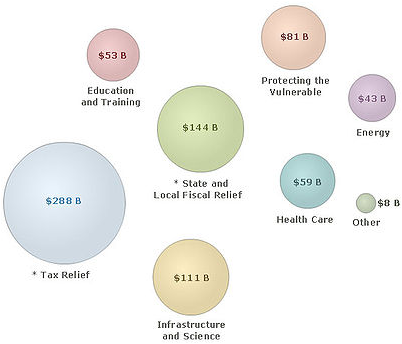
The total stimulus included in the ARRA is $787 billion:

Also shown as (from recovery.gov):

Solid data on the timing of fiscal stimulus due to the ARRA is hard to come by. The best guide I could find that projects into the future was provided by Mark Zandi of Moody's Economy.com.

As the following chart shows, the projections he made (in spring 2009) have substantial stimulus throughout 2010, but the stimulus will have peaked in the first quarter.

According to the government, $410 billion, or 52% of the allocated stimulus of $787 billion, has been spent so far ($163 billion of the $288 billion allocated for tax benefits; $115 billion of the $275 billion allocated for contracts, grants and loans; and $132 billion of the $224 billion allocated for entitlements.)

Through the first quarter, $373 billion had been spent, as shown here:

So $110 billion was spent in the first quarter, up from $84 billion in the previous quarter --- but GDP growth decelerated from 5.6% to 3.1%, and absent inventories from 1.8% to just 1.5%.

As Zandi projected, the positive contributions to real GDP growth are just about done, and will turn negative in H2.
So, though, as per above, the White House is projecting a bigger deficit in 2010 than 2009, which adds to GDP growth YoY, that will be front-loaded, with H2 relying on private demand for growth.
And there will have to be enough growth to offset the continued declines to be expected from state and local governments. State and local government spending is about 50% bigger than federal government spending ($1.5 trillion vs. $1.05 trillion).
And state and local governments have already been detracting from GDP growth --- negative growth in 5 of the last 6 quarters, including the last 3, down 0.6%, 2.2% and 3.9% QoQ annualized, subtracting 0.1%, 0.3% and 0.5% from total GDP growth.

Double-dip? I think so.