COVID-19 notes:
Clinical
Outcomes in Young US Adults Hospitalized With COVID-19
Young adults age 18 to 34 years hospitalized with COVID-19 experienced
substantial rates of adverse outcomes: 21% required intensive care, 10%
required mechanical ventilation, and 2.7% died.
Fisman: As Ontario’s test numbers decline one way to keep
track of the epidemic is by monitoring percent of positive tests, by age group
and overall.
Green line is overall; orange line is excluding <10yrs age.

The Saga of
False-Positive COVID-19 Tests. Dr. Claus Rinner, Ryerson
Univ.
Note that in conjunction with the PCR test, I like to put “cases” and
“infected” in quotation marks since the test does not distinguish sick people
carrying an infectious virus load from healthy, presymptomatic, or asymptomatic
people carrying traces of inactive genetic material from the virus.
Regular Related Fare:
An Avalanche Of
Bankruptcies Is Coming In The U.S.
According to the latest Fitch report, the “three-year 2020–2022
cumulative US default rate forecasts for term loan (LL) and high-yield (HY)
bonds are 17%-20% and 15%-18%, respectively. This forecast compares with the
three-year cumulative default rate of 15% for LL and 22% for HY bonds from 2008
to 2010 occurring as a result of the Great Recession.”
FED LENDING
SAVED CORPORATE AMERICA. IT COULD DO THE SAME FOR CITIES AND STATES.
Local budgets are facing a wave of austerity that
could be avoided with low-interest lending by the Fed, a new report suggests.
Faced with cratering revenues since the start of the pandemic, states
have already cut billions from their public education budgets. .. At least 65
percent of U.S. cities plan to delay or cancel capital spending to fix roads,
upgrade water systems, or make other infrastructure improvements.
Rosenberg: We
Are in a Depression
"All these polls say basically the same thing—it will not be
'business as usual,' as the bulls will try and convince you, and the best we
can hope for is a partial recovery. I mean, at best. What we had on our hands
was a vertical down economic decline with job losses an order of magnitude
higher than anything we have witnessed since the Great Depression. So, even as
the stock market is telling you it has it all figured out, I can assure you
that what we face at this very moment is a very uncertain economic future. And
unfortunately, most of the longer-term risks are to the downside.
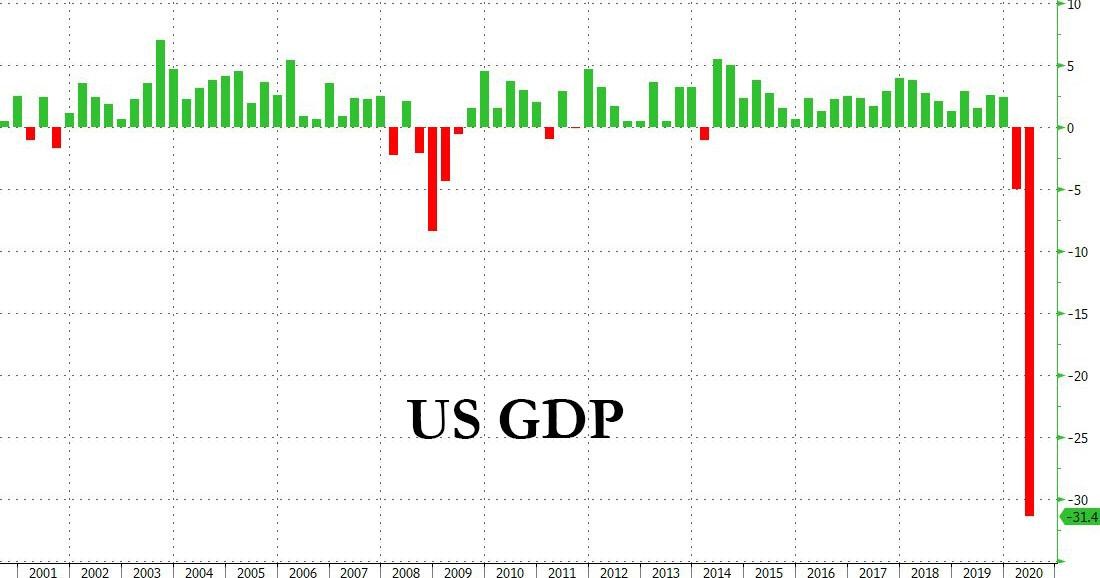
We are in a depression—not a recession, but a depression. And I think the dynamics of a depression are different than they are in a recession
because depressions invoke a secular change in behavior. Classic business cycle
recessions are forgotten about within a year after they end—the scars from this
one will take years to heal."
How Deep Will
the Depression Get? – Interview with Rana Foroohar
and Mark Blyth
So, after the shit show debate and the ongoing warnings of a second or
even third wave of the pandemic, I’m left with some questions.
First of all, does the shxt show debate reflect an even more profound
problem with the U. S. economy and political structures? Two, the financial and
tech elites, how are they responding to the campaign, the debate? Have they
bailed on the maniac or just doubling down on the Senate? How deep and how long will the recession, depression go? It looks like there could
be more lockdowns. Four, if there is another full lockdown, which many
scientists are saying will be necessary to contain the second, third wave.
What, if any, are the limits of how much money the Fed can pump into the
economy? What are the economic limits? What are the political limits? Six, how
serious is the split over the new Fed money? Does Wall Street want a big new
stimulus package? Are there really serious concerns about the U.S. dollar? And
finally, seven, if we have time to get to it, is Wall Street getting the danger of the climate crisis? Will they do anything about
it? Will they accept the government intervening in a serious way with
regulations and massive investments in green infrastructure, including phasing
out fossil fuel, not just relying on carbon capture, which is mostly what the
Biden plan is about.
Regular Fare:
Net short bets
against 30-year Treasury bond hit record high -CFTC
Chris Whelan: Negative Returns
are Now in US Mortgages
We believe short-term rates will remain low in the US, even as offshore
demand for dollars soars. If the 10-year Treasury
backs up much further, then we’d look for the FOMC to act on some calls by
governors to buy longer duration securities. That is, a very direct and large
scale increase in QE and particularly on the long end of the curve. We expect that Chairman Powell
knows that underneath the comfortable blanket of low interest
rates lie some truly appalling credit problems ahead for the global economy,
the US banking sector and also for private debt and equity investors. We expect the low interest
rate environment to drive volumes in corporate debt and residential mortgages,
even as other sectors like ABS languish and commercial real estate gets well
and truly crushed. ….. We don’t think that the Fed is going to take its foot
off the short end of the curve anytime soon, in part because the system simply
cannot withstand a sustained period of rising rates.
More Stimulus
And The 2nd Derivative Effect
While most hope more stimulus will cure the economy’s ills, it will
likely disappoint due to the “2nd derivative effect.” … While the additional
fiscal stimulus may help stave off a more in-depth economic contraction, its
impact becomes less over time… With economic growth rates now at the lowest
levels on record, the change in debt continues to divert more tax dollars away
from productive investments into the service of debt and social welfare… Due to
the debt, demographics, and monetary and fiscal policy failures, the long-term
economic growth rate will run well below long-term trends.
Supporting
Workers and Protecting Families

Bubble Fare:
Which Cities
Have the Highest Risk of a Housing Bubble?


(not just) for the ESG crowd:
Accelerating the
EVolution: The Road to Mainstream EV Adoption
Three Scenarios
for the Future of Climate Change
The Stories
Michael Shellenberger Tells
How Trump damaged science — and why it could take
decades to recover
Trump hasn’t just gone after regulations. At the EPA, his administration
has sought to undermine the way the government uses science to make
public-health decisions. … Much of the damage to science — including regulatory
changes and severed international partnerships — can and probably will be
repaired if Trump loses this November. In that event, what the nation and the
world will have lost is precious time to limit climate change and the march of
the virus, among other challenges.
Quote of the Week:
“Utopia has suddenly changed
camp. Today, the utopian is whoever believes that everything can just keep
going as before.”
Pics of the Week:


EXTRA FARE:
Socio-political Fare:
The Senate:
Profoundly Undemocratic: The Senate lives up to
its original functions every single day
James Madison said that the
function of the senate is to protect the opulent minority from the majority.
James Madison realized that if we have true Democracy, people would vote to be
less poor. The function of the senate was to maintain a level of inequality so
that the those who had money would be protected from those without.
Trump's
brilliant stimulus ploy rattles Democrats & Well Played, Mr.
President. Sorry To Have Doubted You
Poll Which
Correctly Called 2016 Election Sees Another "Shocking" Outcome In
November
In the following Election
Review from Camelot Portfolios, we look at what some of the polling firms that called
2016 correctly are seeing today. "Shocking", their polling suggests that President Trump will be re-elected, either narrowly or by a large margin.
Therefore, as Camelot notes, "capital allocators today cannot easily
assume next month’s results." It’s very possible that Trump will win
Florida, North Carolina and Arizona. If so, a win in Pennsylvania or Michigan
will likely put him over the top in the electoral college. And speaking of
"shocking", Camelot notes that as far as the Senate and House are
concerned, it also appears that Republicans will keep control of the Senate, especially
if Trump has a strong night.
Russell Brand: Trump VS Covid –
Who Won?!
(this Brand bit, about the
absurdity of so-called American democracy, was even better: Who Really Won?
Trump Or Biden?!)
I Didn’t Vote
For Trump In 2016, But I’d Crawl Over Broken Glass To Vote For Him Now
The primary reason I didn’t
vote for Trump in 2016 was that I didn’t believe him. I didn’t trust that he
would be pro-life, a non-negotiable issue for me. His bluster and bravado
didn’t appeal to me. I took him literally but not seriously, in contrast to his supporters
who took him seriously but not literally (credit to Peter Thiel for identifying this
significant distinction).
How Did People
Have Conversations Back Before Tech Oligarchs Were There To Police Them?
As my regular readers are no
doubt tired of hearing me repeat by now, when you have monopolistic tech
corporations which attract the bulk of online communication coordinating with
governments to censor speech, what you have is government censorship. As Matt
Taibbi recently wrote after the irrational Facebook purge of QAnon cultists,
this censorship regime is continually expanding and this expansion is likely to
continue, especially in the direction of those who oppose these same
establishment power structures that are promoting this censorship.
…. First the wealthy
controlled the newspapers, then they controlled the radio, then they controlled
television, now they control online speech. It’s been the same story for
centuries, and in each instance they collaborated with existing power
structures to protect the status quo upon which their kingdoms were built. They
did this because they understood the real secret of power: that whoever
controls the narrative controls the world. Humanity will only transition into a
healthy collaborative way of functioning on this planet when everyone else
awakens to this truth as well.
Big Thoughts Fare that for some reason I don’t want to publish
internally:
Art Berman: Oil and the Changing World Order
Paradigm Change
Much of the thinking about
oil markets and the economy assumes that what is happening now is a temporary
anomaly and that things will return to the previous state at some time.
We are in a depression—not a recession, but a
depression. And I think the dynamics of a depression are different than they
are in a recession because depressions invoke a secular change in behavior.
Classic business cycle recessions are forgotten about within a year after they
end—the scars from this one will take years to heal.
—David Rosenberg, Rosenberg Research
We should pay attention to what David Rosenberg says but even his stern
message suggests a return to normal after a number of years. Return is never a
useful or valid assumption for the future but particularly not now. A new
paradigm is needed.
A paradigm is a model that
for a time seems to explain the state of the world better than competing
theories (Thomas Kuhn, The Structure of Scientific Revolutions). Economic
growth has been the ruling paradigm since the end of World War II.
Technological innovation, capitalism and democracy have evolved as possible
causes for the growth paradigm. The problem is that they were hardly unique to
the second half of the twentieth century.
Energy is the economy. Money is a call on energy. Debt is a lien on
future energy.
The extraordinary growth
after 1945 was because of the widespread shift to petroleum as the primary
energy source for the world. Because a barrel of oil contains the equivalent of
about 4 1/2 years of human work, the resulting increase in productivity was the
true cause for economic growth.
Early empires rose by
enslaving conquered populations and capturing their work, and by taking their
gold—a claim on work. World War I was fought initially over coal. Germany
challenged England’s energy dominance by sinking ships like the Lusitania that
was carrying coal. World War II was fought largely over oil. Germany’s first
attacked Poland because it produced oil. Japan took Indonesia for its oil and
then attacked the United States for denying it oil exports.
The United States rose
initially on the backs of negro slaves. It became a major power first on the
back of coal and then petroleum, the most productive slave in human history.
Great states fall when they
reach the limits of their resources or they are defeated in wars trying to
obtain more. The rise and fall of world powers is closely related to their
access to credit which, in turn, is a call on future energy resources.
The world order has changed.
U.S. dominance is declining and China’s is rising. Producing countries largely
determined oil prices until 2014. Since then, consuming countries led by China
have begun to assert their power.
Many people tell me, “I
agree with everything you say but the difference between you and me is that
you’re a pessimist and I’m an optimist.”
I am neither an optimist or
a pessimist. I am a scientist. I use data to best describe the present state of
things. If someone prefers a different story, I understand. Stories are good
for entertainment but rarely lead to a clear view of what the future may bring
much less good investment decisions.
The growth paradigm is dead or dying. Most future energy scenarios do
not acknowledge slow growth. They imagine that technology will allow the world
to simply switch from fossil to renewable energy without sacrificing living
standards. The physics of
that simply don’t work.
Most analysts incorrectly
assume that slowing oil demand signals the end of the oil age. They don’t
understand that all growth is slowing because of unmanageable debt and a weakening economy. Covid-19 brought
that grim future to us a decade or so earlier than expected.
The world order is changing. The world will need oil more than ever because of its unparalleled
productivity. Oil was responsible for the singular economic growth after World
War II. It is the
only thing that can prevent slow growth from becoming negative growth in that
new world order.
Quotes of the Week:
“That Harris could become
president without winning a single
delegate in the primaries – having dropped out before they even started – seems
an irony completely lost on the media and the party normally harping on about
“our democracy,” norms and traditions.”
W.J. Astore: “For all the talk of a “free” press that has
the guts to tackle the powerful, the truth is our press is mainly a for-profit
operation that is largely owned by the powerful. We get a lapdog press instead
of a watchdog; we certainly don’t get an attack dog. I wrote about this in
January of 2012; what I didn’t foresee is how that press would facilitate the
rise of a petty demagogue like Donald Trump, mainly because he’s good for
ratings and serves the needs of the powerful, but also because so many
Americans have lost faith in the media, so much so that they buy the lies of a con
man and serial liar like Trump. In short, if you’re tired of the
corporate-friendly lies at CNN, why not turn to the entertaining conspiracy
theories and lies of a manipulator like Trump?”
Tweets of the Week:
Fighting for the
Truth: @jsolomonreports says @realDonaldTrump
shouldn’t tolerate his cabinet slow walking the release of vital Obamagate
documents that the American people have the right to see before the election.
And a reply: don'tcha just love all these
armchair quarterbacks who think they know better than trump what he should and
shouldn't do? i'm pretty sure, as you all should be, that he knows exactly what
he's doing.
Satirical Fare:
Media Criticizes
Trump For Downplaying Virus Threat By Not Dying