***** denotes well-worth reading in full at source (even if excerpted extensively here)
Economic and Market Fare:
The highest interest rates in almost two decades have so far failed to plunge the US into recession.
But that will change through 2024 as rising borrowing costs bite, making a slump later next year increasingly unavoidable.
“Human impatience crystallized into a market rate,” said Irving Fisher about interest. That impatience grew extreme in the wake of the pandemic, fomenting a rapid rise in inflation and prompting the Federal Reserve to raise rates in its fastest ever rate-hiking cycle.
The elegies were swiftly written for the booming economy as many (myself included) assumed it would not be long before a full, NBER-defined recession would ensue. But so far it hasn’t turned out like that.
Most assets, notably equities, credit and gold, continue to be unpriced for a downturn. .....
........ It is also important to remember that in 2021 the main concern was and should have been ensuring a full recovery from the pandemic. Few anticipated the size of the inflationary shock (i.e that Russia would invade Ukraine, or that there would be so many supply side bottlenecks), and the pandemic made it difficult to read the state of the labour market. My own view, and in contrast to many others including various Lordships, is that central banks were right to delay raising rates until 2022. Once they understood that the recovery from the pandemic had been strong and that as a result the labour market was tight, they acted by raising rates pretty fast.
The fact that inflation is now falling quite rapidly strongly suggests that central banks have done enough to stop this energy and food price shock leading to permanently higher inflation. What we don’t know yet is whether they did too much, because the lag between nominal interest rate increases and falls in economic activity can be quite long. However we can still make one important point.
When inflation was near its peak some economists (let’s call them the inflation pessimists) argued that a significant period of depressed economic activity would be necessary to bring inflation back down to be close to the 2% target. Only when unemployment was significantly higher than it is today, they suggested, would wage inflation start to fall back towards levels that are consistent with a 2% target.
We now know that that argument is almost certainly wrong. Wage inflation has fallen in the US and elsewhere without any large increase in unemployment. Of course unemployment may still rise because of the delayed effect of higher interest rates, but it is a bit of a stretch in the US at least to suggest that falling wage inflation in the US is a response to expectations of above trend unemployment ...
....
Given that historical perspective, it certainly seems apparent that investors should NOT be anticipating a Fed rate-cutting cycle. Such should, in theory, coincide with the Fed working to counter a deflationary economic cycle or financial event.
Yet, since the beginning of November, the markets have risen sharply in anticipation of the Fed cutting rates as soon as the first quarter of 2024. More interestingly, the worse the economic data is, the more bullish investors have become looking for that policy reversal. Of course, in reality, weaker economic growth and lower inflation, which would coincide with a rate-cutting cycle, do not support currently optimistic earnings estimates or valuations that remain well deviated above long-term trends.
Shrinking maturities leave little breathing room for some businesses and also governments.
*** Pettis: What Will It Take for China’s GDP to Grow at 4–5 Percent Over the Next Decade?
If China’s GDP is to continue growing at 4–5 percent for the next decade, either other major economies must be willing to reduce their economies’ investment and manufacturing shares to accommodate China or China must establish policies that cause the locus of growth to shift from investment to domestic consumption. Neither is easy, and the former is very unlikely.
........... I don’t mean to pick on any of this data (well actually, I do). We’ve argued for years that it’s bizarre at best that we live with consistently wide and persistent variations in two surveys (Household and Establishment), both of which attempt to measure the same thing and don’t come close. We’ve highlighted, again and again, that the BLS publishes survey response rates; they are abysmal and getting worse! We’d be nervous driving without a speedometer, but give me two surveys (with low and declining response rates, which don’t remotely tie out) and I’m confident that we can use them! (hmmmmm….)
On JOLTS, there was a noticeable uptick years ago that seemed to coincide more with the transition to online job postings than any macro indicator. But…it couldn’t be that we’re just bad at measuring a generational shift in how people advertise for jobs? No, that wouldn’t make sense, the data must be right! (hmmmmm….) .....
....... The 10 year went from a low of 3.3% in the spring then shot up to 5% this fall for no apparent reason whatsoever. Since then yields have fallen back to 4.2% in a hurry. That’s not the Fed; that’s the market.
A lot of people want to blame the Fed for allowing inflation to get out of control following the pandemic. I do agree the Fed should have acted sooner.
But would it have mattered as much as people think?
Just look at the path of inflation readings across other developed economies:
All of these countries had different fiscal and monetary policy responses to the Covid outbreak. And yet inflation rates all went up at the same time and fell at the same time.
Was the Fed and U.S. government spending really to blame for inflation around the globe?
And can we really give the Fed credit for bringing inflation down through interest rate hikes if inflation fell in these other countries concurrently? ....
Prices of durables have been falling for five straight months
- Lending rates in real terms climb as consumer prices fall
- Narrow room for aggressive rate cut puts focus on fiscal moves
The country should stimulate consumption with spending on education, healthcare and public housing
Vid Fare:
...
...
...
...
...
...
(not just) for the ESG crowd:
.. As confirmed by the acceleration of climate extremes, consistent with the prediction by Wallace Broecker, the authoritative climate scientist, global climate change is racing beyond tipping points (Figure 1), yet the evidence continues to be denied, including in the recent COP-28 climate conference, where climate scientists are almost nowhere to be seen.
Considering COP 28 and the crisis it addresses
The most significant hole we have dug is fossil fuels. The world’s governments subsidize those to the combined tune of $7.2 trillion per year or $228,310.50 per second. We take the money from other sources—health care, education, small business loans, public housing—and give golden parachutes, homes in the Hamptons or Hempstead Heath, and four-story yachts or a seat in Congress or the House of Lords, to oil and coal executives. Sorry, we really wanted to get orthodontic care for our child but this year we had to give $5000 to our neighbor, the oil company shareholder. ......
If you think the debate on ending fossil fuels is simple, try for a moment to see how this all looks to poorer nations
......... But as it happens, no: this is not quite as simple as some people would have you believe. In fact it’s desperately complex. I should say at this point that, like George, I’m very much in the getting-rid-of-fossil-fuels camp (albeit that having written Material World I’m in little doubt about how difficult that will be). But I’m also very worried that we’re ignoring something incredibly important: the ability of poor countries to increase their access to energy.
You see, there’s a reason why it’s not just Saudi and other oil producers who are fighting the “phase out fossil fuel” ambition. Western newspapers often ignore this, but alongside Saudi are China, India and Brazil. Now, given Brazil has a large and growing petrochemical sector one could lazily dismiss them as another fossil fuel apologist, but then what about China? What about India? That brings us to the nub of the matter. Enormous energy inequality. ..........
........ So instead we see what we’ve seen in recent weeks. Rich nations lecturing everyone else (even as they continue to consume large quantities of fossil fuels themselves). Indeed, as I tried to explain in a thing I did for Sky News today, far from plateauing as laid out in the IEA’s net zero modelling, actually oil production is still rising. And in part that’s because we continue to use rather a lot of it. ......
............... When Al-Jaber told Mary Robinson there was “no science” showing that her proposed rapid phasing out of fossil fuels — 100% less oil, 100% less gas, and 100% less coal by 2030 — would keep the world beneath the 1.5° guardrail, he was technically correct. The IPCC did not even consider that, and had it done so, it may well have concluded that the aerosol masking effect — a.k.a. the McPherson Paradox or Hansen’s Faustian Bargain — would spike the world 4°C warmer. At his press conference, Al-Jaber brought along the COP28 IPCC spokesperson to confirm precisely what “science” had to say on the matter.
That, of course mattered not at all to the mob. Within hours, The New York Times, CNN, BBC and the rest were ignoring Al-Jaber’s protests and parroting the trending X-line portraying him as a climate denier. All nuance was lost. .......
The real problem with the press conference came not from the man in white sitting at the center of the dais but the man from the IPCC seated to his left. The esteemed arbiter of the science had got the science wrong. .....

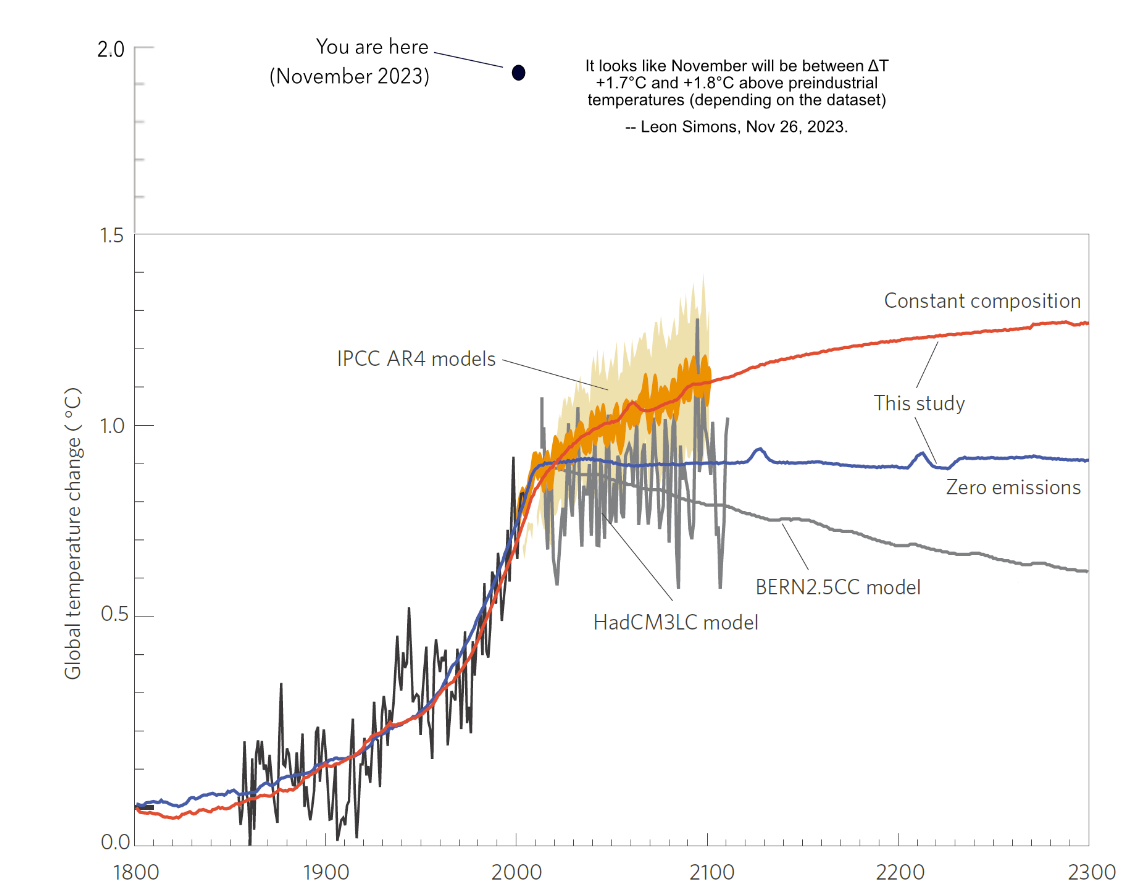
I took the liberty of superimposing a black spot for where global temperature anomaly stood in November 2023, compared to the IPCC AR4 models that assume a gradual, mid-to-late century phase-out of fossil fuels.
I recognize that a monthly average global temperature change is not the same as annual or decadal averages, which is what we must go by, and that the immediate effects of the maritime rules on sulfur fuels, wildfire haze, El Niño, and methane from fracking may obscure the longer trends. That said, we are, at least for the time being, well above 1.5 and closing in on 2.0. We don’t have until mid-century for an orderly phase-down.
For Al-Jaber, my black dot is a mark on his otherwise perfectly white dishdasha. He is fond of saying that science is his “North Star,” but in this case, the science arbiter, the IPCC, got it wrong. The poles shifted. The North Star is somewhere else in the sky. ......
... There is little evidence supporting assertions that: current greenhouse gas emissions reduction and removal methods can and will be ramped up in time to prevent dangerous climate change; overshoot of Paris Agreement targets will be temporary; net zero emissions will produce a safe, stable climate; the impacts of overshoot can be managed and reversed; Intergovernmental Panel on Climate Change models and assessments capture the full scope of prospective disastrous impacts; and the risks of climate interventions are greater than the risks of inaction.
These largely unsupported presumptions distort risk assessments and discount the urgent need to develop a viable mitigation strategy. Due to political pressures, many critical scientific concerns are ignored or preemptively dismissed in international negotiations. As a result, the present and growing crisis and the level of effort and time that will be required to control and rebalance the climate are severely underestimated.
Cop28 president not even trying to hide his obvious bias
............ We humans excel at reality-denial. It is not helpful. Rather than starting to deal with the problem of climate change thirty years ago – the science was already crystal clear by then – we’ve dug ourselves a much deeper hole. ........
In Sweden’s Arctic, a battle for the Earth’s climate rages, and a question looms: Are we simply trading out one extractive industry for another?
Sci Fare:
New research is uncovering the hidden differences in how people experience the world. The consequences are unsettling
New research is revealing surprising complexity in the minds of goats, pigs, and other livestock
Notes on Complexity: A Buddhist Scientist on the Murmuration of Being
................. Zooming out to the planetary scale, he argues that all living beings on Earth are a single organism animated by a single consciousness that permeates the universe. The challenge, of course, is how to reconcile this view with our overwhelming subjective experience as autonomous selves, distinct in space and time — an experience magnified by the vanity of free will, which keeps on keeping us from seeing clearly our nature as particles in a self-organizing whole. ........
Geopolitical Fare:
... The Washington DC apparatchiki and nomenklatura live in an isolated bubble of misinformation constructed by their own disinformation. They believe their own lies, producing their world populated by simulacra, denial of responsibility and a special lack of self-awareness. Only when the lies are exposed and maintaining the fiction becomes a hopeless, self-destructive pursuit or the domestic political struggle dictates another line does something akin to reality is able to stick out its ugly head. .....
The self-delusion on the other side of the aisle goes beyond befuddling, even astonishing. The Democrat Party-state nomenklatura lives entirely in its own world—one of fakes, arrogance, self-righteousness, and the disinformation, obfuscation, and simulacra necessary to maintain them. In their world, men can give birth; there are 150 genders and counting; children should change their sex; censorship is freedom of speech; fraudulent elections are free and fair; authoritarianism is democracy; foreign states’ sovereignty must be protected but US sovereignty must not; Russia does not oppose NATO expansion; Putin wants to ‘recreate the Soviet Union’ or the Russian Empire—take your pick.
Democrat Party-state simulacra and self-delusion leaves most of the American ‘elite’ in a mirage-filled cocoon regarding Russia and the Ukrainian war, conjuring fairy tales for the American and Western publics. One recent example was a talk Michael McFaul gave to an audience of Stanford alumni that left them in a fog of illusions topped off by self-righteousness and demonstrated why American diplomacy is so feckless, reinforcing the reliance on military power and economic coercion (e.g., sanctions) in US foreign policy ..........
If you question any part of this official story, you’re an evil Jew-hating monster who loves terrorism and wishes Hitler had won.
................... (The official story of October 7 also previously included narratives about beheaded babies, babies cooked in ovens, and babies ripped from the wombs of pregnant mothers, and you were an evil Jew-hating Holocaust denier if you doubted them, but those narratives have since been walked back and are no longer part of the official story, so belief in them is now optional.) ...............
.... These horrors are all caused by a genocidal onslaught that is being backed to the hilt by the US government, who just single-handedly blocked a UN resolution demanding a ceasefire to end this nightmare. Instead of focusing on the unfathomable depravity of all this, Americans are being propagandized into worrying about a completely fictional epidemic of university demonstrators chanting for the genocide of Jews.
The Last Stage of a Dead Settler-Colonialist Ideology
In the face of Israel’s genocidal assault on the Palestinians in Gaza and the West Bank, the question of Zionism has received remarkably little attention. This may appear counter-intuitive but ask yourself how public debates about this crime against humanity have mostly been framed: Israel’s so-called “right to self-defense” has been asserted. Never mind that, in legal terms, Israel simply cannot have such a right against a population it occupies and terrorizes. Legally as well as morally, the only ones here who have a clear right to defend themselves – yes, by military means – are, of course, the Palestinians. Anything else is bullshit. ...
................................ What people don’t get, living within Empire, is that they’re living with an Empire at all. The American Empire — inherited from the British Empire — goes unnamed, which is why I call it one White Empire. It’s all one unbroken reign of terror from the slave ships to sanctions and it has to be defeated by any means necessary. But too many people don’t even know their enemy. They still think it’s the latest people Empire tells you to hate, and not the hateful Empire exporting violence all over the place.
People also don’t see Israel for what it is, a colony that would collapse without support from the mothership of motherfuckers in the United States. Israel is just America’s guns near the gas station. That’s all it is. It’s just a traumatized population kept in a state of constant conscription and violence because the ruling Empire wants to keep the region divided and conquered. The Arab people, especially Palestinians, are just the latest people who must be constantly demonized and destroyed so their resources can be looted. They are relentlessly smeared as ‘terrorists’ just as Native Americans were smeared as ‘savages’ before. It’s the same program, which is pogromming and looting. Same shit different day. ...........
Ignoring US laws and its own token promises, the Biden administration protects Israel's extermination campaign in Gaza.
Gaza has been aptly described as a high tech laboratory experiment for how to most efficiently oppress, surveil, starve, torture, and ultimately dispose of a population deemed to be nothing but excessive, superfluous human flesh taking up too much valuable land and resources.
At its essence, the US-financed genocide by the state of Israel of some two million Palestinians confined in their open-air prison is the ultimate expression of the global class war being waged by multinational oligarchs and militarized corporations against the rest of us. ...
Netanyahu desperate to shift narrative away from Gaza carnage with targeted killings
An oligarchy, as we use the word today (the dictionary definition is different) is rule by the rich, because they are rich. (A feudal king may be rich, but his power is not primarily a result of his wealth, but rather his wealth is primarily a result of his power.)
As I have written a number of times before, Russia is NOT a plutocratic oligarchy. America, on the other hand, is.
Other Fare:
On May 25, 2020, George Floyd had a run-in with the Minneapolis police over his passing counterfeit bills, and the result was Floyd’s death. Four officers were involved in the altercation, and one, Derek Chauvin, was subsequently charged and convicted of second-degree murder and manslaughter (with a sentence of 22.5 years) for apparently kneeling on Floyd’s neck, causing him to suffocate. Three other officers were also convicted of violating Floyd’s civil rights, and were given sentences between 3 and 4.75 years. In a civil suit, the city of Minneapolis settled with Floyd’s family for $27 million. Recently and unsurprisingly, Chauvin was stabbed 22 times in prison, coming close to death but surviving.
After Floyd’s death, there were not only violent riots in Minneapolis (downplayed by the mayor and the media), but, importantly, the “racial reckoning” began that continues to this day. Floyd’s death could be considered the pivotal act of not only this reckoning, but the spread of DEI activities throughout America. The man has become somewhat of a hero: a latter-day Martin Luther King.
A new 142-minute crowdfunded movie, “The Fall of Minneapolis,” takes issue with the Floyd narrative, and for the first time shows the bodycam video of the arrested Minneapolis police officers. It argues the following points:
- Floyd was not murdered by the police: he had serious heart problems, hypertension, artherosclerosis, COVID, and was high on near-lethal doses of fentanyl and methamphetamine during his arrest. He was also complaining about not being able to breathe well before he was brought to the ground by the police. Difficulty in breathing could easily be explained by both his heath condition and ingestion of serious drugs.
- The official autopsy found drugs in Floyd’s system, confirms the health problems mentioned above, and found no evidence from examining his neck that he died from asphyxiation.
- The bodycam videos were not allowed to be shown to jurors by the judge. They show that Floyd might have been restrained simply by having a knee on his shoulder, not on his neck. This method of restraint, called “MRT” (maximal restraint technique) is taught to all Minneapolis police recruits as a way to subdue resisting suspects. (There is no doubt from the bodycam videos that Floyd insistently resisted arrest and fought the officers.)
- The judge did not allow mention or a photo of MRT in the Minneapolis police manual to be shown to the jury. Further, the police captain, lying, denied that MRT was taught to all police officers.
- The police called for medical assistance within minutes of Floyd having a medical emergency when he was on the ground. They also tried to resuscitate him via CPR. This is inconsistent with the narrative that the officers were trying to kill Floyd.
- The judge, mayor, city council and police hierarchy all “conspired” to convict Chauvin and the other officers, buttressing into an official narrative that was likely wrong.
There’s a lot more—the movie is tendentious and doesn’t try to pretend it’s impartial—but there’s surely enough there to disturb the viewer about both the narrative around Floyd’s death and its aftermath ± both the immediate rioting and the “racial reckoning” that still pervades America.
I watched the movie, and think that every reader should, too. Just make the time to watch it (it’s at the bottom as well as on YouTube). for you won’t be sorry. ...... The movie was fairly successful in convincing me that there was no good ground to initially bring charges against Chauvin for the murder of George Floyd. It also suggests how corrupt and duplicitous the mayor, judge, and city officials of Minneapolis were in ignoring facts to further a convenient narrative.
But I’m not the only one to react this way to the movie. Both John McWhorter and Glenn Loury watched the movie, too, and came to the same conclusion. ....
Pics of the Week: